|
|
|


Home | Current Issue | Editions | Archives | Contact Us

Volume 1, Issue 1 (Spring 2008)
Globalisation of a ‘Clash', or an ‘ Alliance ' of Civilisations?
The Mainstream Media and Its Coverage of Islam
Muhammad Ahsan The author is a UK based research consultant and has extensively published on the current issues related to the Muslim World.
Abstract: In the contemporary globalised world, the confusion and mistrust between Islam and the West has lead to insecurity and instability, and this is particularly true in the context of the events of 11 September 2001, which have changed the course of history. In this whole process, the global media has played an important but controversial role in making and reshaping international scenarios. A large number of people in the Muslim World consider that the mainstream media is generally biased against their faith and this helps to promote a clash of civilisations. How can we analyse the current volatile global environment and the best way forward to initiating a process of mutual trust and stability? In this context, the main focus of this paper is to explore various empirical dimensions of the notion of a clash of civilisations, particularly in the context of the role of the global media and its coverage with regard to Islam. The paper is based on secondary sources of information and discusses relevant topics such as globalisation, clash of civilisations, global instability and injustice, double standards in international politics, the role of the global media in relation to a clash of civilisations, and the socio-religious and politico-economic perspectives of the idea of a clash. Finally, the discussion concludes with the exploration of the recently developed UN strategy to promote an alliance of civilisations.
Key Words : Clash of civilisations, alliance of civilisations, the media and Islam, the media and Muslims, Islam and clash of civilisation, Islam and alliance of civilisations
Before we start the actual discussion, it is noteworthy that The World Guide 2005/2006 argues that: ‘Globalisation is not just economic but also cultural and ideological. … Globalisation as a cultural phenomenon occurs, like the economy, as a result of the expansion of capitalism. … Globalisation is, essentially, a model created by Northern cultures' (New Internationalist Publications 2005: 37). Needless to say that cultural and ideological aspects are closely associated with religion as the same publication reveals that: ‘The US government of George W Bush seems to be increasingly dominated by a fundamentalist Christian agenda that believes America to be doing God's will.' It also quotes Florence Toussaint (Professor of Communications, The National University, Mexico), who says that: ‘People are caught in a whirlwind, not knowing when they will get out – or even if they want to. In many instances, they are not aware of where they are headed' (New Internationalist Publications 2005: 71). Toussaint's argument is strong, especially in the context of the role of the media in the post-9/11 era. The discussion made in this paper reflects that the global media is an important source of informal mass education. But unfortunately it is dominated by major global players who use it to further their own interests on global affairs, even some times by defaming Islam and the Muslims. Although the paper acknowledges some pro-Islamic views reported in the media, they are well in the minority and thus ineffective in forming public opinion. Regrettably, this situation is not helpful in promoting global peace as on several occasions, Islam has been branded a violent religion while Muslims are labelled as terrorists. Resultantly, this type of environment promotes a clash between Islam and the West.
_____________________________________________
The author is a UK based research consultant and has extensively published on the current issues related to the Muslim World.
Clash of Civilisations or Promotion of Global Instability?
With reference to the context, it is important to discuss briefly the works of two famous American intellectuals, Francis Fukuyama and Samuel Huntington. Both have been given enormous coverage in the media due to which their books received extensive publicity all over the world. In 1992, after the demise of the Soviet Union, Fukuyama (a former US State Department official) presented the concept of ‘the end of history'. The main argument of his thesis (entitled: End of History and the Last Man ) is that after the fall of communism, capitalist liberal societies are the end-product of the historical process of humankind. In other words, it is now only Western socio-cultural and politico-economic liberty that will prevail in the world. He also believes that the days of Islam are over. Interestingly, in spite of extensive discussions in his book, Fukuyama does not elaborate on which strategy should be adopted to attain and maintain a stable global society and how the political and economic liberty of the ‘last man' can be achieved? Moreover, how will this ‘last man' enjoy the fruit of the end product of history? Interestingly, Samuel Huntington attempts to tackle this issue. His book Clash of Civilisations and the Remaking of World Order (1997) warns that the point of the ‘end of history' is the beginning of the civilisational war to dominate the world. He predicts that future wars will not be fought between nation states, but between civilisations. He has written and lectured extensively and lectured to promote his ideas. His emphasis is on: i) ‘civilisational consciousness is on the rise', ii) ‘conflicts between civilisations will replace ideological and state conflict', iii) ‘conflicts between groups from different civilisations will be more violent than those between groups within civilisations', iv) ‘political, economic and security relations will develop within civilisations rather than cross civilisations', and v) ‘the paramount axis of world politics will be the “West” and the “rest”.'
In Huntington 's view, besides the ‘West', there are six or seven other civilisations in the world. However, he warns that in the future, only the Chinese and Islamic civilisations will pose a challenge to the ‘West'. He is very apprehensive of the two-digit economic growth rate of China . Due to his West-centric views, Huntington totally ignores the facts that do not fit in his ‘clash of civilisations' frame. For instance, he warns of the growing military power of China but ignores the fact that statistics indicate that in contrast to the United States , Chinese military spending with respect to its GNP has gone down in the past two decades. Furthermore, this country is now a member of the WTO and has attracted huge foreign investment particularly from Europe and the United States . Huntington further accuses China of arming Muslim countries, ignoring world statistics that their major source of arms are the United States and Europe . Another important point is that he is totally silent with regard to the root causes of his notion of ‘clash of civilisations'. In particular, he is unable to highlight the unjust global system which is considered to be the most important reason of global instability.
Specifically, with regard to Islamic civilisation, Huntington suggests that the under-developed, over-stretched and unstable Muslim World from Indonesia to Morocco fails to pose a collective threat to the West. However, in his view, the real threat from the Muslim World is its rising human capital, i.e., the growing proportion of young people in the Islamic civilisation. Directly or indirectly he attempts to warn the West that the troubles in the former Yugoslavia , Kashmir, Palestine or in various other regions are caused by this segment of Islamic civilisation. Huntington is unable to answer the question why these young people pose a threat to the West. Interestingly, while Huntington warns of the ‘rising' human capital of Islamic civilisation, Fukuyama warns of the ‘declining' human capital of the West, or in other words, the proportionate increase of the aging population in Western civilisation. Indirectly, both warn of the rising migration of Muslim youth to western countries which is rapidly changing the demographic balance. This fact was also highlighted by the BBC (23 December 2005) in a report which says that: ‘Islam is widely considered Europe's fastest growing religion, with immigration and above average birth rates leading to a rapid increase in the Muslim population.' Unfortunately, instead of exploring the nature and root causes of major global problems, both_______________________________
See various issues of World Bank's World Development Reports and World Development Indicators . Also see various issues of UNDP's Human Development Reports .
See various issues of Military Balance published by the International Institute for Strategic Studies, London .
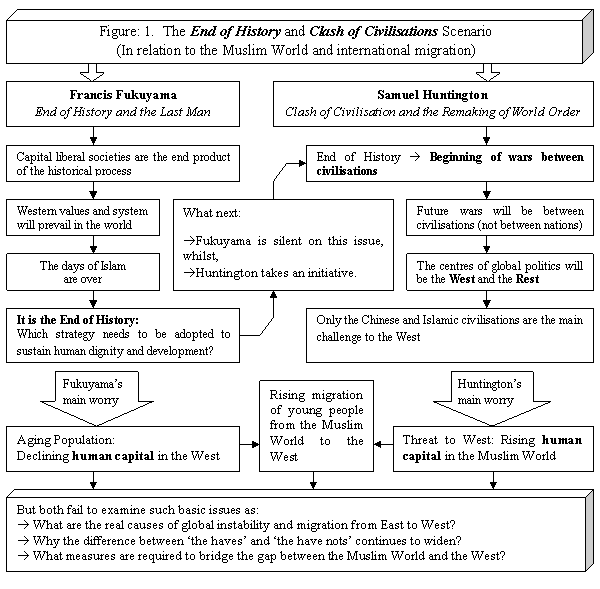
Huntington and Fukuyama spend their energies on synthesising a conceptual and ideological network to provide a base to promote misunderstandings and troubles between faiths and ideologies, particularly with reference to the Muslim World (Faruqi 2001: 6-12). This discussion is better illustrated in diagram 1. With reference to the context it is also important to mention here the views of Fethullah Gulen (2004): 256), an eminent Turkish scholar and a devoted advocator of pluralism. He says:
Regarding Huntington's claim about the clash of civilisations, I think that rather than realistic evaluations about the future, these types of claims seems to be determining new goals in an attempt to influence public opinion within the framework of these goals. Until the disintegration of the Soviet bloc, there was the idea of a clash between the ‘East' and ‘West', or between NATO and the Warsaw Pact countries. This time, by creating a new enemy front, a clash between civilisations mainly based on religio-cultural differences is being perpetuated and a new foundation is being laid to the continuation of the rule of power bloc. Actually, up till now, conflict is something that is desired by certain power centres. The masses have been put on alarm against a frequently conjectured and feared enemy, which is more imaginary than real. It is in this manner that the masses have been prepared for a kind of war. In truth, no divine religion has ever been based on conflict, whether it is the religions represented by Moses and Jesus, or the religion represented by Mohammad, upon them be peace. On the contrary, these religions especially Islam, strictly forbids disorder, treachery, conflict and oppression. Islam means peace, security, and well-being. _____________________________________________________
With regard to ‘war for civilisation' and ‘war on terror', see: Rahul Mahajan (2002), The New Crusade: America's War on Terrorism , New York : Monthly Review Press.
In fact, the creation of the above type of socio-political environment promotes global instability and global injustice. The global injustice itself is based on three factors: i) economic : injustices of the global capitalist system which has caused a huge gulf between the ‘haves' and the ‘have-nots', ii) political : application of double standard in foreign policies by the major global players, and, iii) biased media : which usually portrays a negative image of the developing countries in general and the Muslim World and Islam in particular. Here, to judge the overall level and quality of neutrality of the global media, it is important to quote the words of the following three personalities who can be considered an authority in this area (quoted in What Really Happened 5 May 2002).
Richard Salent, Former President CBS News : Our job is to give people not what they want, but what we decide they ought to have.
Rubin Frank, Former President NBC : News is what someone wants to suppress. Every thing else is advertising.
John Swinton, Former Chief of Staff, New York Times : There is no such thing, at this date of the world's history, as an independent press. You know it and I know it. There is not one of you who dare to write your honest opinions…. We are the tools and vassals of the rich men behind the scenes. We are jumping jacks, they pull the strings and we dance. Our talents, our possibilities and our lives are all the property of other men. We are intellectual prostitutes.
Further to our discussion, a careful review of global politico-economic factors in relation to the role of the mainstream media reflect that they are mutually supportive in the overall process of the globalisation of a clash of civilisations. In the following paragraphs we will briefly discuss this situation.
Economic Injustice and Double Standards in Global Politics
A review of international statistics indicates that the gulf between the rich and poor, and, the ‘haves' and ‘have nots' is continuously on the rise. Maddison argues that ‘inequalities have been rising steadily for nearly two centuries. An analysis of the long term trends in world income distribution between countries shows that the distance between rich and poor countries was around 3 to 1 in 1820; 11 to 1 in 1913; 35 to 1 in 1950; 44 to 1 in 1973, and, 72 to 1 in 1992' (UNDP 1999: 38). What is even more amazing is the fact that the British in 1820, had an income around six times that of the Ethiopians in 1992. Similar trends can also be seen at an individual level, where this gap is increasing even faster. Forbes Magazine reveals that in 1994, the world's top 200 richest people owned total assets worth US$ 440 billion while four years later in 1998, the same people owned US$ 1042 billion (around 59% growth rate per annum). The report further reveals that the assets of the three richest people were more than the combined GNP of all the least developed countries, while the assets of the 200 richest people were more than the combined income of 41 percent of the world's total population. This report also suggests that a yearly contribution of only ‘one percent' of the wealth of the top 200 rich people could provide universal access to primary education for all (UNDP 1999: 38).
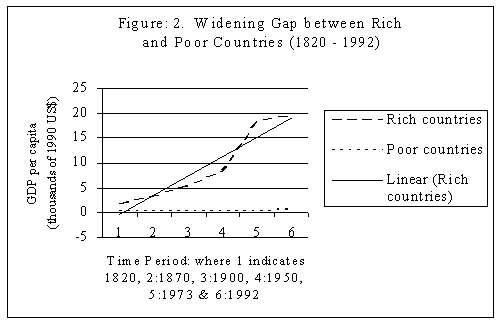
Source: Maddison, A. (1995), in UNDP (1999), p. 38.
With regard to the application of double standards in global politics, we will briefly review the nuclear issue which is a matter of great concern for the whole world. According to a recent estimate, the United Sates possesses nearly 5,968 nuclear warheads, followed by Russia (4,978), France (350), Britain (200) and China (100). However, these are deliverable warheads only, as there is a huge additional stockpile which can be readily available at short notice (Arms Control Association: April 2005). According to another source, Israel has 200 nuclear arsenals, India between 110-150, Pakistan 75 and North Korea around 13 (Elert (ed.) 8 March 2006). In fact, ‘the United States of America was the first country in the world to successfully develop nuclear weapons, and is the only country to have used them in war against another nation. During the cold war, it conducted over a thousand nuclear tests and developed many long-range weapon delivery systems' (Wikipedia Foundation 1 March 2006). Even more recently, on 23 rd February 2006, this country again ‘carried out a sub-critical nuclear experiment at an underground test site in Nevada ' (ABC News Online 24 February 2006). According to Schaeffer (1999: 218-19), ‘the US has issued nuclear threats on some 20 occasions since it destroyed Hiroshima and Nagasaki … [It] has been guilty of only threatening non-nuclear opponents.' The outcome of this type of environment is not difficult to judge. It has encouraged non-nuclear countries to acquire nuclear technology, resulting in increased regional and global insecurity and tension. Iran 's attempt to develop its nuclear sector is a good example in this regard. However, being a Muslim country, major global players, including India , do not want her to have access to nuclear technology. In spite of its strong friendship with Iran , in IAEA's meeting held in February 2006, India voted against Iran 's nuclear energy programme and wanted to forward the case to the UN Security Council ( Seattle Post-Intelligencer 5 March 2006). By the same token, during his visit to India in early March 2006, President Bush welcomed India into the global nuclear club ( Times Argus 3 March 2006). Here, a question to ask is whether Iran is really making nuclear weapons? To judge the situation, a few news-reports and quotations are worth noting.
• ‘Production, stockpiling and using nuclear weapons are against Islamic and human values' (Ayatollah Ali Khamenei: 08 November 2004).
• ‘ Iran suspends uranium enrichment and opens way to fresh nuclear deal with EU.' ( The Independent 23 November 2004).
• ‘Message from Iran says Tehran seeks talks with Israel ' ( Haaretz Daily 30 October 2003).
• We are certainly ready to give any kind of guarantee that Iran will not divert towards nuclear weapons' (Kamal Kharrazai – Iran 's Foreign Minister 22 February 2005).
• ‘ Iran invited the United States to take part in building its nuclear programme, aiming to allay Washington 's fear that Tehran is developing a nuclear bomb' (CBS News 3 June 2003).
• ‘UN nuclear watchdog rebuts claims that Iran is trying to make the atomic bomb' ( The Independent 14 August 2005).
• ‘ Iran is offering to suspend full-scale uranium enrichment for up to two years' ( Macleans 7 March 2006).
• However, in spite of this, the strategists at the Pentagon have been busy in drawing up plans for devastating bombing raids backed by submarine-launched ballistic missile attacks against Iran 's nuclear sites as a “last resort” to block Tehran 's efforts to develop an atomic bomb. ( Telegraph 12 February 2006).
• This was the reason that Mohamed El-Baradi, Director General of the International Atomic Energy Agency argued that: ‘The Security Council had practiced double standards by using a “good guys versus bad guys' approach” and accused the council of having “little to no response” as North Korea built nuclear arms. … We haven't seen any concrete intelligence that points to a fact that Iran has a nuclear programme. [Global] arms race could be slowed if the United States and its allies implemented the Comprehensive Nuclear Test Ban Treaty, which would halt all nuclear weapons testing' ( San Francisco Chronicle 5 November 2004).
• In the International Herald Tribune (22 September 2004), Jonathan Power says: ‘These Western powers have argued convincingly for decades that nuclear deterrence keeps the peace – and themselves maintain nuclear arms long after the cold war has ended. So why shouldn't Iran , which is in one of the world's most dangerous neighbourhoods, have a deterrent too?'
Unfortunately, this type of situation strengthens the feelings of mass frustration and anger throughout the Muslim World. By enhancing their popularity, it also strengthens the hands of autocrat rulers and religious extremists within their own countries. Therefore, whether it is an unjust global politico-economic system or the double standards applied by major powers of the world, or, irrational and hardliner statements issued by the current Iranian president, e.g., to wipe-out Israel from the global map (CNN 29 October 2005) – neither is helpful towards eradicating human poverty which is a major cause of the clash of civilisations and a pre-requisite to initiating a sustainable process of global human development. Regrettably, being a special target of the global media, the Muslim World is the main loser in this scenario. Furthermore, such an environment also levels the ground for major global players to keep the Muslim World out of the global decision making process. The intensity of the problem can be realised in the words of Australian Journalist, John Pilger (17 September 2004), who argues that: ‘The world is divided into two camps: Islam and “us.” That is the unerring message from Western governments, press, radio and television. For Islam, read terrorists.'
Global Media and Clash of Civilisations:
Socio-religious and Politico-economic Perspectives
Needless to say that in one way or other, most of the global cultures are based on their respective faiths and the basic philosophy of all faiths is to preach love for humanity and nature. The same is the spirit of secularism and there is no controversy in this argument that a vast majority of the inhabitants of this globe wish to live and let live in accordance with the principles of mutual respect, coexistence, harmony, peace, democratic norms and the freedom of expression. The imbalance in these points can create instability and promote violence. In fact, within the contemporary state of widespread misunderstandings about Islam all over the world, there is the need to take extra care so that global peace and stability may not be harmed by creating further hatred among different faiths and civilisations. Unfortunately, in the contemporary volatile global situation, Muslims are taken for granted and misinformation and mischief making about them by the media is supported by various political circles. This situation presents a serious threat to global human security. Here, we will quote only one example. It is well known that Muslims all-over the world have a high respect for their Prophet, and are very sensitive with regard to the divine book. On 30 September 2005, the Danish paper Jyllands-Posten published cartoons about the Prophet Mohammad which was followed by their reprinting in a Norwegian paper on 10 January 2006. On the first of February 2006, papers in France ( France Soir ), Germany ( Die Welt ), Italy ( La Stampa ) and Spain ( El Periodico ) also published some of these caricatures. These were 12 images which also appeared in various other papers published in Bulgaria , Switzerland , Belgium , Hungry, Poland , Ukraine , New Zealand , Australia , the United States and Israel . Throughout the Islamic civilisation, these cartoons were considered most offensive and a direct attack on the Muslim faith. In one of these images, the Prophet was shown wearing a bomb-shaped turban while another showed him as a knife-wielding nomad accompanied by veiled women. Another image is of him standing in paradise before a parade of suicide bombers and saying: ‘Stop, stop. We have run out of virgins.' On 3 January 2006, Jyllands-Posten apologised (30 January 2006) but maintained that it was legal under state law to print such material and they were published as a part of an ‘ ongoing debate on the freedom of expression that we cherish so highly .' But the paper neglected the fact that the f reedom of expression implies responsibility. These drawing had specific objectives as they attempted to associate Islam's Prophet with terrorism, criminality and the repression of women. Does freedom of expression equal a right to humiliate, offend, demonise, defame or slander? There are a few important points which need to be mentioned here:
• The German paper Die Welt challenged Muslims by arguing that ‘there is a right to blaspheme in the West, and asked whether Islam was capable of coping with satire. France Soir writes: ‘it had the full set to show that “religious dogma” had no place in a secular society' (BBC News 1 February 2006). The editor of France Soir said: ‘There is nothing in these incriminated cartoons that intends to be racist or denigrate any community as such. Some are funny, others less so. That's it. … No, we will never apologise for being free to speak, to think and to believe' ( Times Online 1 February 2006).
• The result of this situation was obvious. Although the violence cannot be justified in any circumstances, unfortunately, the publication of these caricatures led to violent protest all-over the Muslim World as well as in Europe . Lebanese demonstrators set fire to the Danish consulate in Beirut while Syrians set the Danish and Norwegian embassies ablaze in Damascus (MSN News 5 February 2006). Several people were killed in riots. Although this violence was condemned by a large number of Muslim scholars and governments, the situation remained tense and in Saudi Arabia , consumers boycotted Danish products.
• The severity of the situation can be judged from the statement of the Danish Prime Minister, Fogh Rasmusen (Yahoo News 7 February 2006) who said: ‘We are facing a growing global crisis that has the potential to escalate beyond the control of governments and other authorities.' But, in the view of the foreign ministers of various Arab countries, the solution was simple. After their meeting in Tunis they issued a communiqué, i.e.: ‘We seek the Danish authorities to take the necessary measures to punish those responsible for this harm and to take action to avoid its repeat.' However, neither the Danish government nor others whose countries' newspapers published these images agreed with this solution. Thus, Amr Moussa, the Secretary General of the Arab League asked: ‘Why do they talk about democracy and freedom of expression just when the issue concerns Islam?' (Islam Online 1 February 2006).
• This instability also caused a trade war situation and led to a considerable decline in the sale of European products in various Muslim countries. Peter Mandelson, the Trade Commissioner of the European Union, warned Saudi Arabia that the issue was very serious and ‘a boycott of Danish goods was a boycott of the European Union'. He further threatened that the matter could be brought up in the WTO ( Financial Times 31 January 2006).
• Nobel Peace Prize winner and respected South African retired Anglican Archbishop, Desmond Tutu, says: ‘Imagine if the subject had been the Holocaust and it had been treated in a way that the Jews deemed offensive and the reaction of the Danish government and the international community had been as it is now.' He further pointed that: ‘Look at the Ku Klux Klan, who use a cross as their symbol and propagate hatred against others and encourage lynching. And yet we never hear anyone say that there's an example of how Christianity encourages violence' (Yahoo News 28 February 2006).
A simple question emerges here that what was the specific need to publish these images? One possible answer to this question is provided by the Economist (3 February 2006). It reveals: ‘If the aim was to provoke a reasoned debate about self-censorship, religious intolerance and the freedom of speech, the editor of Jylland-Posten failed miserably.' Due to the seriousness of the situation, Kofi Annan, the then Secretary General of the United Nations said: ‘I share the distress of Muslim friends who feel that the cartoons offend their religion. I also respect the right of freedom of speech. But of course, freedom of speech is never absolute. It entails responsibility and judgment' (UN News Service 3 February 2006).
‘ Alliance ', Rather than a ‘Clash' of Civilisations: A Way Forward
For this reason, the word ‘jihad' sends shivers down the spines of many people in the Western world. Unfortunately, the term Jihad is one of the most misinterpreted terms in the media. As a matter of fact, the term ‘holy war' was coined in Europe during the medieval crusades which meant war against Muslims and in reality it does not have a parallel term in Islamic literature. This argument is also supported by Karen Armstrong. In one of her articles, entitled, The True, Peaceful face of Islam ( Time Magazine 1 October 2001: 15) she says: ‘Islam is not addicted to war. ... The primary meaning of the word jihad is not “holy war” but “struggle.” It refers to the difficult effort that is needed to put God's will into practice at every level – personal and social as well as political.' With regard to the Prophetic approach to peace, Armstrong writes: ‘A major part of his [Muhammad] mission was devoted precisely to bringing an end to the kind of mass slaughter we witnessed in New York City and Washington . … [H]e devoted his attention to building up a peaceful coalition of tribes and achieved victory by an ingenious and inspiring campaign of non-violence.'
for Reform Judaism. In his opinion, Muslims have been turned into ‘satanic figures.' He further stated that: ‘There exists in this county [US] among all Americans, whether Jews, Christians, or non-believers, a huge and profound ignorance about Islam. … Americans needs to know how far removed Islam is from the perverse distortion of the terrorists who too often dominate the media, subverting Islam's image by professing to speak in its name' ( Haaretz 1 September 2007).
In the words of Judith Latham (18 June 2002): ‘Many people believe that Jews and Muslims have been enemies throughout the history. But some Muslim, Jewish and Christian scholars are looking to the past to show that this has not always been so. These scholars point to Muslim Spain in the Middle Ages where, they say, members of all three faiths got along.' Latham also quotes Abdulaziz Sachedina (a Professor of Islamic Studies at the University of Virginia), who revealed that: ‘They [Spanish Muslims] created a civilization that was very close to what we would call a “pluralistic” civilization in which people of different faiths lived together.' However, o ne may argue that, was history - what about the contemporary state of minorities in Muslim countries? A possible answer to this question can be traced in an article written by Michael Theodoulou (3 February 1998) in the Christian Science Monitor . There he quotes a member from the Iranian Jewish community who says that: ‘It comes as a surprise to many visitors to discover that Iran , a country so hostile to Israel and with a reputation for intolerance, is home to a small but vibrant Jewish community that is an officially recognized religious minority under Iran 's 1979 Islamic Constitution. “[Ayatollah Ruhollah] Khomeini didn't mix up our community with Israel and Zionism - he saw us as Iranians,” says Haroun Yashyaei, a film producer and chairman of the Central Jewish Community in Iran .' A similar situation can also be seen in Turkey where Fiachra Gibbons (17 November 2003) writes in the UK's daily Guardian that: ‘The 17,000 or so remaining Jews of Istanbul are living proof that Jews and Muslims can coexist in harmony. It is a bond that has endured for more than 1,300 years of trials and tribulations and held fast every time.'
These examples reflect that a clash is not imminent as argued by Huntington . Possibly this was the reason that Kofi Annan took the responsibility to promote and strengthen the strategy of Alliance of Civilisations. In fact, during 2004, this initiative was first unveiled by Spain 's Prime Minister Jose Luis Rodriguez Zapatero. The idea was later co-sponsored by Turkish Prime Minister Recep Tayyip Erdogan in a summit between both leaders held in March 2005. During the same year, a high level group of eminent personalities was established by Kofi Annan with its primary objective to produce a document on this initiative. In November 2006, the group produced a report entitled: Alliance of Civilisations: Report of the High-level Group (13 November 2006). The report takes a multi-polar approach to galvanise collective action across diverse societies to overcome the challenges of extremism and socio-cultural barriers mainly between the Western and the predominantly Muslim Worlds. The main argument of the report is that it is politico-economic interests, rather than religion which are the root causes of a growing divide between the Muslim and the Western worlds. It further says that:
The history of relations between cultures is not only one of wars and confrontations. It is also based on centuries of constructive exchange, cross-fertilisations, and peaceful coexistence. … [But unfortunately,] by promoting the misguided views that cultures are set on an unavoidable collusion course, they help turn negotiable disputes into seemingly intractable identity-based conflicts that take hold of the popular imagination. … In this context, the need to build bridges between societies, to promote dialogue and understanding and to forge the collective political will to address the world's imbalances has never been grater. This urgent task constitutes the raison d'etre of the Alliance of Civilisations.
The report highlights major global challenges and suggests measures for improvement. It is noteworthy that rather than using a theoretical approach, the report is purely empirical in nature. Although, it is good, timely and constructive step towards the right direction, there is still a lot to do in this regard. The main features of the UN initiative can be presented in figure 3.
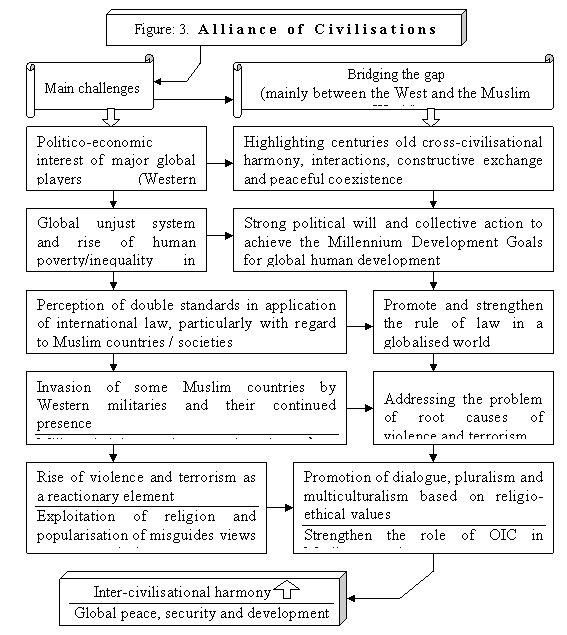
In the context of this report, there is another important point with regard to the clash of civilisations and migration from Muslim countries to the Western world. As mentioned earlier, due to the growing proportion of the aging population in the West and rising in-migration, the demographic structure is continuously changing. Specifically, the proportion of the Muslim population in Europe and the United States is on the rise. Fukuyama and Huntington 's findings reflect that this is an alarming situation. However, both are silent about discussing the causes and remedies of the problem. This situation is analysed in the UN report on alliance of civilisation (13 November 2006: 29-30) which reveals that in the prevailing age of globalisation, due to high income inequality between the developed and developing countries on the one hand and rapidly evolving modes of transportation and communications on the other, such migration is a natural phenomenon. It further states that the solution is not to build walls around nations, rather to deal with the reasons of migration. Furthermore, instead of considering new immigrants as a threat to host countries, measure should be adopted to their adequate integration in the mainstream system. No doubt, apart from various challenges, the immigrants also significantly contribute to the socio-economic development of the host country. To reduce the income inequality between the developed and developing worlds, adequate investment is also required particularly in the least developed countries. The report specially highlights the problem of racial discrimination faced by Muslim immigrants in Europe and the United States . These views are also confirmed by another study (entitled: Intolerance and Discrimination Against Muslims in the EU: Developments Since September 11 ) conducted by the International Helsinki Federation for Human Rights in March 2005. The report covered 11 EU member states. It revealed the widespread negative attitudes towards Muslims as well as biased media coverage portraying Muslims as ‘an enemy within'. Being an independent organisation, the International Helsinki Federation for Human Rights also expressed its concerns with regard to the developments which enhanced the vulnerability and marginalisation of Muslims and violation of human rights against them. These are the circumstances due to which the UN report stresses the need to initiate a process of comprehensive dialogue between Muslim and host communities. Interestingly, as Huntington argues that the clash is inevitable, the UN analysis presents a different picture and provides a strategy to promote peaceful co-existence, tolerance and harmonisation of civilisations. This discussion is illustrated in the following diagram.
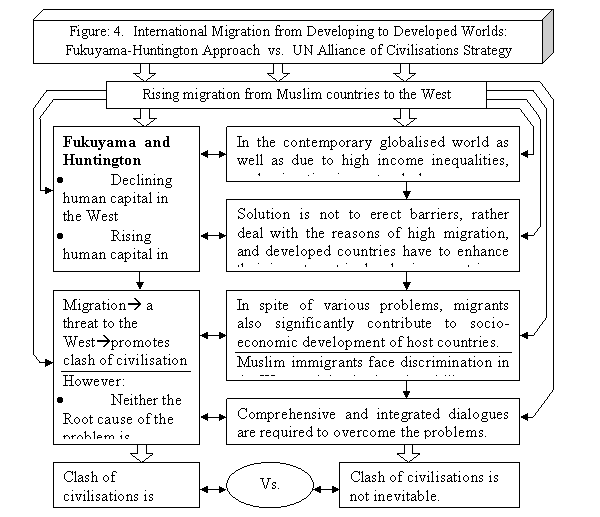 It needs to be mentioned here it this is not only Huntington who believes in a ‘clash' or Fukuyama who revealed the process of the ‘end of the history'. There are others, such as Hizb ut Tahrir (a Muslim hardliner movement) and the Taliban that believe the same. In accordance with the UN report (13 November 2006) these are the misguided religious extremists who spread the wrong interpretation of Islam to further their own specific strategies and interests. The current wave of suicide attacks ____________________________________________________________
These countries are Austria , Belgium , Denmark , France , Germany , Greece , Italy , Holland , Spain , Sweden and Britain .
reflect that such groups are not interested in peaceful co-existence. Hizb ut Tahrir is a network of extremist Muslims with their ultimate objective to eliminate political systems of all governments of Muslim countries and replace them by a unified medieval style caliphate. Similar to Huntington , they also believe that clash of civilisations is inevitable. In their book entitled, The Inevitability of the Clash of Civilisations , 105 verses of the Quran and sayings of Prophet Mohammad are quoted in support of their idea. Unfortunately, this out of context and misinterpretation of Islamic teachings is a main source to misguide Muslim youths which pose a threat to global human security. Regrettably, this group did not mention in this book that their own Prophet also made peace agreement with non-believers during his life time. Nor did they quote the very first verse of the Quran which highlights that the whole world is a family of God. A UK based left wing writer Tariq Ali (2002) argues that whether it is US imperialism or fanatical Mullahism , both are competing for global dominance by whatever methods they can use. This situation demands that there is an urgent need to overcome these challenges. One possible way is to highlight the commonalities of the major religions of the world. As is discussed above, the roots of all major civilisations can be traced in their respective faiths and all faiths emphasise on peaceful coexistence and tolerance.
The vast majority of Muslim scholars believes that the current waves of suicidal attacks by some religious extremists are in fact the acts of misguided individuals and these are based on the wrong interpretation of the Islamic faith.
An overview of the line of action of this group reflects that it does not believe in universal democratic norms. Furthermore, it is also unclear what would be its strategy to establish a unified caliphate in the entire and fragmented Muslim World? Needless to say that hugely stretched and socio-culturally diverse Ummah is a heterogeneous mixture of over 1.5 billion Muslims who are divided into numerous sects and schools of thoughts. How would this Ummah be able to reach a consensus to elect or select a single person as its caliph to rule it? What would be the politico-economic structure of this caliphate and how will it address modern challenges? In fact, the Hizb is unable to provide satisfactory answers to these questions. In fact, similar to various other hardliner religious groups, the activities of Hizb ut Tehrir are also banned in several countries (see Hizb's website: http://www. hizb.org.uk/ hizb/ index.php).
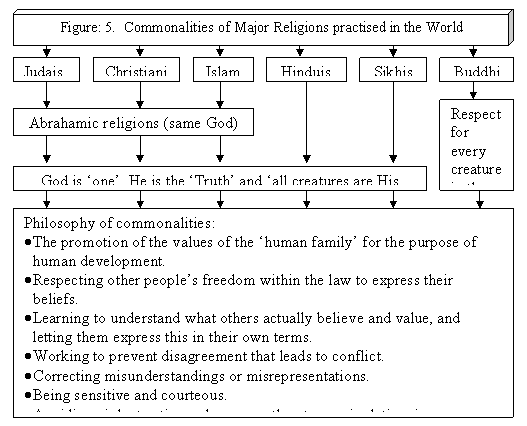
Source: Ahsan, M. (2005), p.18.
----------------------------------------------------------------------------
The vast majority of Muslim scholars believes that the current waves of suicidal attacks by some religious extremists are in fact the acts of misguided individuals and these are based on the wrong interpretation of the Islamic faith.
An overview of the line of action of this group reflects that it does not believe in universal democratic norms. Furthermore, it is also unclear what would be its strategy to establish a unified caliphate in the entire and fragmented Muslim World? Needless to say that hugely stretched and socio-culturally diverse Ummah is a heterogeneous mixture of over 1.5 billion Muslims who are divided into numerous sects and schools of thoughts. How would this Ummah be able to reach a consensus to elect or select a single person as its caliph to rule it? What would be the politico-economic structure of this caliphate and how will it address modern challenges? In fact, the Hizb is unable to provide satisfactory answers to these questions. In fact, similar to various other hardliner religious groups, the activities of Hizb ut Tehrir are also banned in several countries (see Hizb's website: http://www. hizb.org.uk/ hizb/ index.php).
Review and Reflection
In the perspective of the contemporary process of globalisation, this paper attempted to analyse the notion of a clash of civilisations in relation to the role of the mainstream media and its coverage of Muslims communities and the Islamic civilisation. The discussion reflects that in the present world, the tremendous enhancement in the interaction between nations and individuals has generated various challenges. Therefore, in the prevailing environment of the global village, living and working together is not always easy. This is particularly true where the contradicting and competing politico-economic interests of various nations and groups cause instability in the world. A varying interpretation of this situation is undertaken by different thinkers and groups. Fukuyama 's notion of the ‘end of history' and Huntington 's theory of ‘clash of civilisations' are its living examples. While Fukuyama argues that the Western values and system is the end product of human history, Huntington believes that a clash is inevitable to reach that stage. Directly or indirectly they both feel that Islamic civilisation is a threat to the Western value system and this situation is a major challenge for global peace and security. Unfortunately, rather than exploring the root cause of the problem, both attempt to synthesise various arguments in support of their respective theories. In this whole process, the global media plays an important but divisive role. The problem is encouraged when the Islamic faith is associated with violence and Muslims are labelled as trouble makers and aggressors. The discussion made in this paper reflects that in this type of situation, both, Western and Islamic worlds are losers since the hostility and conflict between them is beneficial to none. Therefore, this path must be avoided and adequate measures taken to avoid the problems that would result.
In realising the sensitivity of the issue, the United Nations took the initiative of promoting an alliance of civilisations. The main argument of its report is that human history is not only full of wars and violence, but for centuries, there has been peaceful coexistence, intensive cross-fertilisation and continued international trade among various civilisations of the world. In the present globalised environment, the roots of instability and violence can be traced to the politico-economic interests of various nations. This situation is exploited by religious extremists who spread misguided views to achieve their own specific objectives. No doubt, religion harnesses deep emotions which can sometimes take destructive forms. Multiplicity brings with it differences, which one cannot simply eliminate. Yet, the deep commonalities in the values of various faiths are to be constantly probed and appropriated for the development of a deeper spiritual and human solidarity and fellowship, transcending cultural and other barriers. At the same time, the distinctive theological and core-symbol elements and rites central to all faiths and civilisations need to be respected in dialogue and inter-relations. There is a need for accurate understanding and mutual empathy of all religions. Needless to say, being citizens of the present globalised world, we all need to work together to eliminate the horrors that have been committed in the name of God and religion. This translates into good community and inter-civilisational relations, and integrity in global public life.
Work Cited
ABC News Online (24 February 2006), ‘US Conducted Subcritical Nuclear Test,' <http://www. abc.net/news/ newsitem/ 200602/s1577409.htm>.
Ahsan, Muhammad (2005), South Asian Oral History: Tales and Cultural Identity in Worcestershire ,' Worcester : Worcestershire Racial Equality Council.
Ali, Tariq (2002), The Clash of Fundamentalists: Crusades, Jihads and Modernity , London : Verso.
BBC (23 December 2005), ‘Muslims in Europe : Country Guide,' (1 February 2006), ‘Cartoon Row Intensifies,' <http:// www.bbc.co.uk/...>.
CBS News (3 June 2003), Iran Invites U.S. to Bid on Nukes,' <http://www. cbsnews.com/ stories/ 2003/ 06/ 09/ world/ main557633.shtml>.
Christian Science Monitor, The (3 February 1998), ‘Jews in Iran Describe a Life of Freedom Despite Anti-Israel Actions by Tehran ,' by Theodoulou, Michael. <http://csmonitor.com/ cgi.bin/ durableRedirect.pl?/ durable/ 1998/02/03/ intl/intl.3.html>
CNN (29 October 2005), ‘Security Council Condemns Anti-Israel Words,' <http:// edition.cnn.com/ 2005/ WORLD/ meast/10/ 28/ iran.un.reaction/…>.
Economist, The (3 February 2006), ‘Religion and Freed of Expression.' <http:// www.economist.com/ agenda/ displaystory. cfm?story_id=E1_VQGQQVG>.
Elert, Glenn (ed.) (8 March 2006), ‘Number of Nuclear Weapons Capable Nations,' <http:// hypertextbook. com/ fact/ 2005/YuenHFong.shtml>.
Farooqi, M.H. (October 2001) ‘A Terrorist Disaster and the Warmongers Takeover,' Impact International , 31-10, pp. 6-12.
Financial Times (31 January 2006), ‘ Denmark Warns on Saudi Arabia Trip,' <http:// financialtimes. printthis. clickability. com/pt/cpt?action…>.
Fukuyama , Francis (1993), The End of History and the Last Man , London : Penguin Books.
Guardian (17 November 2003), ‘The Attack on Istanbul Jews is an Attack on Hope Itself,' by Fiachra Gibbons; (20 June 2002), ‘The Curse of the Infidel,' by Karen Aramstrong.
Gulen, M. Fethullah (2004), Towards A Global Civilisation of Love and Tolerance , Somerset : The Light Inc.
Haaretz (1 September 2007), ‘Reform Jewish Leader Tells U.S. Muslims that Islam is Being Demonized,' by Rabbi Eric Yoffie, <http:// www.haaretz.com/ hasen/ objects/ pages/ PrintArticleEn. jhtml?item No= 899630>; (30 October 2003). Quoted in Something Jewish (BICOM Daily Briefing) <http:// www. somethingjewish.co.uk/ articles/544_ bicom_daily_ briefing.htm>.
Hizb ut Tahrir (2002), The Inevitability of the Clash of Civilisations , London : Al-Khilafah Publications.
Huntington, Samuel P. (1997), The Clash of Civilisations and the Remaking of World Order , London : Simon & Schuster.
Independent (14 August 2005), ‘UN Nuclear Watchdog rebuts Claims that Iran is Trying to make A-bomb' <http:// news. independent.co.uk/...>; (23 November 2004), ‘Iran Suspends Uranium Enrichment and opens Way to Fresh Nuclear Deal with EU,' <http://news. independent. co.uk/ world/ middle_ east/ article 21592.ece>.
International Helsinki Federation for Human Rights (March 2005), Intolerance and Discrimination Against Muslims in the EU: Developments Since September 11 , Helsinki : International Helsinki Federation for Human Rights.
International Herald Tribune (22 September 2004), ‘ Israel 's Nukes Serve to Justify Iran 's,' by Jonathan Power .
International Institute for Strategic Studies (various issues) Military Balance , London : Oxford University Press.
Islam Online (1 February 2006), ‘French Paper Reprints Explosive Danish Cartoons,' <http:// www.islam-online.net/...>.
Jyllands-Posten (various issues 2005-2006) <http://jp.dk...>.
Khamenei, Ayatollah Ali (8 November 2004), ‘ Iran : Nuclear Pact may be Finalised Soon,' <http://www. msnbc.msn.com/ id/6417121...>.
Latham, Judith (18 June 2001), ‘Restoring the Legacy of Muslim Spain,' <http:// www. guidedones.com/ issues/ regions/ spain / legacy. htm>.
Macleans (7 March 2006), ‘Iran Reportedly Offers to Suspend Large-scale Uranium Enrichment up to 2 Years,' <http:// www. macleans.ca/ shared/print.jsp? content=w30741A>.
Maddison, Angus (1995), ‘Monitoring the World Economy', 1820- 1992, Paris : Organisation for Economic Cooperation and Development, cited in UNDP (1999), Human Development Report 1999 , New York : Oxford University Press.
Mahajan, Rahul (2002), The New Crusade: America's War on Terrorism , New York : Monthly Review Press.
MSN News (5 February 2006), ‘Police Urged to Act Over Cartoon Protest,' < http:// newsbox.msn. co.uk/ article.aspx? as=adimarticle…>.
New Internationalist Publications, The (2005), The World Guide 2005/2005 , Oxford : New Internationalist Publications.
Pilger, John (17 September 2004), ‘They and Us,' <http:// www.johnpilger.com>.
San Francisco Chronicle (5 November 2004), ‘Top UN Arms Inspector Slams Bush'; (16 February 2006), ‘U.S. Rejects U.N. Report on Gitmo,' <http:// www.sfgate.com/...>.
Schaeffer, Robert (1999), Warpath – the Politics of Partition , New York : Hill & Wang.
Seattle Post-Intelligencer (5 March 2006), ‘ India Urges Diplomacy for Iran Nuke Crisis,' <http:// seattlepi. nwsource. com/ national/1104AP_India_Iran_Nuclear.html>.
Telegraph (12 February 2006), ‘US Prepares Military Blitz Against Iran's Nuclear Sites,' <http:// www. telegraph.co.uk/...>.
Time Magazine (1 October 2001: Vol. 158), ‘The True, Peaceful face of Islam,' by Karen Armstrong.
Times Argus (3 March 2006), ‘Bush Welcomes India into Nuclear Club,' <http://www. timesargus. com/ apps/pbcs.dll/…>.
Times Online (1 February 2006), ‘French Newspaper Reprints Muhammad Cartoons,' <http:// www. timesonline. co.uk/...>.
UN News Service (3 February 2006) ‘Secretary General's Statement on Cartoon's Issue,' <http://www. un.org/ apps/ news/ searchFull.asp>.
United Nations, The (13 November 2006), Alliance of Civilizations: Report of the High-level Group , New York : The United Nations.
Vàzquez, Alberto Anguiano (2003), ‘UNCTEC Statement,' <http:// www.mor. itesm.mx/ MNU/ paginapasda/ 2003/ OIC%20hb.doc>
What Really Happened (8 August 1999), ‘Media Distortion,' <http:// www. whatreallyhappened. com/ RANCHO / LIE/lie.html>
Wikipedia Foundation (1 March 2006), ‘Nuclear Weapons and the United States ,' <http://enn. wikipedia.org/ wiki/Nuclar_weapons_ and_the_United_States>.
Yahoo News: (7 February 2006), ‘Demark Warns Cartoon Row Could Spin Out of Control,' <http://news. yahoo.com/s/nm/ 20060207/wl_nm/religion…>; (28 February 2006), ‘Tutu: Muslim Anger Not Just About Cartoon,' <http:// news. yahoo.com/ s/ap/ 20060228/ ap_on_re_mi_ea/...>.
Biography of Author:
Dr Muhammad Ahsan (FRSA) is a UK based research scholar and has over twenty years experience of research and teaching in various capacities. He has published extensively on a large number of current issues related to the Muslim World, education and human (under-)development. His research is mainly focused on issues related to Ummatic (under-)development at local, national and international levels. His publications include a large number of research papers several research reports and books. In addition, on a number of occasions, he has also presented papers at national and international conferences. Dr Ahsan has an MA (International Relations), MSc Honours (Cooperation and Credit) and PhD (International Relations) degrees, and a Diploma (Human Resources Development and Planning) from Japan , Pakistan , Britain and Holland , respectively.
Mailing Address:
Dr Muhammad Ahsan (FRSA)
7 Boswells Drive
Chelmsford
Essex
CM2 6LD
Tel: 01245-344006
e-mail: ahsan736@msn.com
Copyright © 2006 Global Media Journal. All rights reserved.