|
|
|


Home | Current Issue | Editions | Archives | Contact Us

Geo TV vs Star Plus Dramas and Female Viewers' Perceptions
Muhammad Nawaz Mahsud, Noman YaserIshtiaq Ahmad Chaudhry
This study explores the female viewers of Sargodha city's consumption pattern of Urdu dramas of two of the most popular television channels the ‘Geo TV, and the Star Plus. Total 210 female viewers are interviewed. The results show that the viewers spend more time on watching Star Plus dramas than the Geo TV dramas. It is observed that most of the viewers watch dramas in night time for getting relaxation and the house wives mostly change work schedule to find time to watch their favorite dramas. The findings reveal that majority of them are of the view that Star Plus dramas portray more gender interaction such as mix gathering, joint office work, drinking habits in parties, dancing, hand shaking, kissing, and modeling than Geo TV dramas. The results also show that both the channels portray the females more in ascribed roles like mother, mother in law, daughter, daughter in law, sister and wife than portraying them in achieved roles like teacher, nurse, journalist, lawyer and sales girl, however, the Star Plus significantly portrays them more in ascribed roles than the Geo TV.
Significance
Television is a most popular medium of communication all over the world. Television, some might say, has been the disease of the century, spreading like spores in living rooms, bedrooms, on the streets, in cafeterias. It is often said that television has altered our world ( www.weekly.ahram.org.eg , and Joshi, 2002, p.19). Most genres of television provide entertainment either they are dramas or music, games, shows or quiz programs. In the present scenario, dramas are being more powerful source of entertainment for all age groups. Story-telling had been a part of many cultures, and teaches values to human through stories. But in our culture an exceedingly large part of this story-telling comes through television and video games ( www.pgs.ca ). D ramas are always based on stories, so draw the attention of all . Drama is a mean of creative expression. People see dramas as for time pass or escaping from boredom or worries of life. ”Drama has a holistic way of teaching and effecting people.” Television has brought a whole new scale and intensity to the experience of drama that is without precedent in the history of human culture. There has never before been a time when a majority of any population had such regular and constant access to drama. Television, whether in its plays, series or serials, has had many a meaningful story to tell and has done so to marvelous effect in its own unique way. Everyone has their own favorites, as well as their pet hates ( www.wikipedia. com , and www.comms. dcu.ie ).
Television has become a significant social phenomenon in Pakistan. Though not yet investigated empirically, TV viewing is, generally believed to generate social forces of undeniable influence. With more than 1.5 million sets are in use and about seven hours of daily transmission. Disregarding TV's one-sided policy in the fields of news and current affairs, common people, especially children and women worship it for the entertainment it provides. It is this part of daily program, which gets full attention of the people. One might say, whatever impact television is able to inculcate, it is because of various plays, films and musical shows etc. which are telecast everyday (www.eprints.hec.gov.pk). Drama provides us different directions to think and different trends to follow. Influence of drama is being felt in each and every sphere of human activity from home to school and to work places. People have begun to opt those trends. Even for children, it can also be ‘third parent‘. For teen ages or young generation, it is a friend who tells them about different fields of life, different realties of life. For females it's a guide who tells how to deal with others as well as family members. In some respect dramas influence the general character building pattern (P.20).
In the field of Urdu dramas the two private important channels, Geo T.V (Pakistan) and Star plus (India) broad cast dramas at prime time, which are the great source of entertainment in almost all the countries where Urdu is a language to communicate or to understand. In drama both channels are promoting their culture values and traditions ( www.Pakaffairs.com ). The purpose of selecting dramas for research is to find out how the two popular private channels attract and sustain audience members' attention with particular focus on female viewers in the presence of so many choices with control mechanism. Dramas are popular content of mass media. Dramas have a dynamic influence on people, which ultimately affect the society as a whole. Various studies ( www.comms.dcu.ie ; www.wikipedia.com ; & Biagi, 2003) show that today more drama is watched in a week or weekend than would have been watched in a year or even in a life time in any previous historical period. There are a lot of other things known for providing entertainment such as movies, websites and dramas. The usual purpose of drama is as entertainment; however, drama can also be used as an educational activity or for therapeutic purpose. It is generally observed that females are fond of dramas; either they are students, working ladies or house wives. Studies ( www.umich.edu ; & www.usask.ca ) illustrate that media play a dominant role in influencing females' perceptions of the world around them, as well as helping them to define their sense of self. The majority of soap operas are set in a domestic situation, often the central characters are females as the result they are affected by those dramas and opt different things. Most of the ladies watch dramas in night time for entertainment while “house wives can watch cable television at their convenience, can change work schedules to find time to watch dramas, thus they have more freedom to watch dramas (on cable television).
As Folkerts and Lacy (2004) and Spigel (1992) state that the history of television is a history of technology and policy, economics and sociology, and entertainment and news. Television was not merely a technical invention. It changed people's lives, even down to arrangement of their homes. Women's magazines of the 1950s discussed how to rearrange household furniture to accommodate the television. The magazines also noted that television could provide a unifying influence in family life. Television revolutionized not only the home but also news, politics and information. Some say that it has revolutionized an entire society. Television caters to the advertising market and the consumer market with news and entertainment networks, cable system, direct broadcasters, and syndicates provide programming that supplies the demand. The chief goal, except in public television, is to make profits, which is usually alone by achieving high ratings. T.V shows can be divided broadly into two types: entertainment and news. Most television stations and networks have separate departments for providing these types of programs. The distinction does not mean that information can not and should not be entertaining. Traditionally the distinction has been that entertainment is mostly fictional and information concerns real events (Spigel, p.263).
Demand for entertainment is as diverse as the population. Most entertainment programming fall into standard categories such as comedy, drama, sports, talk, game shows, children's programs, documentaries, and reality based shows. Within these categories there is a great variety. These programs are air in prime time (between 8pm and 11pm .EST), when most people watch television. Cable networks run movies, sports, music, videos, and syndicated programming, but they may also produce original material. By 2002, critics praised HBO as the best quality network on television and its program The Sopranos was considered the best drama (Marc, 2002). Study (Biagi, 1999, p.151) shows that television gives you access to all types of programs – drama, comedy, sports, news, game shows and talk shows. You can see all kind of people – murderers, public officials, foreign leaders, reporters, solders, entertainers, athletes, detectives, doctors etc. The television screen is truly, as scholar Erik Barnouw observed, a “Tube of Plenty.” People don't watch more channels when more are available. The average house hold receives 36 TV channels but watches fewer then half. Even when people can receive as many as 80 channels, they only watch 14. ” A new generation now has the chance to put the vision back into television and to travel from the wasteland to the Promised Land”(p.151). It is recognized fact that the mental and psychological trends of youth clearly depict the future of any society. In this connection the role of cable network has become more vivid then ever before. Irfanulla (2003, p.1); & Price (1998, p.321) state that entertainment programs forge emotional ties to audience members that influence values and behaviors more forcefully then the purely cognitive information provided in documentaries or single-episode dramas. Television has altered our world. The idea that the advent of television marked a change in the social order has become a part of the received wisdom of our time. They argued that television had pioneered a number of new forms, these include the drama, documentary , education by seeing, discussion, features, sequences and even by which they means some of its intrinsic visual experiences, which are unique to television and which allow us to see things in a new and unexpected ways.
Many studies (Westoff, & Bankole, 1997; Singhal et al, 2003; Singhal, & Rogers, 1999; Rogers, et al. 1999; and Vaughan, & Rogers, 2000) show that mass media, particularly entertainment broadcast media, have played a significant role in a number of countries in bringing about changes in reproductive behavior and in promoting adoption of other health measures. Radio and television soap operas in Mexico, India, Kenya and Tanzania have been documented by independent research in their massive effects on audience attitudes and behavior. they further describe one of the advantages of using serial dramas, and entertainment programs is that they allow time for the audience to form bonds with the characters and allow characters to evolve in their thinking and behavior with regard to various issues at a gradual and believable pace in response to problems that have been well illustrated in the story line. Just as important, entertainment programs forge emotional ties to audience members that influence values and behaviors more forcefully than the purely cognitive information provided in documentaries. As described in the social learning theory that vicarious learning from others is a powerful teacher of attitudes and behaviors. Next to peer and parental role models, role models from the mass media are of particular importance in shaping cultural attitudes and behavior (Bandura, 1986).
Similar researches were conducted in Kenya (1987) and Tanzania (1995-97), which showed the same results. Because entertainment programming attracts the largest audiences, it is particularly important to utilize entertainment media for disseminating information. Therefore, while soap operas do portray women in a more positive way than advertising and other forms of television, it still ultimately respects and conforms to the broader mainstream cultural demands, through the way in which it still tends to put women in a domestic setting, especially if she has a family. Soaps often show women as having jobs, but rarely pursing their careers, and if they do, more often than not, they are unsuccessful. Thus we can see how even a form of television programming aimed at a majority female audience contains subliminal messages reinforcing the dominant male ideology (Rogers, 1999).
The channels
Geo TV is a private channel owned by Jang group and launched in 2002 and is based out of Dubai UAE ( www.Pakaffairs.com ). Geo TV broadcast dramas. Geo TV's dramas have a great effect on its audience and are source of entertainment as well. Its transmissions are easily accessible all over the Pakistan and as well as in other countries through cable services. Being a hybrid channel; meaning hourly news and family shows make it a favorite channel among Pakistanis ( www.Pakaffairs.com ). Geo TV networks claims we are the most viewed network channel- JUST ASK ANY ONE . Geo TV mission is to educate, entertain and inform the public with their great programs ( www.GeoTV.com ) GEO Television is an Urdu Pakistani televission net work. its sister channels are Geo News, Geo Super AGG .
On the other hand Star Plus is one of the Indian channels. Star Plus is India's most watched Hindi language based general entertainment channel. Star Plus's programming primarily consists of family dramas, which mostly boast female protagonists and mother- in- law and daughter –in-law relationship in joint families as their theme. This channel has been India's No.1 cable channel for the last six years reaching more than 50 million viewers every week and boasts 45 out of the top 50 shows on Indian cable and satellite television. Star Plus is also known for bringing in a revolution in the Indian television world with new shows in year 2000. Through cable its transmissions can be received in other countries as well as in Pakistan. Its sister channels are Star one, Star Otsav, Star World, Star Gold and Star Movies ( www.wikipedia.com ). Both of these channels have reasonable viewer ship because of attractive programs. In a very short time span both Star Plus and particularly Geo TV attracting the psyche of viewers, because their programs are based on viewer's needs and wants. It will matter of great interest to explore the viewer auctioned of exposure of both foresaid TV channels and also to determine and document the preference of order of their entertainment program with specific focus to be given to Urdu dramas.
Methodology
To meet the requirement of the study stratified method for specification of the viewers' characteristics is adopted and convenience method is used for collection of data from the target population. Due to resource and time constraints it was not possible for the researchers to collect data from the large population of Sargodha city. Therefore total 210 respondents equally consisting of sub groups—female students 70, working women 70 and house wives 70—are selected. This practice has the effect of improving the representation of a sample by reducing the degree of sample error (Babbie, 1992). Selltez, Wrightsman, and Cook (1976) explain that the population is divided into two or more strata in stratified method. This procedure generated and organized population into homogeneous subsets and selected various elements from form each. Travers (1978) asserts that major advantage of this procedure is that it increases accuracy.
Keeping in view the nature and sensitivity of the selected female viewers' sample, three female students were trained and a pre-test was taken in the homogeneous subgroups. It gives an advance opportunity to see weaknesses and flaws and also to see (a) if the codes designed for categorizing the data and transferring them from the questionnaire to machine are properly designed; (b) to find out whether the questionnaire is too long or too short; (c) to assure whether or not questions have an optimal; and (d) to find out mistakes if any. Some grammatical and conceptual mistakes and errors can be avoided by taking the time to make an adequate pre-test (Sonquist and Dunkelberg, 1977). In the light of pre-test, several changes were made in developing the final questionnaire. Some response categories were done away with and some were added. The format was revised and the order of the variables redesigned to facilitate the recording of sensitive and accurate responses.
An attempt was made to sort out answers to the following research questions:
• Whether the viewers dramas watching habits is differentiated on the basis of exposure—low-high.
• Whether the viewers habits of watching is differentiated on the basis of subgroups—students,
Working women and house wives.
• Whether the viewers' extent of interest is differentiated on the basis of the subgroups in relation
with both the channels dramas types of content.
• Whether the viewers' perceptions about various atmospheres shown by the dramas are differentiated on the basis of their roles—students, field work and house duty—in a society.
• Whether there is any difference between the viewers subgroups perceptions about portrayal of women by dramas in achieved or ascribed roles.
Findings
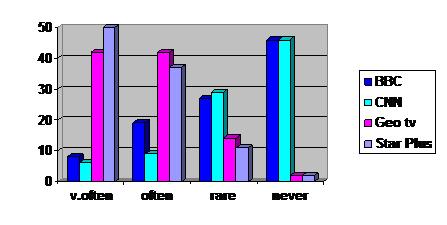
The study results reveal high watching habits of cable television channels among the female viewers of Sargodha city. The comparison of their preference of exposure to Urdu vs English networks illustrates that they (particularly the house wives) significantly prefer to watch Urdu language based networks than the English. Most of them are of the opinion that they prefer to watch Urdu dramas on Star Plus (India private channel) and Geo TV (Pakistan Private channel) because familiarization with the dramas language and characters. The findings regarding their response to exposure major TV channels providing update impartial information throughout the world, show significant difference among viewers' watching habits of Urdu network Geo TV and Star Plus compared to English network BBC and CNN. Although their first preference of watching the cited Urdu channels is getting relaxation after doing hard and stereotype work at home, but they also depend more on the same channels for acquiring fresh information (Fig. 1.1).
Figure 1.1 Figure 1.2
Watching habits of Cable Channels Viewing of Geo TV & Star Plus dramas.
 |
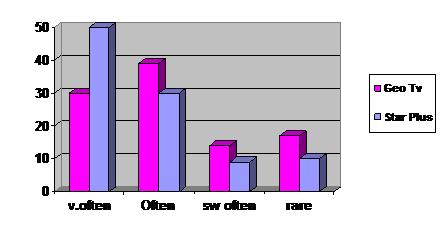 |
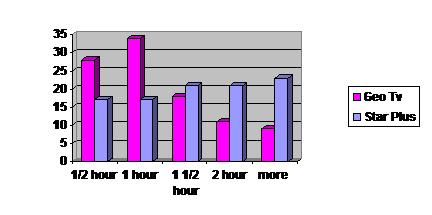
Figure 1.3 Time spending habits.
Viewers' Perceptions about dresses
Figure 1.4 Traditional dresses
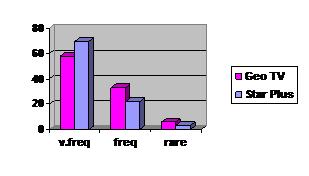 |
Figure 1.5 Modern dresses |
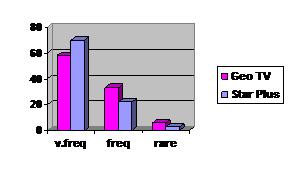 |
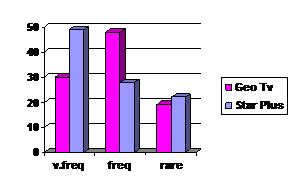
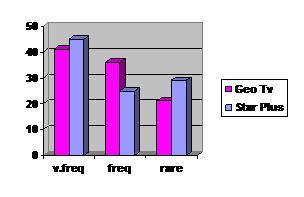
The figure 1.2 shows little but not significant difference between the female viewers exposure to dramas on both the channels. However, watching Star Plus dramas are relatively more preferred by viewers. The comparison of the low and heavy time consumption pattern of both channels reveals that low time spending viewers significantly watch Geo TV dramas. The viewers who consumed heavy time on watching Urdu dramas are significantly exposed to Star Plus channel dramatized programs (fig. 1.3). Reasons behind their heavy watching habits are, that they like Star Plus dramas more because of thrill, suspense, event fast tempo, presentation, glamour, violence and sex scenes, high living standard, e.g. big houses decorated with highly sophisticated materials, best character choice and strong story based. The findings show no significant difference between viewers' perceptions about the use of traditional dress by women characters in both channels (fig.1.4). Little but not significant difference is found between their perceptions about using modern dress. They are of the view that women characters more often use modern dress in Star Plus drama compared to Geo TV (fig. 1.5). The analytical comparison of the viewers' perceived perceptions about women portrayal with long and short hair style by both the channels' dramas reveals somewhat difference. They are of the firm view that female characters are more portrayed with both hair styles by Star Plus compared to Geo TV dramas (fig. 1.6 & 1.7).
Perceptions about hair styles
Figure 1.6 Long Hair Cut figure 1.7 Short Hair cut
 |
 |
The results of the study extend support to the assumption that both the transitional societies and their media are very much influenced by western life style. Change and race of competition are in the air. Geo TV and Star Plus both are independent private channels, having a large circle of audience. However, female segment of our society is the most susceptible and higher consumer of Urdu dramas of both the channels, but there is somewhat difference in overall viewers' perceptions. All the study sample viewers depend more on Star Plus than Geo TV (table 1.1).
It is evident from the findings that the viewers are higher consumers of both the channels entertainment programs. The analysis of their perceived perceptions about the extent of frequency of women portrayal in different social roles with focus on their interaction with opposite sex, illustrates that they all—overall, house wives, students and working women—are of the firm belief that the two most important channels very often show women in western life style in their most of entertainment contents.
Table 1.1 Gender interaction atmospheres in dramas
Overall(n=210)a* b*1 c* 2 |
Students(n=70)a b c |
Working women(n=70)a b c |
House wives(n=70)a b c |
|
Mix gather |
||||
Geo TV |
70*3 23 07 |
74 14 12 |
62 31 07 |
71 26 03 |
Star plus |
92 04 04 |
89 06 05 |
97 00 03 |
91 06 03 |
Office work |
||||
Geo TV |
71 24 05 |
69 23 08 |
71 26 03 |
74 22 04 |
Star plus |
82 10 08 |
71 11 15 |
80 14 06 |
91 06 03 |
Traveling |
||||
Geo TV |
60 30 10 |
55 26 19 |
46 49 06 |
80 17 03 |
Star plus |
73 18 09 |
52 29 19 |
74 23 03 |
94 03 03 |
Drinking |
||||
Geo TV |
20 34 46 |
26 34 40 |
20 34 46 |
14 34 52 |
Star plus |
90 06 04 |
85 11 04 |
89 06 05 |
97 00 03 |
Eating |
||||
Geo TV |
73 18 09 |
66 17 17 |
74 17 09 |
77 20 03 |
Star plus |
82 12 06 |
80 11 09 |
80 14 06 |
86 11 03 |
Singing |
||||
Geo TV |
51 36 13 |
54 31 15 |
51 37 12 |
46 40 14 |
Star plus |
84 12 04 |
83 14 03 |
86 09 05 |
83 14 03 |
Dancing |
||||
Geo TV |
30 34 36 |
31 29 40 |
43 29 28 |
17 46 37 |
Star plus |
89 06 05 |
80 14 06 |
91 06 03 |
94 03 03 |
Kissing |
||||
Geo TV |
11 15 74 |
14 17 69 |
17 17 66 |
00 11 89 |
Star plus |
81 07 12 |
77 06 17 |
83 03 14 |
83 11 06 |
Modeling |
||||
Geo TV |
49 32 19 |
43 34 23 |
51 34 15 |
52 26 22 |
Star plus |
74 13 13 |
77 11 12 |
77 11 12 |
69 17 14 |
Cooking |
||||
Geo TV |
61 29 10 |
51 34 15 |
60 31 09 |
57 34 09 |
Star plus |
63 26 11 |
51 29 20 |
66 29 05 |
57 34 09 |
Hostelling |
||||
Geo TV |
72 17 11 |
69 17 14 |
69 22 09 |
63 26 11 |
Star plus |
86 10 04 |
83 11 06 |
83 14 03 |
80 20 00 |
Hand Shake |
||||
Geo TV |
57 26 17 |
57 29 14 |
69 09 22 |
60 17 23 |
Star plus |
90 04 06 |
80 09 11 |
97 00 03 |
89 03 08 |
__________________________________________________________
* =Very often * 1 = often * 2 = somewhat
* 3 = Figures in table show percentage
The results further show viewers perceptions that the channels very often give importance to portray women as model or cook and hotel business staying. The analysis of the comparison of their perceptions about extent of drinking, dancing, and kissing atmosphere shown by the Urdu dramas indicates that majority of the viewers thinks that Star Plus dramas significantly depict such situation very frequently in entertainment dramas compared to Geo TV. It is also evident from the findings that Star Plus dramas significantly portray women in western life style than the Geo TV dramas. The review of the results further shows that both the channels very frequently show the young and beautiful girls mostly as object of appeal in mix gathering (overall Geo TV 70% vs Star Plus 92%, house wives Geo TV 71% vs Star Plus 91%, student Geo TV 74% vs Star Plus 89% and working women Geo TV 62% vs Star Plus 97%). The viewers are also of the view that both the channels significantly portray women in the dramas' joint office environment, adventure type of traveling, eating, singing, and hand shaking with men during special types of parties or programs (see table 1.1). However, the comparative analysis of the channels' dramas shows significant difference, the Star Plus very significantly portrays women in almost all of the mentioned situations with specific attention on dancing, kissing, and drinking.
Table 1..2 Viewers' interest in various types of dramas content
Overall |
Students |
Working women |
House wives |
|
(n=210)a* b* 1 c* 2 |
(n=70)a b c |
(n=70)a b c |
(n=70)a b c |
|
Violence |
||||
Geo TV |
48* 3 28 33 |
52 31 17 |
33 23 44 |
34 26 40 |
Star plus |
60 25 15 |
63 25 13 |
42 30 28 |
46 23 21 |
Romance |
||||
Geo TV |
56 33 11 |
61 23 16 |
58 20 22 |
64 28 12 |
Star plus |
70 22 08 |
69 26 05 |
60 17 23 |
65 29 06 |
Action |
||||
Geo TV |
61 29 10 |
68 20 12 |
57 32 11 |
62 29 09 |
Star plus |
85 10 05 |
90 06 04 |
87 07 06 |
86 11 03 |
Sex Scenes |
||||
Geo TV |
10 11 79 |
11 09 80 |
21 13 74 |
09 15 76 |
Star plus |
23 19 58 |
18 17 65 |
24 22 56 |
19 18 63 |
Story |
||||
Geo TV |
65 20 15 |
63 19 18 |
60 22 18 |
65 20 15 |
Star plus |
70 22 08 |
72 21 07 |
68 24 08 |
70 22 08 |
Locations |
||||
Geo TV |
58 27 20 |
56 30 14 |
61 24 15 |
56 23 21 |
Star plus |
75 17 08 |
70 18 12 |
67 23 10 |
77 17 06 |
Characters |
||||
Geo TV |
64 23 13 |
57 25 18 |
63 20 17 |
67 21 12 |
Star plus |
82 10 08 |
85 12 03 |
79 16 05 |
83 09 08 |
------------------------------------------------------------------------------------------------
a*: lot of interest b 1* : some interest c 2* : no interest
3*: Figure in the table show percentage
The findings of the table 1.2 regarding the viewers' extent of interest taking in the violent content of the dramas reveal somewhat difference between the overall viewers' (Geo TV 48% vs Star Plus 60%), female students (Geo TV 52% vs Star Plus 63%), working women (Geo TV 33% vs Star Plus), and house wives (Geo TV 42% 34% vs Star Plus 46%). It is also evident from the findings that almost all the viewers take more interest in the Star Plus dramas' violent content compared to Geo TV dramas' violent content. Little but not significant difference is observed between the viewers' interest in romance scenes of both the channels' dramas (overall (Geo TV 56% vs Star plus 70%); students (Geo TV 61% vs Star Plus 69%); working women (Geo TV 58% vs Star Plus 60%); and house wives (Geo TV 64% vs Star Plus 65%). It can be summarized that overall viewers in general and student viewers in particular take little more interest in the Star Plus dramas romance scenes than that of Geo TV.
The results in term of overall viewers' interest in action scenes of the channels' dramas reveal significant difference between overall (Geo TV 61% vs Star Plus 85%); students (68% vs 90%); working women (57% vs 87%); and house wives (62% vs 86%). In the light of the observed findings, it can be concluded that almost all viewers significantly take a lot of interest in the Star Plus action scenes compared to GeoTV. The results of table 1.2 reveal no significant difference between the viewers' extent of interest in both the channels' dramas stories and locations while significant difference is observed between the viewers' extent of interest taking in characters of the dramas. Majority of the viewers take more interest in both male and female characters portrayed by Star Plus dramas than the Geo TV dramas' characters.
The results of the study's sampled viewers' perceptions about women portrayal in different roles by television dramas obviously illustrate that both private channels equally portray them more in the ascribed roles—mother, mother in law, sister, wife, daughter, and daughter in law—compared to their portrayal in the achieved roles—teacher, sale girl, nurse, model, lawyer, air hostess and journalist. The viewers are further of the view that the Star Plus significantly portrays women in dramas in the ascribed roles like wife, daughter, and daughter in law and mother than the portrayal of them in the same roles by Geo TV dramas. One of the study's main concerns is to investigate and determine whether there is any correlation between the viewers' exposure to the private channels western life style depicted in dramas and their extent of participation in such atmosphere in real life.
The detailed analytical review of the results of table 1.3 illustrates that there is no significant difference between the viewers' extent of participation in mix gathering, joint work with opposite gender, and traveling with gents. However, working women's participation in the mentioned conditions is observed little more but not at significant level. The study's findings reveal some confused situation regarding sharing of drink during social gathering or parties. According to the observed findings, working women don't prefer to share drink in parties but the female students and house wives share little drink during social gathering or parties. It is pertinent to mention that by drinking they mean cold drinks not wine and beer.
Table 1.3 viewers participation in various atmospheres.
Overall |
Students |
Working women |
House wives |
|
(n=210) |
(n=70) |
(n=70) |
(n=70) |
|
a* b* 1 c* 2 |
a b c |
a b c |
a b c |
|
Mix gather |
60* 3 30 10 |
54 34 12 |
66 26 08 |
57 34 09 |
Office work |
33 16 51 |
26 20 54 |
69 20 11 |
54 22 24 |
Traveling |
52 39 09 |
49 40 11 |
60 34 06 |
54 40 06 |
Drinking |
09 09 82 |
14 09 77 |
00 11 89 |
09 14 77 |
Eating |
75 18 17 |
69 20 11 |
74 20 06 |
71 20 09 |
Singing |
30 23 47 |
34 29 37 |
31 20 49 |
34 22 44 |
Dancing |
13 21 66 |
17 26 57 |
11 26 63 |
20 20 60 |
Modeling |
10 14 76 |
14 20 76 |
09 20 71 |
20 20 60 |
Cooking |
60 25 15 |
43 40 17 |
63 26 11 |
40 37 23 |
Hotel ling |
53 30 17 |
31 40 29 |
66 20 14 |
46 28 26 |
Hand Shake |
36 22 42 |
40 20 40 |
37 22 41 |
37 22 41 |
--------------------------------------------------------------------------------------------------
* =Very often , * 1 Somewhat often * 2 Never
* 3 = Figures in table show percentage
Results regarding the extent of the viewers' interaction with opposite gender in hotel reveal some what difference between students, house wives, and working women. The working women are of the view that they very often interact with men in hotels during parties or some times they have to stay at hotels when they are out of station for official purpose. The findings in term of the female viewers' extent of hand shaking frequency reveal no significant difference.
The comparison of the study's results shows no significant correlation ship between the dresses used by both the channels dramas' female characters and the viewers' using
Table 1.4 Respondent frequency of wearing various dresses
Overall |
Student |
Working women |
House wives |
|
(n=210) |
(n=70) |
(n=70) |
(n=70) |
|
a* b* 1 c* 2 |
a b c |
a b c |
a b c |
|
Shalwar Qamez |
95* 3 04 01 |
86 11 03 |
100 00 00 |
100 00 00 |
Jeans and Shirts |
14 23 63 |
17 20 63 |
14 29 57 |
09 20 71 |
Two Piece Suit |
09 12 79 |
14 20 66 |
06 11 83 |
06 06 88 |
Long Skirts |
11 27 62 |
20 14 66 |
06 29 65 |
06 37 57 |
Mini Skirts |
06 03 91 |
14 06 80 |
03 00 97 |
00 03 97 |
Sarie |
32 30 38 |
22 22 66 |
29 31 40 |
46 34 20 |
Using Dopata |
93 05 02 |
94 03 03 |
97 03 00 |
89 09 02 |
Using veil |
53 32 15 |
60 22 18 |
43 40 17 |
54 34 12 |
Using Scarf |
66 27 07 |
80 17 03 |
57 31 12 |
60 31 09 |
Sun glasses |
50 37 13 |
46 43 11 |
60 22 18 |
46 46 08 |
Open hair |
27 28 45 |
14 20 66 |
43 29 28 |
22 34 44 |
Using caps |
17 34 49 |
17 26 57 |
20 34 46 |
14 43 43 |
sports kits |
17 26 57 |
06 20 74 |
06 31 63 |
09 26 65 |
--------------------------------------------------------------------------
* =Very frequently , * 1 = Frequently * 2 = Rarely
* 3 = Figures in table show percentage
habits of the dresses which they prefer to wear in their real life. The findings illustrate that almost all of the viewers significantly use shalwar qamez, very little size of them—students and working women—use jeans and shirts, two piece suit, and long skirts (table 1.4). The results further show that house wives prefer to use Sari especially during social gathering and family functions. It is also observed that majority of the respondents significantly use Dopata, while students and house wives mostly prefer to use veil compared to working women. The respondents' response about using scarf illustrates that house wives and students very often use scarf compared to working women, while working women more often use sun glasses and open hair style than house wives and students. The results of study reveal no significant difference between the using habits of caps and sports kits of the respondents.
Note : The data is collected from the female viewers of Sargodha city, where still traditional values and norms are honored. If data from other advanced urban areas like, Islamabad, Lahore or Karachi is collected then more likely the using habits of modern dress and hair style of the female viewers would be observed significantly different.
It is assumed that most of the female viewers get ideas from the interior decoration frequently shown by the television dramas, that is why specific question is asked from the viewers that how often do they pick ideas of home decoration—bedroom, drawing room, dining room, TV lounge, bath room, and kitchen. The observed empirical evidences reveal
Table 1. 5 Picking ideas of home decoration
Most often |
often |
rarely |
never |
Don't know |
|
Bed Room |
|||||
Geo TV |
19* |
23 |
28 |
26 |
04 |
Star plus |
15 |
18 |
31 |
33 |
03 |
Drawing Room |
|||||
Geo TV |
13 |
29 |
25 |
29 |
04 |
Star plus |
17 |
19 |
32 |
30 |
02 |
Dining Room |
|||||
Geo TV |
09 |
27 |
29 |
33 |
02 |
Star plus |
17 |
17 |
29 |
35 |
02 |
TV Lounge |
|||||
Geo TV |
13 |
28 |
27 |
28 |
04 |
Star plus |
21 |
17 |
23 |
37 |
02 |
Wash Room |
|||||
Geo TV |
10 |
15 |
29 |
39 |
07 |
Star plus |
13 |
11 |
22 |
48 |
06 |
Kitchen |
|||||
Geo TV |
19 |
16 |
23 |
37 |
05 |
Star plus |
28 |
07 |
24 |
37 |
04 |
________________________________________
* = Figures in the table show percentages
no significant difference between the viewers extent of getting ideas from both the channels for decoration purpose of their homes (table 1.5). However, the comparative analysis of both the channels' dramas reveals little but not significant difference between the viewers ideas getting from the dramas regarding home decoration. It is observed that the viewers to some extent get more ideas for their home decoration from the Star Plus dramas than the Geo TV dramas regarding bedroom, drawing room, TV lounge, and kitchen.
Summary & Discussion
This study was designed to explore and document the female viewers of sargodha city consumption pattern of entertainment programmes the Urdu dramas of the most popular television channels the ‘Geo TV, and the Star plus. Keeping in view the degree of difference among the sub groups of the viewers documented responses, it can be summarized that most of the viewers consumed both the channels entertainment content with selective attention paid to selected type of contents to fulfill their needs and requirements. Another important factor, which has been observed during data analysis, was the amount of time, which the viewers frequently spent, on watching both the channels dramas, but difference was observed in term of their time spending habits. The viewers significantly spent more time on watching Star Plus dramas than Geo TV dramas.
The analysis further showed that all the study's focus groups significantly preferred to watch Geo TV and Star Plus dramas compared to their watching frequency of the most popular news channels CNN and BBC. This position not only extended support to the research hypothesis that ‘the female segment is more likely to expose more to the Geo TV and Star Plus Urdu dramas than the informative contents of other channels, but also is in the line with the view point of Biagi (1999) that “ television gives you access to all types of programs – drama, comedy, sports, news, game shows and talk shows and also in the line with Ang (1985) that “Soaps in general have a predominantly female audience” and Ingham 's (cited at: www.aber.ac.uk ) point of view that “soap operas watched mainly by women.” The analysis of the findings further showed that majority of the female viewers spent more time and paid more attention to the Star Plus dramas than Geo TV dramas. Therefore, the empirical findings endorsed the study's hypothesis that ‘more likely the female viewers spend more time on Star Plus dramas than Geo TV dramas (see fig. 5.4). However, the results did not extend support to the hypothesis that ‘more the female watching habits of dramas, than the more the chances of getting ideas of home decoration
The analysis of the comparison of the viewers perceived perceptions regarding the gender interaction shown by the dramas with different atmosphere revealed that majority of them were of the firm views that Star Plus dramas significantly portrayed more mix gathering, joint office work, drinking habits in parties, dancing, hand shaking, kissing, and modeling than Geo TV dramas. It was further observed that both the channels significantly portrayed females in ascribed roles like mother, mother in law, daughter, daughter in law, sister and wife than their portrayal in the achieved roles like teacher, nurse, journalist, lawyer and sales girl. While the comparison of both the channels dramas in term of portraying of women in different roles showed that the Star Plus portrayed them more in ascribed roles than the Geo TV. This situation extended support to another research hypothesis that ‘more likely that both the channels portray women in ascribed roles than their achieved roles. This condition is in the line with the Trowler's (1988) view point that “ this is often portrayed through the central female character being a wife and usually a mother, and is domestic, attractive, home centered and content. She does not wish to become involved with the world outside the home, leaving this to her husband” and Ingham 's (cited at: www.aber.ac.uk ) point of view that “ soap operas do portray women in a more positive way than advertising and other forms of television, it still ultimately respects and conforms to the broader mainstream cultural demands, through the way in which it still tends to put women in a domestic setting .”
The findings of the study strongly supported the research hypothesis that ‘working women most likely participate more in different atmospheres shown by the dramas than female students and housewives.' The analytical review of the results did not reveal significant difference between the viewers' extent of participation in mix gathering, joint work with opposite gender and traveling with gents (see table 1.3). However, ‘ female students more likely to opt modern styles in term of dress after watching dramas than house wives and working women.' This situation led us to conclude that the results did not reveal significant correlation between viewers' exposure to dramas and the dresses, which they wear, in real life. One of the apparent reasons behind such observed phenomenon is seemed to be the social structure, because here in Sargodha district traditional norms and values are still honored to great extent and they prefer to opt things according to their traditions and norms. working women's participation in the mentioned conditions was observed little more but not at significant level. The findings did not extend support to one of the research hypotheses that
About the authors
______________________________________________________________
Lecturer, Dept. of Communication studies, University of Sargodha
Prof./Chairman, Dept. of Communication Studies, University of Sargodha
Asstt. Prof. Dept. of Media Studies, The Islamia University of Bahawalpure
References
Ang, L (1985).Watching ‘Dallas': Soap Opera and the Melodramatic Imagination, London:
Methuen.
Babbie, E (1997). Observation on a PhD Proposal, Chief, Information and External
Realtions, UNICEF, Islamabad.
-----(1992). The Practice of Social Research, (6 th ed.) pp.111, 262, Wadsworth Pub. Co.
Belmont, California.
Bandura, A (1986). Social Foundation of Thought and Action: A Social Cognitive Theory,
Englewood Cliffs, N.J. Prentice-Hall Inc.
Beck, V. Huang, C. Pollard, W.E., and Johnson, T.J. (2003), TV drama Viewers and Health
Information, Paper Presented at the American Public Health association 131 st Annual
Meeting and Exposition, san Francisco, Clifornia.
Biagi, S (1999). Media Impact: An Introduction to Mass Media (Wadsworth Pub.Co.
P.151.
Folkerts, Jean. And Lacy, Stephen (2004). The Media In Your Life: An Introduction to
Mass Communication (Pearson Education, Inc.), P.251.
Gerbner, G. Gross, M. Morgan, and Singnorielli (1980). The'Mainstreaming' of America: Violence
Profile, Journal of Communication:30, No. 3:10-19.
Hobson, d (1982). ‘Crossroad'-The Drama of a Soap London: Methuen.
Irfanullah (2003). The Impact of the Cable Networks on the Youth (Master Thesis,
Gomal University, Mass Communication, Dera Isamil Khan unpublished), P.1.
Joshi, U (2002). Media Research: Cross-Sectional Analysis, Author Press Delhi, p.19.
Katz, E., J. G. Blumer and Michael G (1973-74). Uses and Gratification research, Public
Opinion Quarterly, Winter.
McQuail,D., J.G.Blumer, and J.R. Brown (1972). The Television Audience: A Revised
Perspective in d. McQuail (ed.) sociology of Mass communication, Harmondsworth:
Penguin.
Modleski, Tania (1982). Loving with a Vengeance: Mass-Produced Fantassies for women,
Hamden, cT: Archon.
Nawaz, Muhammad (2006). Mass Communication: An Introduction to Information
Revolution, Theories , Skills and Practices (Higher Education Commission
Islamabad, Pakistan), P.202.
Palgreen, P., L.A. Wanner, and Rayburn (1981). Gratification discrepancies a News
Program Choice, Communication Research *: 451-78.
Rogers, E.M., P. Vaughan, R.M.A.Swalehe, N. Rao, P. Svenkerud, and S. Sood (1999).
Effects of an Entertainment-Education Radio Soap Opera of Family Planning Behavior
in Tanzaniz, Studies in Family Planning :30: 193-211.
Price, Stuart (1998). Media Studies (Addison Wesley Longman China Ltd), P.231.
Sabido, Miguel (1981).Towards the social use of commercial television: Mexico's
Experience with the reinforcement of social values through TV soap operas.
Paper Presented at the annual conference of the International Institute of Comm.
(Strasbourg, France). Institute for Communications Research, A.C. (Mexico)
.
Selletez, C, Wrightsman, L.S., and Cook, S.W (1976). Communication Research
Strategies and Sources, p. 60m Wordsworth pub. Co. Belmont, Clifornia.
Singhal, A., M. Cody, E. M. Rogers, and M. Sabido. (2003). Entertainment -
Education and Social Change: History, Research and Practice. Mahwah, New
Jersey, Lawrence Erlbaum Associates.
Singhal, A. & E.M. Rogers (1989).India's Information Revolution. New Delhi/
Newbury Park/London, Sage Publications1999).
Entertainment-Education: A Communication
Sonquist, J.A., and Dunkelberg, W.C (1977). Survey and Opinion Research: Strategy for Social Change.
Mahwah, New Jersey.
Procedure for Processing and Analysis, p.7, Prentice-Hall, Inc. Englewood
Cliffs, New Jersey.
Spigel, Lynn (1992). Make Room For TV (Chicago: University of Chicago Press )
Straubhaar, J. and LaRose, R (2002). Media Now: Communication Media in the
Information Age (Wadsworth Group a division of Thomson Learning, Inc),
P.231.
Travers, M.W. (1978) an Introduction to Educational research. (4 th ed.) Macmillan
Pub. Co. Inc. New York, pp.330-34,
Trowler, P. (1988). Investigating the Media . London: Collins
Vaughan, P., E.M. Rogers, et al. (2000). Entertainment-education and HIV/AIDS
prevention: a field experiment in Tanzania. Journal of Health Communication 5.
Westoff, C. & A. Bankole (1997). Mass Media and Reproductive Behavior in
Africa. Demographic and Health Surveys Analytical Reports No.2 , Macro
International Inc, Calverton, Maryland.
Copyright © 2011 Global Media Journal. All rights reserved.