|
|
|



Home | Current Issue | Editions | Archives | Contact Us

CLIMATE CHANGE COVERAGE ON THE MASS MEDIA OF BANGLADESH
Mahabubur Rahman
ABSTRACT
Many research studies have been conducted on the representation of climate change in the media now. Specifically, the communication of climate change from scientists and policy-makers to the public via the mass media has been a subject of major interest because of its implications for creating national variation in public understanding of a global environmental issue. However, to date, no study has assessed the situation of Bangladesh . As among the major countries affected by climate change, Bangladesh is a significant one. The present study analyzed the coverage trends of Bangladeshi mass media about climate change issues from 2006 to 2009 and also explores the policy maker's view on climate change related journalism. It has been explored out the media policy and editorial landscape about the climate change issues. Result shows that Climate change stories in Bangladeshi mass media have increased rapidly and the mass media concentrate on this issue deeply. The results suggest a favorable environment for producing climate change stories and policy makers want journalists to convey their messages to the public and they view journalists as key actors in the dissemination of climate change information to the public.
INTRODUCTION
Bangladesh is one of the most climate vulnerable countries in the world and the condition will become more worsen as a result of gradual changes. Floods, tropical cyclones, storm surges and droughts are like to occur more frequent and severe in the up coming years (Bangladesh Climate Change Strategy and Action Plan, 2008). These changes will threaten the significant achievements Bangladesh has made over the last 20 years in increasing incomes and in reducing poverty and it will make more difficult to achieve the MDGs. Bangladesh needs preparation to adapt with climate changes and make safeguard for well-being of people in future.
Over the last 35 years, the Government of Bangladesh, with the support of development partners, has invested over $10 billion to make the country less vulnerable to natural disasters (Bangladesh Climate Change Strategy and Action Plan, 2008). These investments include flood management schemes, coastal polders, cyclone and flood shelters, and the raising of roads and highways above flood level. In addition, the Government of Bangladesh has developed state-of-the-art warning systems for floods, cyclones and storm surges, and is expanding community-based disaster preparedness. Climate resilient varieties of rice and other crops have also been developed.
With the various initiatives taken by Bangladeshi government, there is a vital role of the mass media of Bangladesh to increase consciousness about climate change among people. It is well established that public consciousness on the issues like climate change can reduce its negative effect at a large. Mass-media coverage of climate change is not simply a random amalgam of newspaper articles and broadcasting channels segments; rather, it is a social relationship among scientists, policy actors and the people mediated by such news packages. The theoretical underpinning of this work is a recognition that environmental change does not exist in isolation from society. Information and knowledge about the physical world are part of a ‘social chamber', in which they are interpreted in the context of specific social values and cultural norms (Demeritt 2006 ). The mass media are a key part of this process, acting as gatekeepers of information on climate change (Carvalho and Burgess 2005 ). The media exist both in and between the public and private spheres of society, up-scaling normalizing values and simultaneously ascribing them to specific issues and news stories, which are then read and internalized at the private, individual scale (Carvalho and Burgess 2005 ). In short, the political, social, and cultural contexts of a society ‘affect the collective definition of social [and in this case environmental] problems' (Hilgartner and Bosk 1988 ).
Media is called the forth estate of a nation. Media can play a supreme role to build consciousness among the people about the climate change issues. We have to reveal out the answer that how much has the media covered climate change, and what is the driving changes in that coverage. It is also important to know that how does climate change stories come to be reported, who gets cited as legitimate sources in those stories. The present study is an attempt to dig out the answer of the aforementioned questions.
CONTEXT OF THE STUDY
Since Bangladesh achieved Independence in 1971, GDP has more than tripled in real terms food production has increased three-fold (Government of Bangladesh, 1998), the population growth rate has declined from around 2.9% per annum in 1974 to 1.4% in 2006 and the country is now largely food secure (Government of Bangladesh, 1998). Over the last 20 years, growth has accelerated and the country is on track to become a middle income country by 2020. In four out of the last five years the economy has grown at over 6%. Between 1991 and 2005, the percentage of people living in poverty declined from 59% to 40% (Bangladesh Bureau of Statistics, 1975 and 2007) and the country's Human Development Index improved from 0.347 in 1975 to 0.547 in 2005 (Government of Bangladesh, 2007). Child mortality has fallen substantially and gender parity in primary education has been achieved. Despite these successes, more than 50 million of our people still live in poverty (Bangladesh Bureau of Statistics, 2006). Many of these people live in remote or ecologically fragile parts of the country, such as river islands (chars) and cyclone-prone coastal belts, which are especially vulnerable to natural disasters. In the recently released draft, poverty reduction strategy paper (2009-2011), the Government of Bangladesh reaffirmed its commitment to the MDG targets, including halving poverty and hunger by the year 2015, through a strategy of pro-poor growth and climate resilient development.
Climate change will severely challenge the country's ability to achieve the high rates of economic growth needed to sustain these reductions in poverty. In coming years, it is predicted that there will be increasingly frequent and severe floods, tropical cyclones, storm surges, and droughts, which will disrupt the life of the nation and the economy. In the worst case scenario, unless existing coastal polders are strengthened and new ones built, sea level rise could result in the displacement of millions of people - 'environmental refugees' - from coastal regions, and have huge adverse impacts on the livelihoods and long-term health of a large proportion of the population. It is essential that Bangladesh prepares now to face the challenge ahead and to safeguard her future economic wellbeing and the livelihoods of her people.
Over the last three decades, the Government has invested over $10 billion (at constant 2007 prices) to make the country more climate resilient and less vulnerable to natural disasters. Flood management embankments, coastal polders and cyclone shelters have been built, and important lessons learnt on how to implement such projects successfully in the dynamic hydrological conditions in Bangladesh and with the active participation of communities. A comprehensive system of disaster preparedness and management, including , which details the responsibilities of Government officials and others at times of disaster, has also been put in place. The Government demonstrated its competence in dealing with disasters in 2007 when the country suffered two serious floods and a severe tropical cyclone (Cyclone Sidr) in the same year (Bangladesh Climate Change Strategy and Action Plan, 2008). The challenge now facing the country is to scale up its resilience and protect the lives and livelihoods of the people, especially the poorest and most vulnerable families, including women and children. The people and Government of Bangladesh are ready and willing to rise to this challenge.
On the other hand the mass media of Bangladesh extends very rapidly in the present time. There are Twenty one broadcasting television channels, five radio channels and more than three hundreds daily newspaper (DFPA Report,2009) are working here as watchdog. So it is very much necessary to find out the trends of coverage by Bangladeshi Mass Media on climate change issues. It is well known that climate are changing rapidly and its effects seems to be more and more worsen in comparison the previous. In this context it is very essential to know, is the coverage of mass media changes with this rapidly changing issues? What is the trend of the mass media coverage in Bangladesh ? In this study it has been explored up to what is the trend of mass media coverage from the last four years (2006-209).
RATIONALITY OF THE STUDY
Through time, mass media coverage has proven to be a key contributor – among a number of factors – that have shaped and affected science and policy discourse as well as public understanding and action. Representational practices of mass media have broadly affected translations between science and policy and have shaped perceptions of various issues of environment, technology and risk (Weingarten et al. 2000).
Studies have shown that public learns a lot of things about science through consuming mass media news ( Wilson 1995). In what are conventionally regarded as ‘developed nations', many polls have found that television and daily newspapers are the primary sources of information (Project for Excellence in Journalism 2006). For instance, a United States (U.S.) National Science Foundation survey of U.S. residents found that television remains the leading source of news in most households (53%), followed by newspapers (29%) (National Science Foundation, 2004). In another U.S. poll that asked ‘where did you get your news yesterday', participants most frequently also cited television (57%), followed by newspapers (40%), radio (36%) and internet (23%) ( Pew Research Center for People and the Press, 2006). In ‘developing countries' and more specifically in rural areas, radio has been a principle medium through which climate change news is communicated (Luganda 2005).
Media representations have encompassed a wide range of activities and modes of communication. From performance art, plays, and poetry to news and debate, media portrayals have drawn on narratives, arguments, allusions and reports to communicate various facets of the issue. For instance, Liverman and Sherman examined portrayals of natural hazards in novels and films (Liverman and Sherman 1985). Mass media are generally considered a subset of these broader media practices. Mass media have been defined as the publishers, editors, journalists and others who constitute the communications industry and profession, and who disseminate information, largely through newspapers, magazines, television, radio and the internet.
Media coverage has helped to shape public perception and, through it, affected how science is translated into policy, most notably in regard to the environment, new technologies and risks ( Weingart et al , 2000 ). The integral role played by the media is not surprising, as it is still the main source of information and opinion for millions of readers and viewers—and voters—through newspapers, magazines, television, radio and the internet. As people gain most of their political, economic or other news from the media, so they do with scientific stories. Various studies have shown that the public gathers much of its knowledge about science from the mass media ( Wilson, 1995 ), with television and daily newspapers being the primary sources of information ( Project for Excellence in Journalism, 2006 ; NSF, 2004 ). Given their wide reach, it is therefore important to investigate the media's coverage of climate change and how it influences both science and policy. In this viewpoint, the present research is very important to examine the trends of mass media in covering the climate change issue.
There are many studies over the last two decades that have examined how mass media have covered a range of environmental issues. For example, Anderson explored interactions between news media and social movements in the issue of nuclear power ( Anderson 1997). The intersection of mass media, climate science and policy is a particularly dynamic and high-stakes arena of these communications.
In the recent years, there are a significant number of research have been conducted on climate change coverage of media but not a single one on the perspective of Bangladesh . This study attempts to address this deficit by considering one of the world's major countries like Bangladesh suffering by climate change. Bangladesh is one of the top most countries which affected large by climate change. So there are a lot of responsibilities upon the mass media of Bangladesh to raise awareness among the citizen about the tremendous problem of climate change. It is also the responsibility of mass media to attract the attention of international community on the issue. So it is too necessary to find out the trends of coverage by Bangladeshi Mass Media on climate change issues.
OBJECTIVES OF THE STUDY
The main objective of the study is to examine the trends of media coverage by the Bangladeshi mass media. In addition to the main objective of the study the other relevant objectives that are going to be focused are as follows:
- To explore the number of stories related to climate change has increased or decreased in course of time.
- To explore the story producers of climate change issues (local reporters, foreign reporters, Wire services).
- To examine the geographical focus of the stories( local, national, regional, global)
- To find out the sources of the stories of climate change (NGOs, Gov. Officials, scientists, local people etc.)
- To explore the media policy and editorial landscape about the climate change issues.
- To find out the topic of the media coverage related to climate change issues (Mitigation, Vulnerability, impact/adaptation etc.)
- To explore the policy maker's view about climate change related journalism.
RESEARCH QUESTION AND HYPOTHESIS
For this research study, following research questions & hypothesis have been formulated:
Research Questions
What are the recent trends of climate change coverage of Bangladeshi Mass Media? Is the media environment favorable for producing climate change stories?
Research Hypothesis
Climate Change coverage of Bangladeshi mass media has steadily improved from 2006 to 2009 and there is a favorable environment in the mass media of Bangladesh for producing climate change issues.
METHODOLOGY
In this study content analysis and interview method has been applied to find out the answer of the research question. Content analysis technique has been employed here by which it is analyzed how the trends of media coverage related to climate change issues changes through the time of 2006-2009. Content analysis is an effective method of data collection and analysis. It is a popular method in mass media research because, it is “an effective way to investigate the content of the media” (Wimmer and Dominick, 1987: 165). Besides, “content analysis is an excellent way of determining what is being presented to an audience” (DeFleur and Dennis, 1991: 439). According to Bernard Berelson (1954), content analysis is a research technique for the objective, systematic and quantitative description of the manifest content of communication.
Interview method has been applied to assess the media policy and editorial landscape about the climate change issues and explore the policy maker's view about climate change related journalism. In this study the semi structure interview method has been employed through two sets of pre-designed open-ended interview guide among ministry of environment and Forest, Ministry of Food and Natural Disaster Management, editors and chief reporters of various print and electronic media of Bangladesh .
Sampling
One Newspaper and one television channel has been selected for content analysis. The selected newspaper and television channel are like, The Daily Prothom Alo and Bangladesh Television. Purposive sampling method has been applied for selecting different types of media. Newspaper has been selected according to their number of circulation. According to the DFPA report, the circulation of analyzed newspaper has been placed first position from 2006-20009 consecutively.
There are more than three hundreds daily newspapers publishes from Bangladesh (DFPA Report, 2009). The characteristics and publication tendency of mainstream newspapers of Bangladesh are almost same. Even their content, news treatment mechanism, mode of language, make-up are also same. Some newspapers are familiar to the subscribers as the spokesman of some political parties. So sometimes it appears similarity in political content. Without this there is no basic difference in their news presentation. As the aforementioned newspaper is enjoying the highest number of circulation from the last four years so this newspaper has been represented the print media of Bangladesh .
There are twenty one television (TV) channels in Bangladesh (DFPA Report, 2009) where one is government owned and twenty are private channels. Ten of them just received the license; and did not broadcast yet. Among the rest TV channels only government owned Bangladesh Television (BTV) has the terrestrial facility. Without the terrestrial facility private TV channels broadcast are limited only in urban areas. Eighty six percent people of our country are the viewers of BTV. Only fourteen percent people are looking on the private channels that are also enjoying BTV (DFPA Report, 2009). In this regard it can easily say that BTV is the most representative TV channels in Bangladesh .
Ten government officials of Ministry of Environment and Forest , Ministry of Food and Natural Disaster Management and twelve editors and chief reporters of the analyzed mass media were interviewed purposively by two sets of pre-designed questionnaire (one for government officials and one for the journalists) with open-ended questions. However a pre-test was conducted among four respondents (two government officials and two journalists) to test the effectiveness of questionnaire and to find out possible weakness, inadequacies, ambiguities and problems. After the pre-test, necessary correction and modification will be take place in the questionnaire. Purposive sampling has been also applied to select the sampling period. The sampling period is September and October each year because BTV was shown unwillingness to provide full volume of broadcasting material in any other period of the year rather than September and October.
RESULTS AND DISCUSSION
Result shows that Climate change stories in Bangladeshi mass media have increased rapidly and mass media deeply concentrate on this issue. It has been found that the number of print stories on climate change issue in the analyzed newspaper increased from 8 to 17 between 2006 and 2007. The number of the stories increased two fold in 2008 and 5 fold during the last year in comparison with 2007. It has been found that the number of climate change report increased less rapidly in television than newspaper. The number was 4 in 2006 which were reached 9 in 2007, 14 in 2008 and 31 in the last year.
Figure 1 The number of climate change stories in newspaper and television has increased by many fold in the sampling period of September and October each year.
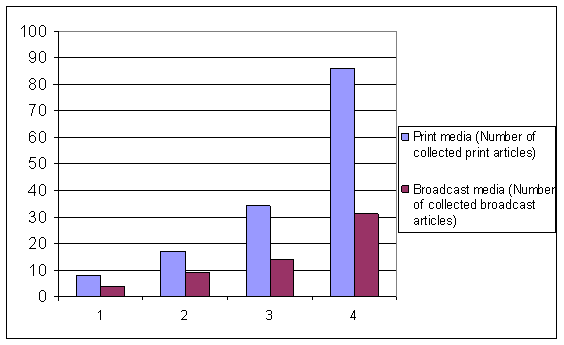
Although the result does not cover the entire media landscape of Bangladesh due to limited sampling and time constrain, it suggest a rapid increase in climate change stories as a broader trend. In this sample group, the numbers indicates for instance, that newspaper printed more than one story per day in an average in 2009 compared to 4 climate change stories per month in 2006, above 8 per month in 2007 and 18 per month in 2008. Television broadcasted more than 15 reports per month in the last year which was only 2 stories per month in 2006, more than 4 stories per month in 2007 and 7 stories per month in 2008.
The increased number of stories can be attribute more active Bangladeshi Ministry of Environment and Forest, Ministry of Food and Natural Disaster Management , a huge amount of accessible information at the global level, and the increase in environmental journalism capacity by Bangladeshi Journalists. Media leaders have found that climate change issues can attract more audience, which is also more supportive for environmental journalism.
Table 1 Number of collected print articles and collected broadcast item
Year |
Print media (Number of collected print items) |
Broadcast media (Number of collected broadcast items) |
2006 |
8 |
4 |
2007 |
17 |
9 |
2008 |
34 |
14 |
2009 |
86 |
31 |
Story Producers
Local reporters are producing more stories in both print and broadcast media while fewer broadcast stories are coming from wire services and fewer print stories are coming from foreign journalists. The trend suggests that local reporters have become more active in seeking stories for their products. Foreign reports come from various international print outlets (Time, some British and American journals and newspapers), while broadcast media is used from broadcasting channels (such as CNN, BBC, Al-Zazira) which are working in Bangladesh . Wire agencies such as AP, AFP, Reuters etc. are also sources for Bangladeshi media.
Table 2 .Story producers for print media
|
Year
|
|||||||
2006 |
2007 |
2008 |
2009 |
|||||
Number |
% |
Number |
% |
Number |
% |
Number |
% |
|
Local reporters |
4 |
50 |
10 |
58.9 |
19 |
55.9 |
52 |
60.5 |
Foreign reporters |
3 |
37.5 |
4 |
23.5 |
9 |
26.4 |
21 |
24.4 |
Wire services |
1 |
12.5 |
3 |
17.6 |
6 |
17.7 |
13 |
15.1 |
Total |
8 |
100 |
17 |
100 |
34 |
100 |
86 |
100 |
 Story producers
Table 3 .Story producers for broadcast media
Story producers
|
Year
|
|||||||
2006 |
2007 |
2008 |
2009 |
|||||
Number |
% |
Number |
% |
Number |
% |
Number |
% |
|
Local reporters |
3 |
75 |
6 |
66.7 |
8 |
57.1 |
20 |
64.5 |
Foreign reporters |
0 |
- |
1 |
11.1 |
2 |
14.3 |
5 |
16.1 |
Wire services |
1 |
25 |
2 |
22.2 |
4 |
28.6 |
6 |
19.4 |
Total |
4 |
100 |
9 |
100 |
14 |
100 |
31 |
100 |
The difference between “foreign reporters” and “wire services” is that foreign reporters consist of stories authored by named reporters while wire services consist of news from media organs and institutions
Geographical Focus of the Stories: Weak at the national level
Most of the stories collected tend to be locally focused (sub-national level). In print, 44 percent were local stories in 2009 up from 38 percent the previous year. In broadcast, local stories take up 33 percent of the total up from 28 percent in 2008. In both types of media, regional level coverage is the weakest geographical focus. It is observed that regional level climate change policies have not attracted a great deal of attention from the media.
Table 4 Geographical focus of print media
Geographical focus |
Year
|
|||||||
2006 |
2007 |
2008 |
2009 |
|||||
Number |
% |
Number |
% |
Number |
% |
Number |
% |
|
Local |
3 |
37.5 |
9 |
52.9 |
13 |
38.2 |
38 |
44.2 |
National |
3 |
37.5 |
5 |
29.4 |
11 |
32.4 |
26 |
30.2 |
Regional |
1 |
12.5 |
1 |
5.9 |
4 |
11.8 |
12 |
14 |
Global |
1 |
12.5 |
2 |
11.8 |
6 |
17.6 |
10 |
11.6 |
Total |
8 |
100 |
17 |
100 |
34 |
100 |
86 |
100 |
Table 5 Geographical focus of broadcast media
Geographical focus |
Year
|
|||||||
2006 |
2007 |
2008 |
2009 |
|||||
Number |
% |
Number |
% |
Number |
% |
Number |
% |
|
Local |
1 |
25 |
4 |
44.4 |
4 |
28.6 |
10 |
32.3 |
National |
1 |
25 |
2 |
22.2 |
6 |
42.8 |
9 |
29 |
Regional |
0 |
- |
1 |
11.1 |
2 |
14.3 |
3 |
9.7 |
Global |
2 |
50 |
2 |
22.2 |
2 |
14.3 |
9 |
29 |
Total |
4 |
100 |
9 |
100 |
14 |
100 |
31 |
100 |
Sources for Climate Change Stories
Government officials are the most numerous sources for climate change stories. In print, they contribute 35 percent of the stories compared to 39 percent in the previous year, and in broadcast 39 percent compared to 36 percent in 2008.
Local people, international experts, NGOs and scientists, however, are among the least used sources in Bangladeshi media. In print media, local people's voice are represented in 16 percent of the stories compared to 12 percent and in broadcast stories 10 percent, down from 14 percent in the previous year. For scientists, their contribution in print media is down to 9 percent from 16 percent in 2008 and similarly in broadcast media, 10 percent from 7 percent in the year prior. Part of the reason for their low contribution as sources may be that journalists do not contact local people and scientists directly. Instead, they often get their stories from various regional departments of the Ministry of Environment and Forest , Ministry of Food and Natural Disaster Management etc .
The sources classified in this study (Table 6 and Table 7) are not totally exclusive of one another. However, classification of sources has been done according to the following guidelines:
• Government officials are those, working in Government agencies such as in the Ministry of Environment and Forest , Ministry of Food and Natural Disaster Management , and various regional departments of these ministries .
• Scientists are those currently working on research and teaching in various research and teaching institutions. There are some government officials who are involved in research and teaching (in general only those whom have the designation of professor and associate professor and those whom have doctoral degrees)
• It should be noted that scientists and local people often send information to the ministry and regional departments of Ministry of Environment and Forest , Ministry of Food and Natural Disaster Management , from which in turn journalists get their information.
• International experts whom are working in various international NGOs in Bangladesh .
• “Others” include travelers, business people, etc who provide information.
Table 6 Sources of stories for print media
Sources
|
Year
|
|||||||
2006 |
2007 |
2008 |
2009 |
|||||
Number |
% |
Number |
% |
Number |
% |
Number |
% |
|
Gov. officials
|
4 |
50 |
7 |
41.2 |
13 |
38.2 |
30 |
34.9 |
NGOs
|
1 |
12.5 |
2 |
11.8 |
5 |
14.8 |
14 |
16.3 |
Scientists
|
0 |
- |
4 |
23.5 |
6 |
17.6 |
8 |
9.3 |
Local people
|
2 |
25 |
2 |
11.8 |
4 |
11.8 |
14 |
16.2 |
International experts
|
1 |
12.5 |
0 |
- |
3 |
8.8 |
8 |
9.3 |
Others
|
0 |
- |
2 |
11.7 |
3 |
8.8 |
12 |
14 |
Total |
8 |
100 |
17 |
100 |
34 |
100 |
86 |
100 |
Table 7 Sources of stories for broadcast media
Sources
|
Year
|
|||||||
2006 |
2007 |
2008 |
2009 |
|||||
Number |
% |
Number |
% |
Number |
% |
Number |
% |
|
Gov. officials
|
1 |
25 |
3 |
33.3 |
5 |
35.8 |
12 |
38.7 |
NGOs
|
2 |
50 |
1 |
11.1 |
3 |
21.4 |
8 |
25.8 |
Scientists
|
0 |
- |
1 |
11.1 |
1 |
7.1 |
3 |
9.7 |
Local people
|
1 |
25 |
2 |
22.2 |
2 |
14.3 |
3 |
9.7 |
International experts
|
0 |
- |
1 |
11.1 |
1 |
7.1 |
4 |
12.9 |
Others
|
0 |
- |
1 |
11.1 |
2 |
14.3 |
1 |
3.2 |
Total |
4 |
100 |
9 |
100 |
14 |
100 |
31 |
100 |
Topics of coverage: weak on the treaty progress and stronger on Mitigation issues
About one third of the climate change stories are about mitigation measures, with the year-on- year trend stabilizing in print and broadcast stories. However, the most visible change is that there is more interest in vulnerability stories; in percentage terms the number has more than doubled from 2006 to 2009 in print and in broadcast it is 26 percent where in 2006 it was zero percent. This increase in vulnerability interests reflects the reality of typhoons, cyclones, floods and droughts, in Bangladesh .
It is observed that the general sentiment of the Bangladeshi people is that there is a limited option in their capacity for increasing mitigation. There is a slight difference in the treatment of vulnerability stories and adaptation stories in this study topic classification (Table 8 and Table 9). Generally, adaptation stories address concerns about how to face disaster and vulnerability stories raise concerns about vulnerable group and their possible hardship.
Coverage of climate change treaty progress remains weak. In print stories they accounted for 6-8 percent in 2008 and 2009 and in broadcast media 7 and 3 percent. Our researchers observed that public is interested in the climate treaty and politics and in sequestration stories which are about government taking control of land and factories for capturing carbon.
Table 8 Topics of the stories for print media
Topics
|
Year
|
|||||||
2006 |
2007 |
2008 |
2009 |
|||||
Number |
% |
Number |
% |
Number |
% |
Number |
% |
|
Mitigation |
3 |
37.5 |
6 |
35.3 |
14 |
41.1 |
41 |
47.7 |
Vulnerability* |
1 |
12.5 |
4 |
23.5 |
11 |
32.4 |
25 |
29.1 |
Impact/ Adaptation |
2 |
25 |
2 |
11.8 |
5 |
14.7 |
10 |
11.6 |
Sequestration
|
1 |
12.5 |
3 |
17.6 |
2 |
5.9 |
3 |
3.5 |
Politics/ Treaty talk |
1 |
12.5 |
2 |
11.8 |
2 |
5.9 |
7 |
8.1 |
Total |
8 |
100 |
17 |
100 |
34 |
100 |
86 |
100 |
*Stories about vulnerable groups of people and possible hardship
Table 9 Topics of the stories for broadcast media
Topics
|
Year
|
|||||||
2006 |
2007 |
2008 |
2009 |
|||||
Number |
% |
Number |
% |
Number |
% |
Number |
% |
|
Mitigation |
2 |
50 |
3 |
33.33 |
5 |
35.7 |
14 |
45.2 |
Vulnerability* |
0 |
- |
2 |
22.22 |
4 |
28.6 |
8 |
25.8 |
Impact/ Adaptation |
2 |
50 |
2 |
22.22 |
2 |
14.3 |
6 |
19.4 |
Sequestration
|
0 |
- |
1 |
11.11 |
2 |
14.3 |
2 |
6.4 |
Politics/ Treaty talk |
0 |
- |
1 |
11.11 |
1 |
7.1 |
1 |
3.2 |
Total |
4 |
100 |
9 |
100 |
14 |
100 |
31 |
100 |
Subjects linked to climate change
Poverty alleviation and waste management received the most attention as issues linked to climate change in 2009. Nearly a quarter of the stories collected in 2009 related climate change to poverty issues, while a little over 17 percent linked to waste management. Population came in third at 10 percent and biodiversity at about nine percent.
Poverty and climate change as well as waste and climate change are becoming hot issues in the Bangladeshi media. The number of families becoming poor as a consequence of typhoons, cyclones, floods and droughts raises concern about immediate and long term effects of climate change. Industrial development without appropriate management of waste is seriously affecting people's lives. . It raises concerns about human behavior and climate change
Favorable Media Policy and Editorial Landscape
Ten government officials were interviewed: five from the Ministry of Environment and Forest and five from the Ministry of Food and Natural Disaster Management by using a semi semi-structured questionnaire. The results suggest a favorable climate for producing climate change stories. Policy makers want journalists to convey their messages to the public and they view journalists as key actors in the dissemination of climate change information to the public.
Interviews reveal also what and how Government responds to climate change through the answers of the representatives from these ministries. Twelve editors and chief reporters of the analyzed mass media participated in interviews with semi-structured questionnaires. It has been found that chief editors are well informed about climate change and they understand the journalists' difficulties in covering the issue and are willing to support journalists in their work accordingly.
What are their perceptions of the difficulties facing the journalists? They believe that their journalists should have the collaboration of scientists in reporting on climate change, particularly for the interpretation of the immediate consequences of natural disasters and the long term effects of climate change. Without close collaboration with scientists, they fear that their journalists will exaggerate the minor issues while forgetting the main messages of climate change. There is not yet a good mechanism for improving this collaboration.
CONCLUSION AND COMMENTS
Climate change coverage by the Bangladeshi media has steadily improved from 2006 to 2009. The number of print articles and broadcast items collected from one selected newspaper and one broadcast channel has roughly doubled each year. Print articles became triples between 2007 and 2008. The reason for this improvement could be attributed to:
Journalists acquiring more knowledge on climate change more skilled become writing issues of climate change and enthuse more in reporting on climate change as observed from interviews and focus groups with journalists.
The environment in which journalists work has become more favorable for covering climate change issues, due to the favorable attitudes of national and institutional policy makers, as observed in the documentary analysis and interviews of policy makers.
It is the view of researcher that scientists are more cooperative and willing to share scientific information with journalists, as observed from interviews and focus groups with scientists, but the fact is that this collaboration is still low.
In the opinion of scientists in interview, misconception and over-enthusiasm of journalists about climate change issues could make them exaggerate on climate change problems in their reporting. Scientists fear that journalists seek to please the curiosity of their readers while neglecting to communicate key scientific messages to the public. A solution to this possible mistake could be solved by closer cooperation between scientists and journalists.
REFERENCES
Anderson, A. (1997). Media, culture, and the environment. New Brunswick , New Jersey , Rutgers University Press.
Abarbanel, A. & T. McClusky (1950). Is the World Getting Warmer? Saturday Evening Post : 22-23, 57, 60-63.
Bangladesh Bureau of Statistics (1975 ). Statistical Yearbooks, Dhaka
Bangladesh Bureau of Statistics (2007). Statistical Yearbooks, Dhaka
Bangladesh Bureau of Statistics (2006) Statistical Yearbook, Dhaka .
Bell , A. (1994). "Climate of Opinion: Public and Media Discourse on the Global Environment." Discourse and Society 5(1): 33-64.
Bell , A. (1994). "Media (Mis) Communication on the Science of Climate Change." Public Understanding of Science 3: 259-275.
Berelson, Bernard (1954). Content Analysis of Communication Research. New York : The Free Press.
Boykoff, M. T. &J. M. Boykoff (2004). "Bias as Balance: Global Warming and the U.S. Prestige Press." Global Environmental Change 14(2): 125-136.
Brossard , D., J. Shanahan, et al. (2004). "Are Issue-Cycles Culturally Constructed? A Comparison of French and American Coverage of Global Climate Change." Mass Communication & Society 7(3): 359-377.
Carvalho A, Burgess J (2005) Cultural circuits of climate change in the UK broadsheet newspapers, 1985–2003. Risk Anal 25(6):1457
Carvalho, A. (2005). "Representing the politics of the greenhouse effect." Critical Discourse Studies 2(1): 1-29.
Cowen, R. (1957). Are Men Changing the Earth's Weather? Christian Science Monitor . Boston : 13.
DFPA .(2009). Dhaka Federal Press Association Report, Dhaka , Bangladesh .
DeFleur, Melvin L. and Everette E Dennis (1991). Understanding Mass Communication. First Indian Edition, Delhi : GOYLSaaB
Demeritt D. (2006). Science studies, climate change and the prospects for constructivist critique. Econ Soc 35(3):453–479
Govt. of Bangladesh (1998). Fifth Five-Year Plan Planning Commission, Dhaka .
Govt. of Bangladesh (2007). Bangladesh Economic Survey, Ministry of Finance, Dhaka .
Govt. of Bangladesh (2007). Bangladesh Economic Survey, Ministry of Finance, Dhaka .
Gelbspan, R. (1998). The Heat is On: The Climate Crisis, the Cover-up, the Prescription , Perseus Press.
Hilgartner S, Bosk CL (1988) The rise and fall of social problems: a public arenas model. Am J Sociol 94(1):53–78.
Henderson-Sellers, A. (1998). "Climate Whispers: Media Communication about Climate Change." Climatic Change 40: 421-456.
Kaempffert, W. (1956). Science in Review: Warmer climate on Earth may be due to more carbon dioxide in the air. New York Times . New York : 191.
Peterson, C. (1989). Experts, OMB Spar on Global Warming: 'Greenhouse Effect' May be Accelerating, Scientists Tell Hearing. Washington Post . Washington , D.C. : A1.
Luganda, P. (2005). Communication Critical In Mitigating Climate Change in Africa . Open Meeting of the International Human Dimensions Programme, Bonn , Germany .
Liverman, D. M. & D. R. Sherman (1985). Natural Hazards in Novels and Films: Implications for Hazard Perception and Behaviour. Geography, The Media and Popular Culture . J. Burgess and J. R. Gold. London , Croom Helm: 86-95.
McCright, A. M. & R. E. Dunlap (2003). "Defeating Kyoto : The Conservative Movement's Impact on U.S. Climate Change Policy." Social Problems 50(3): 348-373.
McManus, P. A. (2000). "Beyond Kyoto ? Media Representation of an Environmental Issue." Australian Geographical Studies 38(3): 306-319.
National Science Foundation (2004 ). Science and Engineering Indicators , National Science Board, National Science Foundation, Division of Science Resources Statistics. Arlington , VA.
New York Times (1932). Next Great Deluge Forecast by Science. New York Times . New York : 4.
Peterson, C. (1989). Experts, OMB Spar on Global Warming: 'Greenhouse Effect' May be Accelerating, Scientists Tell Hearing. Washington Post . Washington , D.C. : A1.
Pew Research Center for People and the Press (2006). Biennial news consumption survey.
Project for Excellence in Journalism (2006). The State of the News Media 2006.
http://www.stateofthenewsmedia.org/2006/index.asp (accessed on 25 October 2010).
Schneider, S. S. (2001). "A Constructive Deconstruction of Deconstructionists: A Response to Demeritt." Annals of the Association of American Geographers 91(2): 338-344.
Shabecoff, P. (1988). Common Ground Seen on Warming of Globe. New York Times . New York : A8.
Trumbo, C. (1996). "Constructing Climate Change: Claims and Frames in U.S. News Coverage of an Environmental Issue." Public Understanding of Science 5: 269-283.
Ungar, S. (1992). "The Rise and (Relative) Decline of Global Warming as a Social Problem." The Sociological Quarterly 33(4): 483-501.
Weingart, P., A. Engels, et al. (2000). "Risks of Communication: Discourses on Climate Change in Science, Politics, and the Mass Media." Public Understanding of Science 9: 261-283.
Weisskopf, M. (1988). Two Senate Bills Take Aim at 'Greenhouse Effect'. Washington Post. Washington , D.C. : A17.
Wilson, K. M. (1995). "Mass Media as Sources of Global Warming Knowledge." Mass Communications Review 22(1&2): 75-89.
Wilkins, L. (1993). "Between the Facts and Values: Print Media Coverage of the Greenhouse Effect, 1987-1990." Public Understanding of Science 2: 71-84.
Wimmer, Roger D. and Joseph R. Dominick (1987). Mass Media Research. Second Edition, California : Wadsworth, Inc.
ABOUT THE AUTHOR
The author is Lecturer, in the Department of Mass Communication and Journalism, university of Rajshahi , Rajshahi- 6205, Bangladesh
E-mail: mcmahabub@yahoo.com
Copyright © 2006 Global Media Journal. All rights reserved.