|
|
|


Home | Current Issue | Editions | Archives | Contact Us

Volume 1, Issue 1 (Spring 2008)
Government Influence on Print Media Content in Pakistan :
Pakistani Journalists' Perspective
Saqib Riaz
Abstract
There are a number of studies on media effects and communication process throughout the world but research on media content is limited. Most of the media researchers paid attention to studies about media effects. Most books on mass media research cover mainly studies dealing with the process through which the audience receive mass media content or with the effects of content on people and society. But it is equally important to understand the influences that shape content. This study investigates the governmental influence on print media content in Pakistan due to its advertising and economic power, through perceptions of journalists working in national dailies of Islamabad . This is the first ever study of its kind conducted in Pakistan . The results of the study show that journalists are of the view that the government has a very strong influence on media content in Pakistan .
Perhaps Pamela Shoemaker (1994) is the first scholar who presented the idea that media not only influences target audiences but it, itself is influenced by a number of factors. Shoemaker and Reese presented a model of theoretical approaches about influences on mass media content. These approaches are following.
• Content is influenced by media workers' socialization and attitudes.
• Content is influenced by media routines. These routines are the ways in which media workers and their companies organize their work.
• Content is influenced by the ideology of those who are in power in the society.
• Content is influenced by other social institutions and forces. This approach suggests that economic and cultural forces and audience determine content. (Shoemaker & Reese, 1994, pp.4-5). This approach is the basic idea of this research and the whole research revolves around this approach.
Media and Reality
Do the media represent reality? This is an important question. In other words we can ask the question how closely the media world actually resembles the world outside. There are two concepts in the answer of this question. First concept is that the media are passive transmitters of events and the second concept is that the media play active role in manipulating reality. The first concept is called as ‘media as channels', which says that the media are nothing more than pipes through which bits of information flow. This model suggests media as neutral transmitters of messages, linking senders to receivers. Such a model assumes that nothing important happens to the message while it is in the channel. The Neutral Journalist theory and the Null Effects Model support this concept. This concept can be summarized in the words that media content is assumed to provide an accurate and representative portrait of the world. The other concept is about manipulation of reality. According to this concept reality is necessarily manipulated when events and people are relocated into news or prime time stories. People can be portrayed with different labels (for example same person can be labeled as freedom fighter or terrorist). Media content highlights certain elements over others. Symbolic environment can be created by giving greater prominence to some events over others. Pictures can also be distorted, by cropping, angling and short selection. It is possible to depict a subject favorably or unfavorably by choosing different camera perspectives. The first concept has been absolute while the second concept about manipulation of reality is accepted throughout the world. Our daily media experiences are full of examples to prove this concept accurate.
Political Economy View
The concept of political economy has a focal point in this research. Media protect interests of those who own and control media. Hence the role of owners and proprietors has become most important in a media organization.
Ownership is considered as the primary means through which the ruling class exerts control over media institutions. Ultimately, a political economy approach leads us to expect that capitalist owned media decisions and content will tend to favor those with economic power. From a political economy perspective, changes in media ownership do not greatly alter power relations, because each owner acts in a manner consistent with the interests of capital.
Altschull (1984) has proposed a framework for studying variations within owner control of the media. Like the political economists, Altschull starts with the assumption that media reflect the ideology of those who finance them, or “pay the piper.” He outlines four sources of media support; (1) under the “official” pattern, media are controlled by the state (such as in many Communist countries), (2) in the “commercial” pattern, media reflect the ideology of advertisers and their media-owning allies, (3) under the “interest” pattern, media content reflects the ideology of the financing group, such as a political party or religious group, and (4) in the “informal” pattern, content reflects the goals of individual contributors who want to promote their views. The mix of these financing patterns varies from country to country and over time within countries. (Altschull 1984, p.254)
This framework reminds us that whether the press is called free or state controlled, it reflects the ideology of the paymaster.
Primacy of Economic Goals
In the words of Shoemaker and Reese (1994), to make a profit is the primary goal of a media organization. For most of the media organizations the primary goal is economic. Other goals are built into this overarching objective, such as to produce a quality product, serve the public, and achieve professional recognition. In unusual cases, the owner of an organization may choose to make the economic goal secondary. If professional objectives are to be met, the organization obviously cannot afford to ignore the economic goal indefinitely. (Shoemaker & Reese, 1994, p.34)
Media sociologists view economic considerations as constraints on news work and, thus, as indirect influences on editorial decision. News workers find it hard to relate audience demand and advertising revenue to the nature and quality of news coverage. Most media organizations want to make money. Sigal (1973) concludes on the basis of his research that profit maximization provides no guideposts, only constraints. These economic constraints establish the parameters within which gatekeepers must contend for scarce resources (Sigal,1973). Here lies another fact too. Print media organizations select news items of greater audience appeal to attract maximum readers to buy the newspaper. The purpose of this practice is to increase circulation size. Newspapers of larger circulation attract advertisers to advertise their products. Hence advertising revenue increases. The same practice is adopted by the electronic media in the whole world.
Shoemaker and Reese (1994) discussed the changes in media organizations in these words:
“Economic priorities have changed the whole infrastructure of the print media industry. Now the editors have become managers or the managers have become editors. In both situations, media content is influenced due to economic priorities. Economic pressures have forced news organizations to revise their structure to favor audience-based routines. Installing mangers in positions formerly filled by news people makes a strong impact on content.” (Shoemaker & Reese, 1994, pp.134-135)
Power of Advertising
Advertising income is necessary for the survival of mass media. The bigger the advertiser, the more power it has. Multinational manufactures and advertising agencies have enough power to suppress public messages they do not like.
Tobacco companies have made the most attempts to control mass media content, although some of the controls may be self imposed by the media themselves in an attempt to ward off censure by tobacco companies. A researcher Kessler (1989) investigated the editorial and advertising content of six major U.S. women's magazines to see whether the presence or absence of tobacco advertising would be related to the amount of editorial content about the health hazards of smoking. Although women's health was major topic in the magazines, there was almost no editorial content about any health hazard of smoking (Kessler, 1989, pp.316-322). Tobacco companies have a long history of influencing media content. In 1957 the world's largest circulated magazine Reader's Digest published an article about the health effects of smoking. Ads were subsequently withdrawn by the American Tobacco Company (Weis & Burke, 1986, p.60).
Government-Media Relationship:
The Government- Media relationship is a burning and debatable topic that has attained a great attention in the field of media studies throughout the globe. The concept of the Freedom of Press is also under discussion especially in the developing countries. A number of researches have been conducted in this regard. This study elaborates the situation of the press-government relationship in Pakistan . However, a brief description about worldwide situation of media freedom is elaborated in the following lines.
A famous American website has described the media-government relationship in U.S in these lines.
“Despite the claims that the press has an adversarial relationship with the government, in truth U.S. media generally follow Washington 's official line. This is particularly obvious in wartime and in foreign policy coverage, but even with domestic controversies, the spectrum of debate usually falls in the relatively narrow range between the leadership of the Democratic and Republican parties” (www.fair.org).
Governments of almost all countries of the world exert controls over mass media. In countries where the media are largely privately owned, controls are exerted through laws, regulations, licenses and taxes. In countries where the media are primarily government owned, government control is exerted through media financing (Janus, 1984, p.57).
In a research fifty eight governments' relationships with their mass media were reviewed. It was found that the United States , Canada and Greece have the least inclination towards press control. At the time of the study, those governments that most controlled their press included China , Germany , Iraq , Syria , Tunisia , Cuba and Peru . (Merrill, 1988, p.839).
SITUATION IN PAKISTAN
In Pakistan , electronic media is almost totally owned, controlled and financed by the government. Such a strict control is exercised by the government over radio and television in Pakistan that not a single word can be broadcast against the government on radio and television. This is not true only for the present government but every government adopted the same policy to use electronic media for its own publicity and projection. Hence the media has become the tamed instrument of the government.
In Pakistan the print media is privately owned and the govt. influence is indirect. It is in a way concealed rather than open. The government can use a number of techniques and tools to influence print media. Financial benefits are offered to owners and chief editors of the newspapers, and their businesses are protected by the govt. agencies, if they favor and support the govt. Otherwise they are deprived of these benefits. Obviously no body will make a deal of loss. Foreign trips are also a shape of bribe to get the support of the journalists. Heavy gifts are also presented to media people. Precious plots are allotted to journalists. In February 2004, Government has invited applications from journalists to allot them plots in Islamabad , the most precious city of the country. (Daily Nawa-i-waqt, Feb.24 th , 2004) Hundreds of plots are reserved for journalists and the price of these plots varies from three million rupees to six million rupees. This is a huge governmental bribe to purchase favor of the journalists. These plots have been offered to journalists at a time when the government was facing a great criticism by Press on the issue of fight against terrorism and Wana operation against Al-Qaida to gain the sympathy of the American government.
Governments try to purchase the loyalties of the affluent and influential journalists. Big amounts are presented to journalists by government agencies. (A lot of journalists are enjoying this facility by selling their consciousness.) If some journalist does not agree to go along them, he is harassed by the government agencies. He is threatened and warned by them and is forced to change his/her attitude. A number of journalists have been kidnapped and beaten by the government secret agencies. Their crime was that they did not support the government. In almost every regime, opponent writers, journalists and editors had to face a lot of problems. The governments even don't hesitate to cancel the declaration of the newspapers and magazines, which criticize them and don't favor their policies.
Among all these influences, the influence of the government as advertiser is the most effective one on media content. In Pakistan , the government has the most powerful ‘weapon' of advertisements. The government uses this ‘weapon' to achieve the desired goals and the flow of government advertisements always remains towards the newspapers that favor and support the government policies and decisions. The newspapers, which criticize the government policies, will have to deprive of the government ads. No newspaper will choose the way of loss. More or less every newspaper is favoring the government to get its share in advertisements. There is no other way to meet the expenses of publishing and to earn a profit. Readers' subscription cannot meet the expenditures of a newspaper.
The government's capability to pressure newspapers economically increased considerably after 1972. For one thing, the scarcity of newsprint as a consequence of the loss of East Pakistan in 1971, has invested the government with the sole authority to allocate non-conformist newspapers. For another, the Bhutto regime's nationalization policy increased the amount of government advertising to 65 % of the total in the country. A newspaper can earn this necessary government advertising on the basis of its “constructive policy”. (Mujahid, !994, p.500)
At the central level, Press Information Department (PID) is responsible for the publicity and projection of the Government of Pakistan. The weapon of advertisements remains in the hands of PID. In provinces, Directorates General of Public Relation (DGPR) does this job. During the military governments, Inter Services Public Relation (ISPR) also does this job. Hence thousands of employees of these organizations are busy day and night, to portray and present the every possible positive image of the government. It is important to note that the government organizations and institutes have no power to release an advertisement directly to the media organizations. They send their ads to the PID or DGPR (in case of provincial government) along with a recommended list of newspapers, according to their allocated budget. The PID or DGPR issues these ads to the media organizations. At this stage PID or DGPR has powers to add or delete the name(s) of some other newspapers. This is the point where the government bargains with the media organizations, especially newspapers. No doubt the newspapers circulation size is a strong factor to get a share of these ads, but favoring the government policies has also become an unwritten criterion of issuance of the government advertisements.
A Bird's Eye view of Pakistani Journalism
In Pakistan , Jang group is the largest media group of the country. The largest widely circulated Urdu newspaper daily “Jang” and the second largest widely circulated English newspaper daily “The News” are owned and controlled by this group. Nawa-i-waqt group is the second largest conglomerate of the country that publishes the second largest widely circulated Urdu newspaper daily “Nawa-i-waqt” and the third largest widely circulated English newspaper daily “The Nation”. The third largest media group is Herald group that owns the largest widely circulated English newspaper daily “Dawn”. This group does not publish any newspaper in Urdu, the national language of the country. The newspapers of the above mentioned three largest media groups are published simultaneously from a number of big cities including federal capital Islamabad and all the four provincial capitals. The owners of these media groups are billionaires.
In addition to these big conglomerates, a number of other prominent and widely circulated newspapers are also published from the big cities of the country. Daily Pakistan Observer, Frontier Post, Business Recorder, Statesman, Baluchistan Times are some of the most prominent English newspapers while daily Khabrain, Aousaf, Express, Pakistan, Din, Al-Akhbar, Asas, and Insaf are included in the list of famous Urdu newspapers. In addition to these national newspapers, a reasonable number of regional and local newspapers are also published from nooks and corners of the country.
While the government says there are over 20,000 dailies, weeklies, monthlies and quarterly newspapers in publication, practically 75 percent of them have no presence on the newsstands. These are dummy papers which still get advertisements from the government. Most of them do not have any working journalist, and are often brought out by two or three computer operators. Yet, dummy newspapers are issued millions of dollars worth of government ads every year. The basic aim and purpose of these dummy newspapers is only to earn money through advertisements, mostly government advertisements .
Research Design
Keeping in view the nature and requirement of this study, survey research was adopted to explore and examine the journalists' perception about relationship between government advertisements and coverage given to government. A survey of 120 journalists from Islamabad was conducted. The respondents were selected through random sampling out of five hundred journalists registered in Islamabad Press Club, the representative body of the journalists of Islamabad . The journalists of the other cities of Pakistan were not included in the study due to limitations of time and resources. Almost ten respondents were selected from big newspapers and five from small newspapers having less circulation size. The questionnaires were filled out by the journalists, both reporters and sub-editors through personal meetings. First, the questionnaires were handed over to them and after a few days, these were got collected from them. Out of the sample universe of 120 journalists, 103 responded and handed over their filled questionnaires to the researcher. The journalists that were not included in the categories of reporter and sub-editor were named as ‘others'. The questionnaire was written in English because almost all of the Pakistani journalists can understand English very well.
Research Question
What is the journalists' perception about government influence on print media content in Pakistan due to governmental advertisements?
Hypothesis
The greater the amount of government advertisements paid to newspapers, the greater will be the pro-government coverage (in journalists' perceptions).
Results
1. Expenditures from Sale of Newspaper
Newspapers earn money to meet their expenditures from different sources. One of these sources is the money received by the sale or subscription of the newspaper. The respondents were asked: “To what extent your newspaper manages expenditures from its sale?” The responses of the respondent journalists can be seen in the second column of the table 1.
Table 1: Journalists' responses about Expenditures from sale of newspaper, Survival on ads, Govt. Influence on Media Content and Govt. Interference in freedom of Expression.
|
Expenditures from Sale of Newspaper |
Survival on ads |
Govt. Influence on Media Content |
Govt. Interference in Freedom of Expression |
Very Greatly |
2% |
45% |
34% |
16% |
Greatly |
17% |
33% |
43% |
31% |
To some extent |
50% |
18% |
17% |
33% |
Not at all |
15% |
4% |
3% |
13% |
Don't Know |
16% |
0 |
3% |
7% |
As apparent from the table, only two percent respondents were of the view that the newspapers meet their expenditures very greatly from the sale of news paper. Seventeen percent replied ‘greatly', 50 percent said ‘to some extent', 15 percent told ‘not at all' while 16 percent simply said ‘they don't know'. Majority of the respondents (50 percent) were of the view that newspapers manage their expenditures to some extent from the sale of the newspapers.
2. Newspapers' Survival on Advertisements
Advertising is a crucial source of income for the whole media industry. The respondents were asked, “To what extent do you think the newspapers depend wholly on advertisements?” The responses of the respondents in this regard are clear in the third column of the table 1.
According to the findings, 45 percent respondents said very greatly, 33 percent said greatly, 18 percent replied ‘to some extent' while four percent said ‘not at all.' The findings are in favor of the hypotheses of the study. If we make a total of greatly and very agreed responses, then we can say that 78 percent respondent journalists believed that newspapers survive wholly on advertisements.
3. Government Influence on Media Content
This is the most important area of this study and perhaps, this was among the most important questions of the questionnaire, “How far do you agree that government influence media content through the provision of advertisements?” The column four of the table 1 reveals journalists' responses on government influence on media content.
Data given in the figure 3 shows that 34 percent journalists highly agreed, 43 percent journalists agreed, 17 percent agreed to some extent with the statement that government influence media content through the provision of advertisements. Only three percent journalists disagreed with the statement while three percent journalists were not aware of the phenomenon and they said, ‘don't know'.
If we make a total of the responses of agreed and highly agreed, then we can say that 77 percent journalists accept and admit that the government influence media content through the provision of advertisements. The hypothesis of the study is strengthened by these findings.
4. Government Influence on Media Content through Funds, Donations, etc.
Government influence media content by using a number of means. Funds, donations, foreign trips, gifts, plots, etc. are some of the shapes of governmental bribe to influence media content. During the survey research of the study, the respondents were asked about the influence of these things on media content.
Twenty nine percent journalists highly agreed, 47 percent agreed, 17 percent agreed to some extent while five percent did not agree at all. Three percent journalists replied they did not know any influence of these factors on media content. By mixing the first two categories, we can say on the basis of the findings that 76 percent journalists agreed that media content is influenced by the government through funds, donations, foreign trips and plots etc. Their opinion indirectly strengthens the hypothesis of the study.
5. Directions by the Newspapers' Management
Sometimes, newspaper managements direct their employee journalists to favor the government for the sake of advertisements. The respondent journalists were asked, “How far have you been directed by the management of your newspaper to favor the government on political issues?” Three percent journalists replied that they were directed very greatly, 15 percent said that they were directed greatly, 41 percent answered that they were directed to some extent, 40 percent said that they were directed not all by the management of their newspaper to favor government on political issues.
The management of a newspaper does not openly direct their employees about any policy but the policy is implemented through gatekeepers of the organization. These are usually editors and news editors, and these are only a few. A lot of journalists have even no interaction with their management. This is the reason why only 18 percent said that they were directed greatly or very greatly by the management to favor government. 40 percent journalists said that they were directed not at all by the management to favor the government.
6. Minimizing Opposition Coverage by Releasing Advertisements
Sometimes, governments release advertisements to minimize the coverage of opposition activities or some disastrous event news to protect its own image. The question was asked, “How far the coverage of special issues (like terrorism, opposition activities or anti-government activities) is minimized by the release of special publicity ads?” Ten percent respondent journalists replied, ‘very greatly', 11 percent said, ‘greatly', 57 percent answered, ‘to some extent', 15 percent replied ‘not at all' while eight percent journalists told that they did know the situation.
The practice of minimizing special events' news varies in different newspapers and it occurs seldom. However, 21 percent journalists said that it happens greatly (including very greatly) while 57 percent journalists said that it happens to some extent. The findings are partially in favor of the hypothesis of the study.
7. Relationship between Government Ads and Press Coverage
This relationship is the actual relationship to be discovered through hypotheses of this study. Two questions were asked from the respondents in this regard. First question was: “The newspapers that are gaining more government advertisements give more positive coverage to the government. To what extent do you agree?” The following figure shows the responses of the respondents.
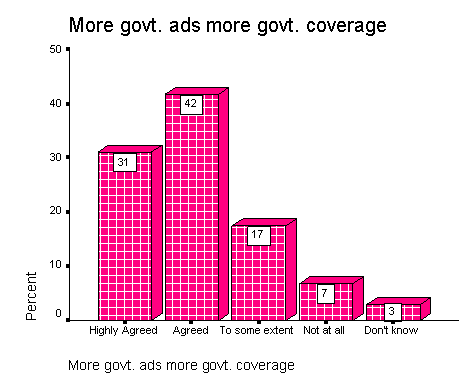
According to the results, 31 percent journalists highly agreed, 42 percent journalists agreed while 17 percent agreed to some extent with the statement that the newspapers that are gaining more government advertisements give more positive coverage to the government. Only seven percent respondents did not agree with statement while three percent respondents did not know about the phenomenon.
By mixing the opinions of the categories of highly agreed and agreed, it can be said on the basis of the research findings that 73 percent journalists agree with the above mentioned statement and hence this finding approves the hypothesis of the study: The greater the amount of government advertisements paid to the newspapers, the greater will be the pro-government coverage.
There was another supplementary question regarding negative coverage of the government. The respondents were asked, “How far do you agree that newspapers that get less government ads give less positive coverage and more negative coverage to the government?” The responses were a little different from those of the first question. According to the results, 15 percent journalists highly agreed, 40 percent journalists agreed, 30 percent agreed to some extent with the statement asked in the question. About 11 percent journalists did not agree with the statement while four percent respondents told that they did not know the answer.
The answer is a little different from the earlier one. Here, by mixing the first two categories, we can say that 55 percent journalists are agreed with the statement while 30 percent are agreed to some extent with the statement that newspapers that get less government ads give less positive coverage and more negative coverage to the government. The findings are in favor of the hypothesis of the study.
8. Government Interference in Freedom of Expression
The structure of this study was built to investigate the level of press freedom in Pakistan . The respondents of the survey research were asked: How far government agencies interfere into your freedom of expression? The respondents' responses are shown in the column 5 of the table 1.
Press Freedom is a debatable topic and is always under discussion worldwide. The column 5 of the table 1 elaborates the results of the survey research in this regard. Sixteen percent respondent journalists replied that government agencies interfere into freedom of expression very greatly. Thirty one percent replied, ‘greatly', 33 percent said, ‘to some extent', 13 percent journalists said, ‘not at all' while seven percent journalists told that they did not know the phenomenon.
Data analysis shows the picture that only a minority (13 percent) of the journalists believe that government agencies' interference in freedom of expression is not at all. Majority of them (47 percent by totaling the first two categories) believe that government agencies interfere into freedom of expression greatly while 33 percent journalists are of the view that this interference is to some extent. The findings support the hypothesis of the study.
9. Stoppage of Government Advertisements
Stoppage of government advertisements to some newspapers seldom occurs but it occurs. Usually it occurs in some unusual circumstances when a newspaper decides to oppose the government at any price, even at the price of the stoppage of government advertisements. The respondents were asked: In your experience as a media practitioner, how often did it happen the stoppage of governmental ads when coverage is not given to the level of expectations? According to the results this event did not happen in the professional life of 48 percent respondent journalists. However, it happened one time in the professional life of 20 percent respondents and two times in five percent respondents. It happened three times in the professional career of three percent respondents and more than three times in the professional life of 24 percent respondent journalists.
The variation in the responses of the journalists relate with the experience of the journalists. Majority of the respondents (48 percent) in whose professional lives this practice did not happen, are junior journalists with comparatively less experience while the 24 percent respondents are senior journalists with a vast experience who said that this event happened in their professional lives more than three times.
10. Effect of Ads Getting Race on Standard of Journalism
The respondents were asked: How far do you agree that the race for getting maximum government ads has affected the standard of journalism in the country? According to findings, 46 percent journalists are of the view that the race for getting maximum advertisements has affected the standard of journalism very greatly. A reasonable number of journalists (34 percent) said that this effect was greatly. Sixteen percent journalists told that the standard of journalism had been affected to some extent by the ads getting race. Five percent journalists disagreed with the statement by saying that there is not at all any effect of the ads getting race on the standard of journalism.
By totaling the number of the responses of the first two categories, it is hereby proved by the survey research that in the perception of 80 percent journalists, the race for getting maximum government ads has affected the standard of journalism in the country.
Conclusion
Findings of the study are in the hypothesized direction and with a few exceptions, the hypothesis of the study has been proven. It can be concluded on the basis of this research that as per journalists' perceptions, the government has a strong influence on print media content in Pakistan due to its advertising power. In their perception, due to economic priorities and financial expenditures, newspapers have no way to ignore the advertising income. Therefore, they have to obey each and every desire of the government because of being the biggest advertiser of the country. Government advertisements are a big weapon in the hands of the government which are issued to those newspapers which favor the government. The governments, usually, have no courage to tolerate criticism. Therefore, the newspapers which criticize government on its policies have to deprive of the government advertisements. Obviously, no newspaper can make a deal of economic loss. This is the reason why newspapers give more and more positive coverage to the government. The study has proven that the journalists are of the viewpoint that the newspapers that get more government advertisements give more positive coverage to the government. The study also siggests that the journalists believe that the government has always damaged press freedom in the country. It can also be concluded that press freedom does not exist in the country and the government claims in this regard are just claims, and the journalists themselves are witness of this reality.
The results are of great concern for the society, government and the media industry. The results need the attention of the government as well as for the international organizations working for the freedom of press.
References:
Altschull, J. Agents of Power. (1984). NY: Longman.
http://www.fair.org/ media-woes/ official-agenda.html
Janus, N., “Advertising and the Creation of Global Markets”, The Critical Communication Review, volume 3, (1984).
Kessler, L. “Women's Magazines' coverage of Smoking related health hazards”, in Journalism Quarterly, 66 (1989)
Merrill. J.C., “Inclination of Nations to Control Press”, Journalism Quarterly. 65 , (1988).
Mujahid, S. (1994) “Press in Pakistan ” in Newspapers in Asia, Edited by John Lent, Kuala Lumpur : Heinmann. Asia , p.500.
Nawa-i-waqt daily, “Plots for Journalists”, February 24, 2004 .
Riaz, S. (2004) , Government Advertisements: Influence on Print Media Content, p.50. Lahore : Urdu Science Board.
Shoemaker, P.J. and Reese, S.D. (1994).Mediating The Message, NY: Longman.
Sigal, L.V., Reporters and Officials. (1973). D.C. Heath: Lexington , M.A.
Weis, W. L. & Burke, C., “Media Content and Tobacco Advertising” in Journal of Communication, 36 (1986).
Copyright © 2006 Global Media Journal. All rights reserved.