|
|
|


Home | Current Issue | Editions | Archives | Contact Us

TREATMENT OF IRAQ ISSUE BY PAKISTAN ENGLISH PRESS
Dr. Muhammad Nawaz Mahsud
Noman Yaser
Abdul Rehman Qaiser
ABSTRACT
This article describes the treatment of Iraq issue by the editorial pages content of two English dailies. Total 122 newspapers content are analyzed. The results show significant difference between the spaces given by the papers editorial pages content published on the Iraq issue The findings show that daily ‘Dawn' has given significant space to editorials, articles, and letters to the editor than daily “The News.' The review of the results regarding both the papers for and against treatment of the selected set of issues shows that ‘The News' has devoted significant unfavorable space to the issue of Saddam and civilian killing than daily ‘Dawn' unfavorable space given to the same issues. The overall comparison of the treatment of the selected issues illustrates that daily ‘ Dawn' has given somewhat favorable space to the issues of Saddam Hussain and Iraq Government while daily ‘The News' has given somewhat favorable space to the US Policy and the Democrat Policy than daily ‘Dawn.' The findings further show that daily ‘ Dawn' has spared significantly more space to the neutral news items of all the selected issues than daily' The News' while ‘The News' has spared more unfavorable space to almost all the selected issues than the ‘Dawn.
STUDY'S BACKGROUND
The Iraq issue involved unprecedented media coverage. The media coverage itself became a source of media controversy, with accusations of bias despite the fact that the U.S. government acknowledges the lack of a link between Hussein and Al-Qaeda, and the absence of weapons of mass destruction. After the invasion, the editor of the New York Times apologized for its coverage of Hussein's alleged weapons programs, acknowledging that "we wish we had been more aggressive in re-examining the claims related to Iraqi weapons programs as new evidence emerged. During the invasion, critics argued that the mainstream media unduly focused on optimistic events, such as the toppling of a Saddam's statue in Firdos Square , which was staged with the help of the U.S. military forces, thus downplaying more negative news developments. In particular, the mainstream media has been criticized for underreporting news about Iraqi civilian casualties (cited at www.wikipedia.org ).
The situation in Baghdad and several provinces is alarming. The level of violence is high and growing. There is great suffering, and the daily lives of many Iraqis show little or no improvement. The ability of the United States to influence events within Iraq is diminishing. Many Iraqis are embracing sectarian identities. It runs along the sectarian fault lines of Shia and Sunni Islam, and of Kurdish and Arab populations. It has the world's second-largest known oil reserves. Most countries in the region are not playing a constructive role in support of Iraq , and some are undercutting stability. Iraq is vital to regional and even global stability, and is critical to U.S. interests. It is now a base of operations for international terrorism, including al Qaeda. Events in Iraq have been set in motion by American decisions and actions. An assessment of the security, political, economic, and regional situation follows (all figures current as of publication), along with an assessment of the consequences if Iraq continues to deteriorate, and an analysis of some possible courses of action (Baker and Hamilton, 2006)
During the last quarter of 2006, perceptions about the civil war in Iraq drastically changed. In September, President George W. Bush was finally persuaded that things were not going well and agreed to a review of his administrative policy. In early December this mood of pessimism was augmented by the publication of the Iraq Study Group (ISG) report, co-chaired by James Baker and Lee Hamilton. The report did not mince its words: “The situation in Iraq is grave and deteriorating. There is no path that can guarantee success.” This in turn forced Bush to admit ‘it's bad in Iraq '. ‘I understand how tough it is. And have been telling the American people how tough it is. And they know how tough it is. Finally, in January after the devastating mid-term congressional election results, Bush announced that ‘the situation in Iraq was unacceptable'; ‘we need to change our strategy'.
The possibility that Saddam Hussain might develop weapon of mass destruction and pass them to terrorist was the prime reason Mr. Bush given in 2003 for ordering the invasion on Iraq . We have also discovered through intelligence that Iraq has a growing fleet of manned unmanned aerial vehicles that could be used to disperse chemical or biological weapons across border. As intelligence gathered by this and other governments leaves no doubt that the Iraq regime continues to possess and conceal some of the most lethal weapons ever devised, cited at: www.fair.org ). What makes Iraq the subject of intense concern, as Mr. Bush noted, is Mr. Saddam Hussain disobedience of the Security Council's longstanding instructions to dismantle Baghdad 's nuclear weapons program and to eliminate all its biological and chemical weapons and the material used to make them. The unwavering goal is to disarm Iraq , enforcing a string of previous Security Council resolutions that Baghdad has contemptuously ignored. The cost of letting that happen has been diminished authority of the United Nations and a growing danger that Iraq's unconventional weapons will be used in war or passed on to terrorists (cited at: www.msnbc.msn.com ).
One catastrophic aspect of the Iraq war that has gone into the background is the irreparable damage done to Iraq 's infrastructure and loss to the Arab people as a whole is often buried in the news about the human tragedy in Iraq . The death of a minimum 300,000 civilians, the flight of at least two million Iraqis to neighboring countries, especially Syria, and the constant rise in the number of internal refugees. Now we know that there is hardly any government in Baghdad worth its name. It does not command the people's confidence because most Iraqis view it as an American puppet. Iraq seems to be splitting on sectarian and ethnic lines. Kurdistan is already virtually autonomous. The amusing part of the bill is that, even if the president issues such a certificate, the withdrawal must in any case begin in March 2008 and be completed by September. The dilemma is President Bush's. If he refuses to pull his troops out, the anarchy and violence will continue; if he withdraws, the Iraqi government will simply be wiped out in a matter of days, and Iraq will be under the control of religious extremists .
The United States has made a massive commitment to the future of Iraq in both blood and treasure. Countless Americans have lost their lives serving in Iraq . To date, the United States has spent roughly $600 billion on the Iraq War, and costs are running about $8 billion per month. In addition, the United States must expect significant “tail costs” to come. Caring for veterans and replacing lost equipment will run into the hundreds of billions of dollars. Estimates run as high as $2 trillion for the final cost of the U.S. involvement in Iraq . Despite a massive effort, stability in Iraq remains elusive and the situation is deteriorating. The Iraqi government cannot now govern, sustain, and defend itself without the support of the United States . Iraqis have not been convinced that they must take responsibility for their own future. Iraq 's neighbors and much of the international community have not been persuaded to play an active and constructive role in supporting Iraq . The ability of the United States to shape outcomes is diminishing. Time is running out (Baker and Hamilton, 2006).
It is a war of blood for oil. People are being killed on daily basis including Americans and allied forces' soldiers. Death sentence of Saddam Hussain led the way to civil war, intersect terrorist activities. As a Muslim country involvement in this false expedition, role of the press in this issue will be a matter of great interest. Expected change in policy after the winning of election by democrats has made this issue more interesting for study. Another important development is the internal pressure of the American nation to withdraw from Iraq is getting strength. Announcement of the withdrawal or reduction in army by member of Allied Forces has given this issue another new outlook. That is why this study seeks to explore Pakistan English press editorial treatment of Iraq issue to determine their role in term of favorable, unfavorable and neutral stance on the issue.
The Role of Press , “Role of the Press” writes, in wartime the press is always part of the problem. When the nation goes to war, the press goes with it ( www.mediaed.org ). Critics agree the role of the press in the war against Iraq has been to deter dissenting opinions and to be "cheerleaders" for the ongoing battle. Any attempt at objectivity was abandoned once the bombs started dropping and was replaced with one-sided and overly patriotic sentiments, which closely resemble the administration's stance on the war. Transfixed with tactical maneuvers and overall strategies inside Iraq , media outlets rarely mention that this entire war by the U.S. government and its British accomplice is a flagrant violation of international law.” In an attempt to decode the reasoning for unbalanced news coverage of the war and the lack of alternative voices, Solomon (2003) believes that the White House has been sending a message to working journalists since September 11th: Exercise too much independence and you'll risk accusations of giving aid and comfort to the terrorist enemy. In other attempts by media critics to define the role of the press during military conflict, many believe that there is loyalty by the press to the administration and vice versa because the two are one in the same: the wealthy and the elite. "The media lines up with the government on fundamental matters...because the media themselves are huge corporations that share the same economic and political interests with the tiny elite that run the U.S. government," .
Many studies ((Peterson and Thurston, 1933) have focused on the concept of “attitude”, or peoples' general predispositions to evaluate other people objects and issues favorably or unfavorably. The attitude construct achieved its pre-eminent position in research on social influence because of the assumption that a person's attitude is information, on the one hand, and behavioral change on the other. Over the past 50 years numerous theories of attitude change and model of knowledge—attitude and behavior relationships—have been developed (Eagly and Chaiken, 1993; Mcguire,1985; Petty, Unnava, and Strathman, 1991). Contemporary analysts of mass media persuasion have focused on the variable that determine when the media persuasion will be effective versus ineffective and what the underlying processes are by which the media induce change. The most well known psychological framework for categorizing and understanding mass media persuasion effects was popularized by Hovland and his colleagues (Hovland 1954,1959; Hovland, Jans, and Kelley,1953) are considerably elaborated by McGuire(1985,1989).
Although the person ability to learn and recall new information was often thought to be important casual determinant of and prerequisite to attitude and behavior change. Little empirical evidence has accumulated to support the view that message learning is necessary step (Greenwald, 1968; Mcguire, 1985; Petty and Cacioppo,1981). The message comprehension and learning can occur in the absence of attitude change, and that a person's attitude can change with out learning the specific information in the communication that is, a person might be able to comprehend all of intended information perfectly, but not be persuaded either because the information is counter argued or seem as personally irrelevant. A person might get the information all wrong (scoring zero on a knowledge test) but think about it a manner that produces the intended change. This analysis helps to understand that why previous research on mass media effects has sometimes found that message learning and changes in knowledge occur in the absence of attitude change and vice versa (Petty, Baker and Gleicher 1991). The attitude change process involves considerable cognitive work does not mean that the attitude formed will be rational or “accurate one.” However, the important point is that a rather thoughtful process in which people attend carefully the issue relevant information presented changes sometimes attitudes. Examine this information in the light of their relevant experiences and knowledge and evaluate the information along with the dimensions they perceive central to the merits of the issue. People engaged in this effortful cognitive actively have been characterized as engaging in “systematic” (Chaiken, Ciberman, and Eagly, 1989), “Mindfull” (Plamero et al 1984), and “Piecemeal” (Fiske and Pavelchak, 1986) processing.
Of course much of the correlation between (print) coverage and rating of issues importance is due to the fact that the media cover issues people already think are important. Nevertheless, some research studies show that the media coverage can precede public perception (Mackuen, 1981). “Greater thinking about a message can also be induced by having the individual arguments presented by multiple sources rather than just one” (Harkin and Petty, 1981; More and Reardon, 1987). The multi source effect is attenuated if people suspect that the multiple sources are not providing independent analysis of the issue (Harkin and Petty, 1987). When strong arguments are presented, disrupting thinking should enhance persuasion by reading counter-arguing (Petty and Brock, 1981). Different media sources have an impact on people's ability to think about message specially people are generally better able to process message that appear in the print media that those are controlled externally (e.g.. radio and television; Chaiken and Eagly, 1976). The U.S. invasion of Iraq was the most widely and closely reported war in military history. Television network coverage was largely pro-war and viewers were six times more likely to see a pro-war source as one who was anti-war. The New York Times ran a number of articles describing Saddam Hussein's attempts to build weapons of mass destruction. The September 8 , 2002 article titled "U.S. Says Hussein Intensifies Quest for A-Bomb Parts" would be discredited, leading the New York Times to issue a public statement admitting it was not as rigorous as it should have been (www.wikipedia.com).
Chang-Ho Lee (2003) study shows how the The New York Times and Arab newspapers reflected their national interests in their coverage of the Iraqi War. It was assumed that the selected papers would express different attitudes toward the war since the former belonged to a country supporting the conflict and the latter to countries that opposed it. It was expected that the media would reflect their respective national perspectives on foreign policy in such a crisis. To test this hypothesis, articles and editorials on opinion pages on war form March 20, 2003 to May 1, 2003 were sampled. Total 502 stories were used for content analysis. It was found that The New York Times emphasized U.S. war efforts, citing primarily U.S. officials while the Arab newspapers devoted more space to antiwar voices, citing primarily Arab sources. The coverage of The New York Times , however, was more thematic than that of Arab Newspapers. In describing Saddam Hussein image, The New York Times emphasized his negative image slightly more than the Arab newspapers. It also carried more stories describing the purpose of the war according to the U.S. administration whereas the Arab papers more often emphasized the aggressive and illegitimate aspects of the war. Overall, these results suggest that The New York Times took a more pro war tendency while Arab newspapers reflected a more antiwar stance. Thus, national interest became an important factor influencing media coverage of conflicts. Considering overall findings, The New York Times followed the interests of an attacking country whereas Arab newspapers reflected the interests of an attacked country.
Kull et al (2003) conclude that from the perspective of democratic process, the findings of this study are cause for concern. In the case of the Iraq war, this dynamic appears to have played a critical role: among those who did not hold the key false beliefs, only a small minority supported the decision to go to war. In a regression analysis, the presence of misperceptions was the most powerful factor predicting support for the war, with intention to vote for the President close behind. This does not prove that the misperceptions alone caused support for the war. It is more likely that it is one key factor that interacted with the desire to rally around the President and the troops. However, it does appear that it would have been significantly more difficult for the President to elicit and maintain support for the decision to go to war if the public had not held such misperceptions. It also appears that the media cannot necessarily be counted on to play the critical role of doggedly challenging the administration. The fact that viewers of some media outlets had far lower levels of misperceptions than did others (even when controlling for political attitudes) suggests that not all were making the maximal effort to counter the potential for misperception.
Hanlon (2006) study assessed coverage by the New York Times , the Wall Street Journal , and NBC News and also looked at the Washington Times , USA Today , ABC News, and Fox News in more limited ways. The goal was not to cover the whole three year time period but to take only a random sampling of months (January, April, and May). Using standard media search engines to obtain the headlines of all stories from each outlet for each month in question. This review allowed scoring the tone of each headline as positive, negative, or neutral. Major finding are Negative stories in the U.S. media have indeed outweighed positive ones by a factor of roughly 2.5 to 1 across several major outlets and in the course of the three years of the U.S. presence in Iraq. It was found that broad argument voiced by critics of the media in the United States is often badly overstated. Even though the overall image of Iraq conveyed by the mainstream media may be somewhat more negative than reality, it is not incredibly dissimilar from the situation on the ground. Given this reality, accurate reporting naturally places over emphasis on the negative aspects than on the positive. If the journalists have faults, as they surely do, it is because they are more inclined to be ultra competitive to beat their media rivals to a good headline than to work against the interests of the U.S. government deliberately. It makes little sense to expect people reporting from a war zone to have a particularly happy set of messages to convey.
Christopher Bollyn in his article “Media Coverage of Iraq Called “Shameful” By Peers” (Cited at www.americanfreepress.net ) has given an over view of coverage of Iraq issue in the view of prominent media analyst. According to him, Maher Abdallah Ahmad of the Arab network, Al Jazeera , based in Qatar , said he felt that Americans still did not know what was happening in Iraq . “Does anyone here know how many Iraqis were killed in the war? You make all these efforts to establish a democracy, and you don't give a damn how many people were killed?” The U.S. correspondent for Italy 's La Republica newspaper Federico Rampini, told the conference “Frankly our job is to win the war. Part of that is information warfare. So we are going to attempt to dominate the information environment. Overall we were very happy with the outcome.” Lt. Co. Richard Long former Marine Corps's public information director and responsible for the media “boot camp” at Quantico , Va. where 700 journalists were coached for the embedded process. Responding to those comments, Todd Gitlin, professor of sociology and journalism at Columbia University , pointed out that “embedded ness” has a tendency toward propaganda because a reporter is effectively part of the military team. The reporter's life therefore depends on the soldiers with whom he is embedded, and his desire to write negative stories is “quite diminished.”
Michael Fumentoi in his Book “ Covering Iraq The modern way of war correspondence” summarized (p-46) the Iraq war coverage as, t he sad truth is that the mainstream media have no interest in covering the Iraq War for what it is. The embeds, however, want the real picture—and we want to tell the truth about it to the world. Yet embeds perform a service beyond just their willingness to see combat, and to describe accurately the specific events they witness. Although some journalism professors may worry that military embedding is subverting the media, I would argue the contrary. The media-elite Baghdad Brigade and its stateside editors have forfeited this opportunity. It's not just that being with the soldiers puts them at risk, but that they don't want to be with those soldiers. They prefer the company of their fellow journalists and that, too, contributes to their unwillingness to leave their walled-in compounds.
Norman Solomon in his article “ Blaming the media for bad war news” mentioned that top officials in the Bush administration have often complained that news coverage of Iraq focuses on negative events too much and fails to devote enough attention to positive developments. Yet the White House has rarely picked direct fights with U.S. media outlets during this war. For the most part, President Bush leaves it to others to scapegoat the media. Karl Rove's spin strategy is heavily reliant on surrogates who are likely to escalate "blame the media" efforts as this year goes on. In effect Bush is holding the coat of those who go after the news media on his behalf. Many pro-war voices constantly accuse the media of anti-war and anti-Bush biases, with the accusations routinely amplified in mass-media echo chambers. Cranking up the volume are powerhouse outlets like Fox News, the Wall Street Journal editorial page, the New York Post, the Washington Times, the Weekly Standard, legions of high-profile loyalist pundits, and literally hundreds of radio talk-show hosts across the country that have political outlooks similar to Rush Limbaugh's. With the current war less popular than ever, it's never been more important for war backers to blame the media.
METHODOLOGY
All the content—editorials, editorial notes, columns, articles, and letters to editor—published on the Iraq issue by the editorial pages of two English dailies ‘Dawn' and ‘The News' from November 1 to December 31, 2006 are analyzed. The reason for the selection of these newspapers was to examine their opinion pages' treatment of Iraq issue. The general category of inquiry forms includes data gathering instruments through which researcher collected the data. The required data for the study in hand was collected through the analysis of the editorial pages of the selected newspapers. Keeping in view the nature of the study and to give strength to study's findings all the issues (122) of both the papers were selected for analysis. The reason behind the selection of the newspapers for analysis was that both the papers editorial pages manifest content covered a series of important issues occurred during the study's stipulated period. It is mostly of limiting the number of categories. Once coder is familiar with the set of categories, he/she should be able to operate without frequent reference back to the list and definitions.
All those editorials and columns, articles, and letters to editor published on the issues, such as treatment of Saddam Hussain, Civilian killing, US policy, Pakistan policy, Iraq Government, Democrat policy towards Iraq issue, war related activities, Iraq Study Group activities, and Allied Forces activities were taken as unit of analysis. To adequately deal with the data collection on scientific way, a broad level standardized coding sheet was developed in which exclusive and exhaustive categories were created. After developing a standardized coding sheet, data was collected from initially 30 newspapers containing 15 issues of each selected newspaper. Four coders (students) were properly trained and facilitated to check the authenticity of the coding sheet. Pilot study is made to check how reliable the coding process is (Hansen, A. et al., 1998). Reliability in content analysis is essentially about consistency: consistency between different coders (inter-coder reliability), and consistency of the individual coder's coding practice over time (intra-coder reliability). There are several different ways of checking or measuring reliability in content analysis, from a simple check on the percentage of coding decisions which coders agree, to more complex formulae which take into account the degree to which a certain level of agreement would occur simply by chance in a set number of coding decisions (pp.120-21). Higher percentage of inter-coder reliability was observed. In this way, finally the required data from the selected 122 newspapers was collected. To check the consistency among the dimension of the study's main concepts 30 newspapers are read and coded the material in the light of the coding sheet. After pretesting and making some minor changes in the data collection sheet finally collected the required data.
Total measurement of all the newspapers was observed as:
Dawn: (a) Total number of editorials = 12 (space 2150 centimeter).
(b) Total number of columns = 06 (space 2139 centimeter).
(c) Total number of articles = 34 (space 11576 centimeter).
(d) Total number of let. Editor = 18 (space 1270 centimeter).
‘ The News ' (a) total number of editorials = 09 (space 1693 centimeter).
(b) Total number of columns= 22 (space 6091 centimeter).
(c) Total number of articles = 21 (space 7259 centimeter).
(d) Total number of let. Editor = 10 (space 603 centimeter).
FINDINGS AND DISCUSSION
The results of the study illustrate that both the selected national English dailies have given significant importance to the Iraq issue in term of sparing reasonable space by their editorial pages for whole study's period of two months. However, somewhat difference between the papers' devoted space to the issue has been observed. Both the dailies have spared significant space by their columns and articles than the space given to their editorials and letters to the editor. The comparison of both the editorial pages content shows that daily ‘Dawn' has not only published more columns, articles and letters to the editor but also devoted significant space than daily ‘The News' (table 1.1). The results further illustrate that both the newspapers have not only published significantly more articles (59) but given them significant space (11576 centimeters) by their editorial pages as compared to their number of editorials, columns, and letters to the editor and the space spared to those. The overall analysis of the findings shows that daily ‘Dawn' has given more space to the editorial page content on Iraq issue as compared to the space given by ‘The News' to the same issue for the whole study's period of two months.
Table 1.1 Editorial Coverage of Iraq Issue by ‘Dawn' & ‘The News'
Month |
Editorial |
Column |
Article |
Let editor |
||||
|
#• |
Space |
# |
Space |
# |
Space |
# |
Space |
November Dawn The News |
07 07 |
1120* 1105 |
04 10 |
1732 3274 |
16 14 |
5777 4684 |
14 09 |
961 554 |
December Dawn The News |
05 02 |
1030 588 |
01 12 |
407 2817 |
22 07 |
5799 2575 |
04 01 |
309 49 |
Total 21 2150 27 2139 59 11576 28 1270
•: Number of editorials, columns, articles and letter to editor
*: Figures indicate space in centimeter
Table 1.2: Comparison of both the papers' coverage .
News Paper |
Editorial |
Column |
Article |
Let editor |
||||
#• |
Space |
# |
Space |
# |
Space |
# |
Space |
|
Dawn |
12 |
2150* |
6 |
2139 |
34 |
11576 |
18 |
1270 |
The News |
9 |
1693 |
22 |
6091 |
21 |
7259 |
10 |
603 |
Total 21 3843 28 8230 55 18835 28 1873
•: Number of editorials, columns, articles and letter to editor
*: Figures indicate space in centimeter
The overall comparison of both the selected newspapers editorial pages' content shows significant difference in term of number of editorials, columns, articles and letters to the editor and difference between their space given to those published content by their editorial pages. The daily ‘Dawn' has published not only significant more editorials, articles, and letters to the editor but given them significant space than daily “The News' (table 1.2). While daily ‘The News' has published more columns on the Iraq issue and also devoted significant space as compared to the daily ‘Dawn' number of columns on the same issue and the space given to them.
The comparison of the results in term of the selected newspapers editorial pages space devoted to the selected set of issues shows somewhat significant difference. The overall space wise comparison illustrates that daily ‘The News' has given significant space to the issues of Sadam Hussain (2545 centimeters) and civilian killing (426), as compared to the space given to the same issues (Sadam 2375 and civilian killing 180 centimeters) by daily “Dawn' (table 1.3).
Table 1.3 Coverage to Selected Issues by the Selected Papers
Categories Editorials Columns Articles Let editor Total
Saddam Hussain
Dawn 604* --- 1031 740 2375
The News 362 736 1071 376 2545
Civilian Killing
Dawn 180 --- --- --- 180
The News 157 --- 269 --- 426
US Policy
Dawn 613 942 2669 --- 4224
The News 150 1007 2750 48 3955
Pakistan policy
Dawn --- 526 --- 61 587
The News 258 --- --- --- 258
Iraq Government
Dawn --- --- 1460 --- 1460
The News --- --- 681 --- 681
Democrat policy
Dawn 164 264 2402 58 2888
The News 460 1636 1071 178 3345
Related to war
Dawn 455 --- 1480 136 2071
The News 98 1767 350 --- 2215
Iraq Study Group
Dawn 134 407 2127 196 2864
The News 208 591 669 --- 1468
Related to Allies
Dawn --- --- 407 --- 407
The News --- 354 399 --- 757
________________________________________________________________
*: Figures indicate space in centimeter
Table 1.4 Treatments of Selected Issues by the Selected Papers
Categories For Against Neutral Suggestion Total
Saddam Hussain
Dawn 182* 1519 590 85 2375
The News --- 2195 241 110 2546
Civilian Killing
Dawn --- 172 --- 08 180
The News --- 373 52 --- 425
US Policy
Dawn --- 2869 1048 107 4024
The News 127 3145 581 102 3955
Pakistan policy
Dawn --- 417 --- 170 587
The News --- 258 --- --- 258
Iraq Government
Dawn 242 830 230 157 1460
The News --- 392 184 105 681
Democrat policy
Dawn 1409 371 987 121 2888
The News 1842 984 319 199 3345
Related to war
Dawn 28 1572 383 88 2071
The News --- 1783 270 162 2215
Iraq Study Group
Dawn 446 1367 841 209 2864
The News 696 538 152 81 1468
Related to Allies
Dawn --- 503 104 --- 607
The News --- 725 27 --- 752
_____________________________________________________________
*: Figures indicate space in centimeter
The analytical review of both the selected newspapers in term of treatment of the selected set of issues shows that daily ‘The News' has given significant space to the issues of Saddam (2546 centimeter) and civilian killing (425) than the space given to the same issues (Saddam 2375 and civilian killing 180) by daily ‘Dawn' (table 1.4). The review of the results regarding both the papers for and against treatment of the issues shows significant difference. Daily ‘the News' has devoted more unfavorable space to both the mentioned issues (Saddam 2195 & civilian killing 373) than daily ‘Dawn' unfavorable space given to the same issues (Saddam 1519 & civilian killing 172).
Little but not significant difference has been observed between the papers treatment of Unite States and Pakistan policy towards Iraq issue. The comparison of the findings shows that daily ‘Dawn' has devoted somewhat overall more space (4024 & 587) to the mentioned issues than daily ‘The News' (3955 & 258, see table 1.4), while the later has given somewhat more unfavorable space (3145) to the Unites States' policy towards Iraq and the ‘Dawn' relatively spared somewhat more unfavorable space (417) to Pakistan policy towards the same issue.
Figure 1.1 Both the papers editorial pages coverage to Iraq issue
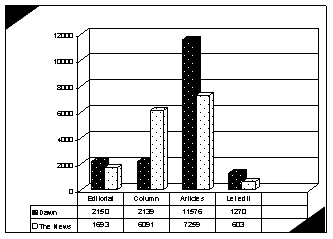
Figure 1.2 Both the paper's coverage to the selected issues
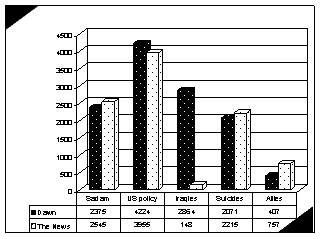
Results of figure 1.1 illustrate that daily ‘Dawn' has given more space wise importance to Iraq issue by its editorials, articles and letters to the editor as compared to the editorial page content of daily ‘The News.' While the later has given importance to the same issue by its columns than the ‘Dawn.' Comparative analysis of both the papers
Figure 1.3 Both the papers treatment of Sadam Hussain
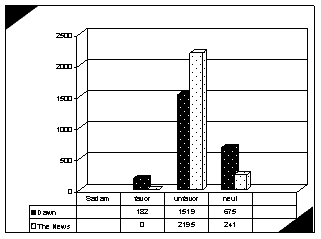
Figure 1.4 Both the papers treatment of US Policy
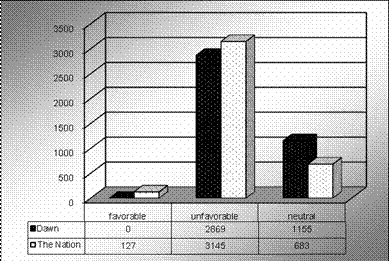
coverage further shows that both papers have significantly more importance by its editorial pages to US policy towards Iraq issue. While daily ‘Dawn' has spared significant space to the issue of civilian casualties. (see figure 1.2). Comparative analysis of the treatment of Saddam issue shows that both the dailies have given significant unfavorable space than their favorable or neutral space (see figure 1.3). The graphic presentation of findings in term of treatment of US policy towards Iraq shows that both the dailies have condemned the US policy towards Iraq war by their editorial pages' spaces unfavorable categories than their spaces given to favorable or neutral stances (see figure 1.4).
SUMMARY & DISCUSSION
The goal of this study was not to cover the whole three year time period but to take only a random sampling of months (November and December 2007). Using standard media search engines to analyze and document the treatment of the Iraq issue by the selected dailies' editorial pages. This review allowed scoring the treatment of each content as positive, negative, or neutral. It was found that broad argument voiced by critics of the media in Pakistan is often badly overstated. The overall image of Iraq conveyed by the mainstream media may be somewhat more negative than favorable, it is not incredibly dissimilar from the situation on the ground. Overall, these results suggest that both the Papers took a more anti war tendency. In the light of the observed empirical evidence it be summarized that both the papers have considered this issue very significant because numerous important personnel and events of international importance have signified the issue that is why they given significant weightage to the selected set of issues. This condition strongly endorsed Straubhaar and LaRose (2004) view point that ‘important figures and important events can help to shape communication content.
It was expected that the media would reflect their respective national perspectives on foreign policy in such a crisis. Thus, national interest became an important factor influencing media coverage of conflicts. To test this assumption, editorial pages content of both the selected newspapers on Iraq war from November and December, 2007 were sampled. The findings extended support to the expectation that the selected newspapers seem to give significantly unfavorable coverage to Us policy on Iraq war, and death sentence of Saddam Hussain. While did not extend support to the assumption that that the English press of Pakistan has not given much space to protest against US war against Iraq, while the results are in support of the assumption that the English press of Pakistan has to favor the Democrat's policy towards Iraq war.
From the perspective of democratic process, the findings of this study are within the line of Kull et al (2003) studies that the case of the Iraq war, this dynamic appears to have played a critical role: among those who did not hold the key false beliefs, only a small minority supported the decision to go to war. This study strongly extended support to the study of Chang-Ho Lee (2003) that how the The New York Times and Arab newspapers reflected their national interests in their coverage of the Iraqi War.The coverage of The New York Times , however, was more thematic than that of Arab Newspapers. In describing Saddam Hussein image, The New York Times emphasized his negative image slightly more than the Arab newspapers. From the perspective of democratic process, the findings of this study are within the line of Kull et al (2003) studies that the case of the Iraq war, this dynamic appears to have played a critical role: among those who did not hold the key false beliefs, only a small minority supported the decision to go to war.
REFERENCES
Baker, James, & Hamilton (2006). Iraq Study Group report, published by Vintage Books, New York , pp.605-614.
Chaiken, S., & Eagly, A.H. (1976). “Communication Modality as a Determinant of Message Persuasiveness and Message Compressibility”. Journal of Personality and Social Psychology, 34, pp.605-614.
Chang-Ho Lee (2003) Thesis on News Coverage of U.S. War with Iraq : A comparison of The New York Times, The Arab News, and The Middle Eas.
Eagly, A.H. & Chaiken, S. (1993). “The Psychology of Attitudes, Fort Worth , TX : Harcourt Brace, and Movanovich..
Fiske, S.T., & Pavelchak, M.A (1986). “Category-based versus Piecemeal-based Affective Responses; Development in Schematriggered Affect”. In R. M. Sorrentino & E.T. Higgings (eds.), Handbook of Motivation and Cognition: Foundation of Social Behavior, New York , Guilford Press, pp.167-203.
Greenwald, A.G. (1968). “Cognitive Learning, Cognitive Response to Persuasion, and Attitude Change” in Greenwald, T. (ed.) Psychological Foundation of Attitude, New York Academic Press, pp.147-170.
Hanlon, M. (2006) “Is the Media Being Fair in Iraq?” published by the Centre for Strategic and International Studies and the Massahusetts institute of Technolo Harkin, S.G, & Petty, R.E. (1981). “The Effects of Source Magnification Cognitive Effort on Attitudes: An Information Processing view”, Journal of Personality and Social Psychology, 40, pp. 401-413.
Hovland, C.I. (1954). Effects of Mass Media of Communication”, in G. Lindsey (d.), Handbook of Social Psychology, Cambridge , MA: Addison-Wesley. Vol. 2, pp.1062-1103,
Hovland, C.I. (1959). “Reconcilling Conflicting Results Derived from Experimental and Survey Studies of Attitudes Change”, American Psychologist, vol. 14, pp.8-17.
Mackuen, M.B. (1981). “Social Communication and the Mass Policy Agenda”, in M.B. McGuire, W.J. (1985). “Attitude and Attitude Change”, in g. Lindzey & Aronson (Ed.) Handbook of Social Psychology 3rd ed., News York ” Random House, Vol. 2, pp. 233-346.
McGuire, W.J. (1989). “Theoretical Foundations of Campaigns”, in R.E. Rice & C.K. Akin (eds.), Public Communication Campaigns, (2nd ed.) Nebury Park , CA : Sage Pub. pp 43-65.
Moore , D.L., & Reardon, R. (1987). “Source Magnification: The Role of Multiple Sources in Processing of Advertising Appeals, Journal of Marketing Research, vol. 24. pp.412-417.
Palmirino, M., Linger, E., and McGills, D. (1984). “Attitude and Attitude Change: Mindlessness- Mindfullness”, in G.R. Eisre (ed.) Attitude and Judgement, New York : Peterson, R.E., and Thurstone, L. (1933). Motion Pictures and Social Attitude of Children, Springer-Warlog, NewYork: Mcmillan, pp.179-195.
Petty, R.E., and Cacioppo, U.T. (1981). Attitude and Persuasion: Classic and Contemporary Approaches, Dubuque : Wm.C.Brown.
Petty, R.E., and Joseph R.E., (1994). “Mass Media Attitude Change: Implication of Elaboration Likely Hood Model of Persuasion”, in J. Bryont, and D. Zillmann (eds.) Media Effects: Advances in Theory and Research, Hove Lawrence , pp. 92-93.
Petty, R.E., Unnava, R., & Strathman, A. (1991). “Theories of Attitude Change”, In H. Kassarhain & T. Robertson (eds.), Handbook of Consumer Theory and Research, Englewood Cliffs, NJ: Prentice-Hall, pp. 241-280.
Solomon, N. (2003) In an interview on April 2, 2003, with Amy Goodman from Democracy Now: Commented on the reporting of Iraqi casualties, pp. 241-280.
Steven Kull, s., Clay, R. and Evan, L. (2003). “Misperceptions, the Media, and the Iraq War” Published by The Academy of Political Science Volume 118 · Number 4 ·
Straubhaar, J. and LaRose, R (2002) Media Now: Communication Media in the information Age (Wadsworth Group a division of Thomson Learning, Inc).
ABOUT THE AUTHORS
Dr. Muhammad Nawaz Mahsud is Chairman, Department of Communication Studies, University of Sargodha.
Mr. Noman Yaser and Mr. Abdul Rehman Qaiser are Lecturers, Department of Communication Studies, University of Sargodha.
Copyright © 2006 Global Media Journal. All rights reserved.