|
|
|


Home | Current Issue | Editions | Archives | Contact Us

Press Council: A Histo-Philosophical & Pragmatic Paradigm
Abstract
The concept of press council is based on the Social Responsibility of the Press which emerged after the publication of Hutchins Commission Report as Free and Responsible Press in 1947. Social Responsibility Theory was outcome of joint efforts of academia and media practitioners to make the press responsible to the society to which it claims to serve. The press councils were set up in different countries in different times, keeping in view the need of the time. Though in most countries, the press councils have now become dormant but such councils have taught the media a lesson as how they should function freely and responsibly. In Pakistan many efforts were made to regulate the press but such efforts could not remain successful beyond a government's tenure. Press council of Pakistan was established in 2002 by the then government. In this article the concept of press council has been studied in historical and philosophical perspective. The methodology of literature survey is employed for the purpose. To know the perception of the media professionals, a survey was conducted. The results of which shows that majority of the media professional favored press council and hoped to be helpful in promotion of professional and ethical standards of the press. The conclusion also suggests that press council should have dominant representation of the civil society and not the government. The council should not be empowered to recommend suspension or cancellation of a newspaper rather it should only be responsible to redress complaints and publish its annual report. The article concludes with the suggestion that press council of Pakistan be given wide publicity so that people should get benefit of it. A separate study to evaluate the performance of press council is also being suggested.
Introduction
The press always takes the form and coloration of social and political structures within which it operates. Especially, it reflects the system of social control whereby the relations of individual and institutions are adjusted. To see the idea of the press council in a clear perspective, one must look at the social systems in which the press functions. To see the social systems in their true relationship to the press, one has to look at certain basic beliefs and assumptions which the society holds regarding the nature of man, society, the relation of man to the state and the nature of knowledge and truth.
i. Foundation of Authoritarianism
According to authoritarian philosophers, man could attain his full potentialities only as a member of society. As an individual, his sphere of activity was extremely limited, but as a member of society or of an organized community his ability to achieve his goals was immeasurably increased. Under this assumption, the group took on an importance greater than that of the individual since only through the group could an individual accomplish his purposes.
This philosophy inevitably developed the proposition that the state, the highest expression of group organization, superseded the individual in a scale of values since without the state the individual was helpless in developing the attributes of a civilized man. The individual's dependence on the state for achieving an advanced civilization appears to be a common ingredient of all authoritarian systems. In and through the state, man achieves his ends; without the state, man remains a primitive being. The state was essential to the full development of man; that assumption resulted in certain basic conclusions concerning the nature of the state. Aside from individual constituents, the state became the summation of all desirable attributes. It derived its power to determine ends and methods for achieving those ends through a process not generally capable of complete human analysis. Sometimes it was divine guidance, sometimes it was dependence on superior intellect or on leadership qualities, and sometimes it was lack of confidence in any other type of process.
To the more basic philosophical problems of the nature of knowledge and of truth, the authoritarian gave equally categorical answers. Knowledge was discoverable through mental effort. Men differed widely in their ability to utilize mental processes and their drive to exert mental effort. Since such differences existed, they should be recognized in the social structure. “Wise men” capable at analyzing and synthesizing should become leaders in organized society, or if not leaders, they should at least become the advisors of leaders. Knowledge, which is not divinely inspired, is acquired through human effort, and this effort can best be channeled for the good of all through the state. Knowledge thus acquired or developed becomes the standard for all members of society and acquires an absolutist aura, which makes change undesirable, and stability or continuity a virtue in itself. In addition, the authoritarian philosophers demanded a unity of intellectual activity since only through unity could the state operate successfully for the good of all. The idealist in the authoritarian camp postulated that this unity would come from the realization of the contribution of each to the society as a whole, while the realists recognized that could in most circumstance be attained only through constant surveillance and control.
A common thread runs through all authoritarian theories of governments from Plato (428-347 B.C),Thomas Hobbes (1588-1679 A.D), George Hegal (1770-1831),and Friedrich Nietzsche (1844-1900) to Adolf Hitler (1889-1945) but not all of these philosophies were based on the greed for power or for personal aggrandizement. Many were sincere efforts to grapple with the abstruse problems of the nature of the state, the relation of man to the state and the nature of truth. Regardless of intellectual method or motivation, the result was a system for organizing society under which mass media were assigned a specific role and were subjected to controls in order not to interfere with the achievement of ultimate ends through the state. Licensing, censorship & persecution were the main instruments to control the press under authoritarian system. Another indirect method of control which was popular in 18 th & 19 th centuries was a system of special taxes designed to limit both the circulation and the profit in printed matter, especially newspapers seeking a mass audience.(Siebert et al -1956
ii. The development of liberaliszm
The principles of libertarian philosophy, as of authoritarianism, are also based on the answers to questions about the nature of man, the nature of society and man's relation to it and the nature of knowledge and of truth.Man, say the libertarians, is a rational animal and is an end in himself. The happiness and well being of the individual is the goal of society, and man as a thinking organism is capable of organizing the world around him and of making decisions, which will advance his interests. Man differs from lower animals in his ability to think, to remember, to utilize his experience, and to arrive at conclusions. Because of this unique ability, man is unique; he is the prime unit of civilization as well as its mover. The fulfillment of the individual therefore becomes the ultimate goal - the goal of man, of society, and of the state. The philosophers of liberalism emphatically deny that the state is the highest expression of human endeavor, although they admit with some hesitancy that the state is a useful and even necessary instrument. The state exists as a method of providing the individual with a milieu in which he can realize his own potentialities. Liberal philosophy does not accept the proposition that a society becomes a separate entity of greater importance than the individual members, which comprise it.
The conception that there is one basic unassailable and demonstrable explanation for natural phenomena as developed by mechanistic experimentation and observation became the model upon which libertarian philosophers proceeded to generalize in all areas of knowledge. Although the path to truth might lie through a morass of argument and dispute, that which lay at the end of the path was definite, provable and acceptable to rational men.
The 16 th century provided the experiences; the 17 th century saw the development of the philosophical principles; and the 18 th century put these principles into practice. Laski (1936) pointed out that social philosophy is always the offspring of history and is unintelligible save from which it arose. The geographical discoveries of the 16 th century provided a new spaciousness for the minds of men. Scientific as well as geographical discoveries influenced the minds of men by emphasizing the rationality of the universe and the possibility of understanding it through patient analysis. The 17 th century was convinced that everything in the universe was controlled by a set of laws, which could be refused to a strict mathematical formulation.
Sir Isaac Newton (1643-1727), Nicolaus Copernicus (1473-1543), Johannes Kepler (1571-1630) and Tycho Brahe (1546-1601) laid the basis for the construction of a new mechanistic universe. French philosopher and Mathematician Rene Descartes (1596-1650) was probably the principal figure in the shift from the old to the new. By insisting on the supremacy of reason, he challenged the whole faith of power and authority. Implicit in his philosophy was the supremacy of a secular as opposed to a theological conception of the universe. Man was forced to rely on himself rather than on a divine providence.
Although the reformation was both a theological and political dispute, it became the reluctant parent of western liberalism. The Puritans in England , with Bible as their authority, revolted against the authority of church, but they soon discovered that they were encouraging the habit of individual judgment. And rationalism in religion inevitably led to sectarianism, to deism, and to secularism.
The reformation also produced a pattern of discussion and argument, which was congenial to the times, and because religion and politics were so interwoven, this pattern was readily transferred to the purely secular arena.
Another factor affecting the development of liberalism was the emergence of the middle class. In most countries of Western Europe , the interests of the developing commercial class demanded an end to religious disputes. It also required limitations on monarchial powers and on the special privileges of the nobility. The free contract became the basis of the economic liberalism which the age of expansion demanded. Neither the church nor the state was allowed to question the moral adequacy of an acquisitive society, which was busily engaged in supplying the wants of men.
England was the principal source of political philosophy in the 17 th century, a century which began with the complete ascendancy of authoritarian principles and which ended with the triumph of liberalism. The Revolution of 1688 resulted in the supremacy of parliament over the crown, in the creation of a party system, and above all in the justification of the right of revolution.
John Locke (1632-1704 AD) was the apologist and theorist for the British developments and his political philosophy profoundly affected all subsequent western libertarians. Basing his conclusions on empirical methods, Locke developed a theory of popular sovereignty, with the center of power in the will of the people. The government was merely the trustee to which the people had delegated authority and from which they could withdraw it. His political philosophy justified limitations on severing power, the existence of popular rights in the form of law, the toleration of a diversity of religious opinions compatible with political unity, and an economic order providing for freedom of individual enterprise. He argued that man under the guise of reason has surrendered his personal rights to the state in return for a guarantee that the state will recognize and maintain his natural rights. The revolutionary aspects of Locke made him a source of inspiration for both the American Revolution (1775-83) and French Revolution (1789-99) and much of his phraseology found its way into American Declaration of independence (July 4, 1776) and the French Rights of Man (1789).
The “Enlightenment” of the 17 th and 18 th centuries contributed immeasurably toward the acceptance and diffusion of libertarian principles. The Enlightenment or Age of Reason was 18 th century philosophical movement that sought to replace orthodox authoritarian beliefs with rational scientific inquiry during the 17 th century. As scientific knowledge increased, such scholars as Isaac Newton (1643-1727), John Locke (1632-1704), Blaise Pascal (1632-62) and Rene Descartes (1596-1650) questioned accepted beliefs, and criticism of established society and assumptions spread throughout Europe . The 18 th century completed the transfer of the press from authoritarian to libertarian principles. At the opening of the century, the authoritarian system of press control was dying. The power of the crown to regulate the press had been abandoned, the church had been removed as a regulatory agency, and in France Charles Montes Quieu (1689-1755), Voltaire (1694-1778), and Rousseau (1712-1778) attacked established religion. The movement came to an end with the French Revolution (1789-99), but its principles sought to gain universal recognition in natural and intellectual sciences, in physics and ethics, in the philosophy of religion, history, law and politics.(Isaacs-1991). State monopolies in publishing had been abolished. By the end of the century, libertarian principles were enshrined in the fundamental law of the land in constitutional phrases protecting freedom of speech and of the press. At least three Englishmen- John Milton (1608-1674), John Stuart Mill (1806-73),& Thomas Erskine (1750-1823) and one American-Thomas Jefferson (1743-1826) made significant contributions toward this transition.
The transfer of the mass media from authoritarian to libertarian principles in England and America was not accomplished overnight but over several centuries. There were two main struggles in the 18 th century to establish libertarian principles as they affected the press. One was concerned with seditious libel; the other dealt with the right of the press to publish the proceedings of government.
The Jurists contended that words, which injured the government, were punishable whether true or false. Libertarian principles finally triumphed with the establishment of truth as a defense in America by constitutional provisions and in England by a parliamentary Act (1843).
Another arena in which libertarian principles battled for ascendancy was parliament, which for centuries had excluded strangers and had prohibited written notes for fear that the public might intrude on the discussions. The newspapers of the time contended that since parliament represented the interests of the people, its debates should be open to the public. The press as a medium for reaching the public therefore had a right as well as a duty to inform the public of what took place in parliament; consequently parliament had no right to place restrictions on the exercise of this function. Traditional British officialdom rose up in horror at this contention, but in a series of skirmishes the press emerged the winner.
In societies based on libertarian principles the status of the press becomes a problem of adjustment to democratic political institutions and to the democratic way of life. Government in a democracy is the servant of the people as such it occupies a much different relationship to its adherents than does the authoritarian government. Yet even though the government is subservient to and responsible to the public at large, it is not thoroughly trusted to identity its ends with the ends of its citizens. Innumerable devices have been inverted in democratic countries to keep governments from reverting to authoritarian practices as well as from subverting the “Unalienable rights” of its individual citizens. Practically all democratic countries in the world adopted the libertarian theories and embodied them in their constitutions or fundamental laws.
Under the libertarian concept the functions of the mass media are to inform, entertain, to provide basis of economic support through sales and advertising function. Basically the underlying purpose of the media was to help discover truth, to assist in the process of solving political and social problems by presenting all manner of evidence and opinion as the basis for decisions.
The essential characteristic of this process was its freedom from government controls or domination. The government together with its officials was frequently a party with a direct interest in the outcome of a dispute. Therefore, it should not have the additional advantage of exclusive access to the public, which ultimately made the decisions. Neither should it have the right or the power to interfere with the presentation of arguments from the opposition. Thus there developed a refinement of the function of the press as a political institution.
It was charged with the duty of keeping government from overstepping its bounds. It was to provide that check on government, which no other institution could provide.Libertarian theorists assumed that out of a multiplicity of voices of the press, some information reaching the public would be false and some opinions unsound. Nevertheless, the state did not have the right to restrict that which it considered false and unsound. If it did, it would inevitably tend to suppress that which was critical of the state or which was contrary to the opinions of government officials. The alternative procedure, as espoused by the libertarians, was to let the public at large be subjected to a barrage of information and opinion, some of it possibly true, some of it possibly false, and some of it containing elements of both. Ultimately the public could be trusted to digest the whole, to discard that not in the public interest and to accept that which served the needs of the individual and of the society of which he is a part. This was the well-known “Self-righting” process.
The libertarians support that let every man who has something to say on public issues express himself regardless of whether what he has to say is true or false, and let the public ultimately decide. At no time in history was this assumption completely in accord with the facts. Some men had superior abilities for verbal expression; some men had the interest, energy and drive to express themselves; and some had more direct access to public audiences than others. But theoretically all had the same opportunity if not the same ability or the same means of access.
The libertarians opposed government monopolies of the avenues of communication. They argued that anyone, citizen or alien, who had the inclination should have the unrestricted opportunity to own and operate a unit of mass communication. The field was open to all.
Despite all that has been said, the state through its various instrumentalities cannot avoid taking some controls on the media. In most democratic societies, the chief instrument of control is the judicial system. All democratic governments recognize the duty of the state to protect the reputations of individuals and to restrict the mass media from injuring members of society by defamation. A particularly difficult problem arises when damaging words are applied to an individual who is also a public official. Under libertarian doctrines, as an individual he should be protected but as a public official he should be open to public criticism.
Another commonly accepted restraint on the press is the prohibition against the dissemination of obscene and indecent materials. More than two centuries of argument have been devoted to the right of the state to protect itself against the dissemination of information and opinion, which might disparage it among its adherents.
In England the common law provided a basis for punishing reflections on the government. But in American, since the independence was accomplished with the aid of both reasoned and vituperative attacks on the British colonial authorities in which many prominent Americans took part.
The same Americans when they framed a government of their own were predisposed to recognize the value of uninhibited criticism of public officials and public affairs.The right and duty of the press in democratic society is to serve as an extralegal check on government. The press was to keep officers of the state from abusing or exceeding their authority. It was to be the watchdog over the workings of democracy, ever vigilant to spot and expose any arbitrary or authoritarian practice. And to fulfill this function adequately, the press had to be completely free from government control or domination by those elements, which it was to guard against. Because liberalism was forced to struggle for several centuries against authoritarianism, it considered the established government its greatest enemy. Government authority, however, could be made to serve the interests of liberalism if strong and effective checks on its use could be found. There was an instrument, which together with other safeguards could fulfill this function.
A fairly valid expression of the publisher's position under libertarian theory was that attributed to William Peter Hamilton of the Wall street journal. “A newspaper is a private enterprise owing nothing whatever to the public, which grants it no franchise. It is therefore affected with no public interest. It is emphatically the property of the owner, who is selling a manufactured product at his own risk. .(Siebert et al -1956).
iii. From Libertarianism to Social Responsibility Theory
The 20 th century, however, brought a gradual shift away from pure libertarianism, and in its place began to emerge the social responsibility theory of the press. The theme of which is that freedom carries concomitant obligations; and the press, which enjoys a privileged position, is obliged to be responsible to society for carrying out certain essential functions of mass communication in contemporary society. To the extent that the press recognizes its responsibilities and makes them the basis of operational policies, the libertarian system will satisfy the needs of society. To the extent that press does not assume its responsibilities, some other agency must see that the essential functions of mass communication are carried out.
The functions of the press under social responsibility theory are basically the same as those under libertarian theory. But it reflects dissatisfaction with the interpretation of those functions by some media owners and operators and with the way in which the press has carried them out. Social responsibility theory accepts the role of the press in servicing the political system, in enlightening the public, in safeguarding the liberties of the individual; but it represents the opinion that the press has been deficient in performing those tasks. It accepts the role of the press in servicing the economic system, but it would not have this task take precedence over such other functions as promoting the democratic processes or enlightening the public. It accepts the role of the press in furnishing entertainment but with the proviso that the entertainment be “good” entertainment.
It accepts the need for the press as an institution to remain financially self-supporting, but if necessary it would exempt certain individual media from having to earn their way in the market place.
Social responsibility theory has grown out of the ideas of many persons and grafting of new ideas onto traditional libertarian theory. However, the Commission on Freedom of the Press was a great deal toward making social responsibility a new integrated theory. In 1942, Henry Luce (1898-1967), who was cofounder of the magazine Time (1923), suggested that there was a need to study the freedom of the press in the United States . He talked to Robert Maynard Hutchins (1899-1977), the president (1929-45) and Chancellor (1945-51) of the University of Chicago . Hutchins selected 12 scholars to serve on a Commission with him, of these 9 were associational with a college or university. Luce donated $ 200,000 for the study. The Commission worked from 1944 to 1946 and its final report titled a Free and Responsible Press was published in 1947. Even member of the Commission were no in unanimous accord, however all members and assent to the joint report and to a brief summary of principles.
The social responsibility was an Anglo-American concept. About the time that the Commission issued its report in 1947, a Royal Commission on the press, formed at the instigation of the National Union of Journalists, started to study concentration in the press in Britain . On the recommendation of the Royal Commission, a General Council of the press had been formed to encourage a sense of public responsibility and public service in the press. Its main function has been to condemn and publicize questional practices on the part of the press, to investigate complaints, to seek redress if the complaints are justified, and to reply to them if they are not.
In America, the publishers of several newspapers i.e. the St.Louis Post-Dispatch, the Louisville Courier-Journal, the Milwaukee Journal, the Cowles newspapers of Iowa and Minnesota-Seem to feel a strong responsibility to the communities they served. A considerable fraction of articulate Americans began to demand certain standards of performance from the press. They threatened to enact legislation, even did enact it, if the press did not meet certain of those standards.
Chiefly of their own volition, publishers began to link responsibility with freedom. They formulated codes of ethical behavior, and they operated their media with some concern for the public good, the public good as they regarded it, at least.
The social responsibility theory of the press was born of several things. One was the technological and industrial revolution which changed the face of the nation and American way of living and which affected the nature of the press itself. Another was the sharp voice of criticism, which spoke often as the media grew in size and importance, and which sometimes carried the tacit threat of government regulation.
And finally there was the development of a professional sprit as journalism attracted men of principle and education, and as the communication industries reflected the growing sense of social responsibility assumed by American business and industry generally.
The technological and industrial revolution and the social changes, which came with it, had manifold effects on the press. Technological advances increased the size, speed and efficiency of print & electronic media. Industrialization was accompanied by a growing volume of advertising, which became the major support of newspapers, magazines and broadcasting. It also was accompanied by urbanization, and the large numbers of persons brought together helped to make possible newspapers of large circulation. Gains in education and in the number of citizens tremendously expanded the market for products of the press. It also became one controlled by a relatively few owners. Technological improvement made it possible for just a few media to serve a vast audience. But the facilities for reaching a large audience were costly. As units of the press became increasingly large and expensive, new comers found it increasingly difficult to enter the communication industries, and many old-timers failed to survive. Ownership of the media came to be concentrated in comparatively few hands.
The theme of the increasing criticism on the press was that it has wielded its enormous power for its own ends. The owners have proposed their own opinions, especially in matters of politics and economics, at the expense of opposing views. The press has been subservient to big business and at times has let advertisers control editorial policies and editorial content and it has resisted social change. The press has often paid more attention to the superficial and sensational than to the significant in its coverage of current happenings; its entertainment has often been lacking in substance and has endangered public morals. It has invaded the privacy of individuals without just cause and is controlled by one socio-economic class, the business class and access to the industry is difficult for newcomer; therefore, the free and open market of ideas is endangered.
The philosophical foundation of the social responsibility theory is an intermingling of individualistic theory (in which individual takes precedence over society) and the collectivistic theory. (This presupposes that society takes precedence over the individual).
The Commission on Freedom of the Press has said that a great potential danger to freedom of the press lies in the appealing notion that the government can solve all of the problems arising from the complexity of modern society and from the concentrations of power; unthinkingly, the nation might move toward totalitarianism if it relies on the government to correct conditions within the press. If modern society requires great agencies of mass communication, if these concentrations become so powerful that they are a threat to democracy, if democracy cannot solve the problem simply by breaking them up then those agencies must control themselves or be controlled by government. If they are controlled by government, we lose our chief safeguard against totalitarianism and at the same time take a long step toward it.
The commission has listed five things which contemporary society requires of its press, and together they provide a measure of press performance. To provide a truthful, comprehensive, and intelligent account of the day's event in a context which gives them meaning; to serve as a forum for the exchange of comment and criticism; to project a representative picture of the constituent groups in society; to present & clarify of the goals & values of the society and to provide full access to the day's intelligence.
The commission detected a wide breach between the acknowledgment of those standards by the press & its actual practice, and looked to three sources: to the press itself, to the public, and to the government for improvement in press performance. The press, to provide the variety, quantity, and quality of information and discussion which the public requires, should assume a professional spirit. Whatever may be thought of the conduct of individual members of professions like law and medicine, each of these professions as a whole accepts a responsibility for the service rendered by the profession as a whole, and there are some things which a truly professional man will not do for money specially, the press should assume the responsibilities of common carriers of information and discussion, should experiment with high quality content which offers no immediate promise of financial return, should engage in vigorous mutual criticism, and should seek to improve the caliber of its personnel. But the public too has certain obligations toward the press. What is need first is a public awareness of the tremendous power enjoyed by the mass media, power concentrated in too few hands; an awareness of how for the press fails to meet the needs of society. Once the public understands those things; it can act in three ways to improve the press. First, nonprofit institutions should help the press carry out its required tasks. Departments of Mass Communication might operate local radio & TV stations or produce video films for audience, which the commercial media find it difficult to serve. Second; educational institutions should create centers for advanced study, research and critical publication in the field of mass communications. Third, an independent agency should be established to appraise and assess press performance and to report on it each year.
The government, recognizing that the press must remain a privately owned business, can nevertheless help to give its citizens the kind of communications system that they require. The government can encourage new ventures in the communications industry. It can adopt new legal remedies to rectify chronic, patent abuses of press freedom.
The social responsibility theory rests on a foundation of thought which has amended certain fundamental assumptions of libertarian theory and which has largely rejected others. The concept of liberty which it represents is fundamentally different from that which libertarian theory represented.
Libertarian theory was born of a concept of negative liberty, which is defined as freedom from external restraint. Negative liberty consisted of leaving the individual free to work out his own destiny. If he were free from outside forces, he could do so by using his reason to discover the unchanging laws of nature which governed the universe and by bringing his institutions into harmony with them. It was enough, then, to remove the restrictions on man. And it was enough to remove all but a minimum of restrictions on the press; for if the press was unhampered, it would feed information and ideas into the market place and from their interchange truth would emerge triumphant.
The social responsibility theory is grounded in a school of thought which sees a purely negative liberty as insufficient and ineffective. Negative liberty, according to this view, is an empty liberty; it is like telling a man that he is free to walk without first making sure that he is not crippled. To be real, freedom must be effective. It is not enough to tell a man that he is free to achieve his goals; one must provide him with the appropriate means of attaining those goals. This is the concept of positive liberty, “freedom for”, which calls for the presence of the necessary implements for the attainment of a desired goal. True freedom must have both its negative and positive aspects. To be free is to have the use of one's powers of action without restraint or control from outside and with whatever means or equipment the action requires.
The Commission said that a free press is free from all compulsions and free for achieving the goals defined by its ethical sense and by society's needs; and to attain this end, it must have technical facilities, financial strength, access to information, and so forth. But the Commission is concerned not just about freedom of those who own the media; it is also concerned about citizens who possess a merely negative freedom of expression. Freedom of press is a somewhat empty right for the person who lacks access to the mass media. On the other hand freedom of expression under social responsibility theory is not an absolute right, though it was a marvelous fighting principle against arbitrary governments but in the context of an achieved political freedom the need of limitation becomes evident. The conditional nature of free expression arises from the basis of the right. Free expression is grounded on man's duty to his thought. If man does not assume this duty to free conscience and uses his free expression to in flame hatred, to vilify, to lie, if he uses it deliberately to contaminate the springs of truth, then he has no claim to the right. He has a moral right only if he assumes the concomitant moral duty. The moral right to free expression does carry with it the right to be in error. The error can be tolerated on the reasons that liberty is experimental, and experiment implies trial and error. And that each individual has the right to be sure that he has found truth through his own free discovery instead of having it imposed upon him by some authority. But the moral right covers only honest error. Even the individual who is wrong must be conscientiously seeking. One does not have the right to be deliberately or irresponsibly in error. Social responsibility theory predicates the exercise of right on the acceptance of accompanying duties to one's own conscience. If one sacrifices his moral right to free expression he may still claim a legal right to it. The law is not a fine enough instrument to measure how closely the individual serves his conscience. It must assume that men in general are speaking in good faith and in an earnest quest for truth. For many individuals, lying is an experiment in morality and society has some correctives against it. It is far more in keeping with a free society that men advice responsibility through their own volition and self-control than through some external force. Therefore, the law must protect some persons who do not assume their moral responsibilities along with all of those who do. But the legal right to free expression under the social responsibility theory is not unconditional. Even libertarian theory imposed certain minimal restraints on free expression such as laws dealing with libel, obscenity, incitement to riot, and sedition. All those restrictions were based on one common principle: that an utterance or publication invades in a serious, overt, and demonstrable manner recognized private rights or vital social interests. The legal restrictions on press freedom might be justifiably extended if new abuses fall within this category.
Regarding the nature of man, the social responsibility theory does not deny the rationality of man, although it puts far less confidential in it than libertarian theory, but it does seem to deny that man is innately motivated to search for truth and to accept it a his guide. Man is viewed not so much irrational as lethargic. He is capable of using his reason, but he is loath to do so. Consequently, he is easy prey for demagogues, advertising pitchmen's, and others who would manipulate him for their selfish ends. Because of his mental sloth, man has fallen into a state of unthinking conformity, to which his inertia binds him. His mental faculties have become stultified and are in danger of atrophy. If man is to remain free, he must live by reason instead of passively accepting what he sees, hears and feels. Therefore, the more alert elements of the community must goad him into the exercise of his reason. Without such goading, man is not likely to be moved to seek truth. The languor which keeps him, from using his gift of reason extends to all public discussion. Man's aim is not to find truth but to satisfy his immediate needs and desires. Man cannot be regarded as truly moral unless he has been subjected to temptation, and that he is better off learning of evil through the media than at first hand.Morality under social responsibility theory seems more relative than under libertarian theory. Nor is it primarily duty to self. As a social being, man owes a duty to his fellow beings, and morality is duty not primarily to oneself but to the interests of the community.
The moral duties, which were implicit in libertarian theory, become explicit in social responsibility theory. The citizen, under libertarian theory, had the right to be uniformed or misinformed, but the tacit assumption was that his rationality and his desire for truth would keep him from being so. The Commission specifically states that the citizen is no longer morally free not to read, not to listen. As an active and responsible citizen, one has a duty to the community to be informed. This is not to say that one must read or listen to any given segment or product of the press. The social responsibility theory recognizes that the citizen's approval or disapproval is an effective control on the media. The citizen is morally obliged to be informed; how he becomes so is his own choice. If a man has a moral duty to be informed, one can logically hold that he has a right to information for carrying out that duty. Hence it is no longer sufficient merely to protect the press's right of free expression but also it is imperative to protect the citizen's right to adequate information.
A press characterized by bigness, fewness and costliness in effect holds freedom of the press in trust for the entire population. Media operators and owners are denied the right of publishing what pleases themselves. Free expression being a moral right, they are obligated to make sure that all significant viewpoints of the citizenry are represented in the press. They need not publish every idea, however preposterous, of course; but they should see that “all ideas deserving a public hearing shall have a public hearing. The public as well as the editors and owners should decide what ideas deserve a public hearing.
But the Commission thinks it questionable that press performance can be left to unregulated initiative alone. The citizen has a moral right to information and an urgent need for it. If the press does not of its volition fill his requirements, then both the community and the government should protect his interests. (Siebert et al -1956).
2. Press Councils of the world: an overview
Although a socially responsible press can mean a different thing to different people, one common requirement is that the press, while remaining free, be fair and responsive to its readers. This requirement seems to be a natural consequence of the importance the mass media have acquired in influencing people's lives.
Governmental and private commissions, investigating press performance in various nations, had voiced a need for regulation to guard against abuses not covered by press laws. The American Commission on the freedom of the press (1945-47), the Royal Commission on the Press in England (1947-49), the Indian press commission (1952-54) and the South African press commission (1951-62) provided but a few examples in which voluntary regulation was suggested to correct press abuses. Voluntary regulation was prescribed in light of the fact that governmental intervention in press affairs would violate press-freedom guarantees. Generally press councils were created by and for the press; journalists and publishers cooperated with them to ensure a proper relationship between the press on the one hand and the state and the society on the other. The councils could be likened to medical or bar associations, which enforced professional ethics, except that press-council decisions were generally non-binding.
The concept of the press council was not new. It began in 1916 when the first Scandinavian press council was established in Sweden to serve as an intermediary between news media and the public. Since then 17 other nations had established press councils, the British press council stood out as quite successful. In early 1980 the press councils of Sri Lanka and the Philippines were under state control. The Turkish press council, established in 1960, was dissolved in 1968. The press council of India , founded in 1965 under the press council act of that year, was abolished in 1976.
Most of the press councils were established voluntarily by the publishers and journalists, or jointly by both. In Great Britain , Israel , and South Africa , governmental criticism of the press paved the way for the creation of the councils. The councils of the South Korea and Taiwan were established by newspaper organizations to circumvent laws providing for press regulation in these countries. It could be said that press councils were established more readily in those countries that do not had the legal institution of the right to reply, for which they tried to offer a substitute.
This is made evident by the fact that the primary objective of every press council was to make the press responsive to the readers' complaints and, where justified, publicize their rebuttals. There was a wide variation in the size of press councils. For example the press council of New Zealand had four members while in that of Israel , the size was so. The press council itself examined complaints against the press or a specialized committee was set up by it. The main functions of the press councils were the preservation of freedom of the press and the maintenance of professional standards. The Austrian press council had the task of ascertaining and seeking to eliminate abuses in journalism, particularly with regard to crime and sex reporting, as well as cases of invasion of privacy for the sole purpose of sensationalism. The Scandinavian Press Councils were primarily concerned with protecting individual privacy and the rights of persons under trial for criminal offenses. Self-control was also the paramount concern of the Korean, Taiwan , South African and Dutch press councils. Germen press council represented the press to its government and parliament, especially in legislative bills affecting the press. The British and New Zealand councils were asked to deal with complaints about the conduct of persons or organizations towards the press. Press councils also strived to engage in such activities as ensuring a flow of information; preventing press concentration and monopoly whenever they threaten to stifle diversity of opinion; promoting education and research in journalism; promoting technical improvements; and representing the press at national and international forums.
With the exception of Germany, Finland, and the United States, all press councils limited their purview to problems affecting newspapers. The German press council also included magazines. The National News Council (NNC) of the United States had limited its scope to national news media except when it deemed local coverage to be of national significance. Although not always specified in their charters, most press councils also being within their purview the working methods and activities of journalists. The Dutch press councils concerned itself with the professional ethics of journalists only, not of publishers, but the Danish council limited itself to publishers, ‘not journalists', professional ethics.
Press councils usually judged complaints against the press on the bases of a national code of conduct for the press, set up by the press rather than by the press council. Denmark , Finland , Norway South Korea and Sweden used this method. A number of councils, including Austria , Israel and Germany had drawn up codes of press ethics on which they based their free-press-fair-press decisions. Others like Great Britain , New Zealand and the United States had preferred to proceed by building a record of “case law” and measured the complaints against established precedents. The Dutch press council made reference to the code of International Federation of Journalists (IFJ) adopted at Bordeaux Congress in 1954 at France . The Danish, Norwegian, and Swedish ethical codes described at length the publication and professional rules, with emphasis on policy regarding the reporting of trials and police investigations. The Danish code was approved only by the publishers and editors; the journalists did not have a written code of their own yet. A pocket-sized copy of the Swedish code of ethics was given to every journalist taking his first job. Similarly, a summarized copy of Norwegian code was included on the Norwegian press card, headed: “journalists, be careful!” The ethical codes of the United Nations and the IFJ, the Finnish journalists' rules and the Finnish Broadcasting Company's rules of program making guided the work of the Finnish press council. The South Korean press council existed to measure press performance against the country's press code of ethics and the standards of conduct for Newspapermen. These codes bore the approval of the country's journalists, editors and publishers. The Israel press council's code of professional ethics was a comprehensive statement of good journalistic practice, with its emphasis on accuracy and responsibility. Similarly, the South African's code of conduct asked all concerns with the press to observe the very highest standards in the performance of the duty of newspapers to inform the public truthfully and to comment fairly. The Austrian and German councils, on the other hand, operated for many years without referring to any single code. It is interesting to note that the Austrian press council in 1971 and German press council in 1973 developed codes of ethics from their experience in deciding free-press-fair-press issue.
British press council had refused to draft or refer to any code since it was established in 1953, in the belief that no code could cover every complaint. However, the council's adjudications in a previous case provided invaluable guidance in deciding cases of a similar kind. The New Zeeland press council and NNC of the United Stats also did not base their decisions on any recognized code. The first chairman of British press council said that the press council had not, unlike many other professional bodies, drafted a code. It had, whether it realized it or not, adopted the methods of generations of judges who produced the Common Law of England. They let it grew out of the decisions they gave.
The press council usually took its first step toward considering a problem when someone filed a complaint, even if not personally affected by the publication. In general, complaints were against sensationalism, violation of individual privacy, factual mistakes and non- publication of letters to editors.
Most press councils including those of Australia, Finland, Germany, Israel, South Korea, and the United States, could also initiate complaints against the press. Councils usually declined to adjudicate on a complaint if it merited judicial inquiry, but when they did decide to consider matters that might become the subject of litigation; they required the complainant to sign a waiver of legal action. In Sweden , however, legal action following adjudication by the press council was possible. The press councils of Great Britain , New Zealand and the United States did not hear a dispute until the parties involved have tried to reach reconciliation. The first step of most others, after accepting a complaint, was to bring direct reconciliation between the complainant and the medium involved. If a direct settlement could not be reached, a hearing was scheduled. All parties were given adequate notice and a full opportunity to present relevant evidence and cross-examine witnesses. To preserve the informality and flexibility of their proceedings, press councils did not allow legal representations or apply systems of legal proof. An exception was the NNC of the United States , which allowed each party the right to engage counsel. Generally, initial investigation into complaints was conducted by specialized committees of the press councils. To insure that the council's findings were not used in any court litigation, the hearings were usually held in private. The American NNC held its hearings in public. Generally the specialized committees limited their investigations to evidence furnished by the parties involved.
The findings and recommendations of the specialized committee were sent to the press council, which could make a decision based on the committee's recommendation, or proceed toward an independent adjudication on the basis of its own investigation. The executive committee of the Israel press council and the complaints committee of the German press council had been delegated the authority to decide complaints in the name of their councils. However, if any member of the German complaints committee objected to its decision, the case was sent to the press council for adjudication. In Sweden the press ombudsman independently investigated complaints and had the authority to refer the unsettled cases to the press council. The press council rendered a decision by a written opinion, which included a statement of facts, a ruling for one of the parties, and a discussion of the considerations on which the ruling was based. Most councils required a simple majority of the cast to reach a decision. However, the German council required a majority of two- thirds and the Australian council three-fourths. Both parties in a complaint and the all members of the news media within the council's purview were notified of the decision and were requested to publicize it. The annual numbers of complaints examined by the press councils varied from one country to another. Most heard fewer than 100; the US and the German councils examined about 150. Only the British and Swedish councils hovered around 400 marks. However, less than one- third of the complaints examined result in a decision in Britain , Germany , Sweden and the United States .
Reproof or censure of a news medium or journalist held to be at fault was the only sanction of a majority of the press councils. In addition, the particular medium involved and the country's press in general was expected to publicize the council's decision. It was from this publicity that the press council derived its real power. The councils of Germany and Finland also expected the medium involved to redress its wrongs. The Israeli council went a step further by asking a public apology and retraction from the newspaper at fault, and usually getting it. The Korean council, in addition to censuring a guilty publication, news agency or journalist, could also imposed exclusion of a journalist from the profession when the press codes were seriously violated. The councils of Sweden and South Africa could impose fines for violating ethical codes. Since 1969, the Swedish press council had the power to impose fines, starting at 1000 Swedish Kronor (about $ 230) on a newspaper, on an ascending scale determined by the number of complaints upheld against it in any one year. However, a person could not collect damages through the press council. The decisions of the South African press council could be appealed to the country's courts.
The National News Council of the United States did not admonish or censure the news organization against which a complaint has been upheld. In pronouncing its decisions, the council simply stated that the complaint was warranted or unwarranted. There was no requirement for the press to publish adverse rulings of the council. However, the NNC hoped that its moral force would encourage the news medium at fault to publicize its findings. (Rampal-1982).
3. The History of Press Regulation in Pakistan
In Pakistan many self-regulatory efforts were made and different bodies constituted in Pakistan during different regimes but these bodies were under the influence of respective Governments therefore these could not function properly due to Governments intention to use these bodies against the newspapers, critical to the ruling elite. The Governments expected the newspapers to function with some responsibility while independent newsmen feared that under the demand that they should be responsible, laid the wish that they should always be in agreement with authority. The independence of Press instead of merely an instrument of propaganda depends on the stability of the Government and its tolerance and also on its ability to withstand criticism. Since rulers in Pakistan lacked this spirit, therefore no self-regulatory effort could continue successfully and such bodies became inactive and ultimately disappeared with the overthrow of the Governments. The same was the case regarding code of ethics. These had been adopted by the Press but whenever the self-regulatory efforts made with understanding of respective Government became no more effective, the implementation on such codes also seems to have been ceased their effect.
There had been a view that enforcement of a Press code of ethics and setting up of a Press council in the presence of Press laws would amount to placing added curbs on the Press. The question of code of ethics that what was good or bad, who was patriotic or unpatriotic should be left to the Press or to the conscience of the general public or at the most to the judiciary.
Any measure on the part of the Government to regulate the Press would be deemed as curbs on the freedom of the Press and the Press would win the sympathies of the general public. If the Government wanted the Press to perform its functions with responsibility, the Government itself would have to fulfill its responsibilities in social services to the people. Bad Press was not the problem of the people rather bad policies of the Government were. Massive illiteracy is the major obstruction inculcating the awareness among the people. If majority of the people become aware they themselves would check the responsibilities of the Press, and the public at large would be able to watch the watchdog. (Paracha-1999)
4. Press Council of Pakistan Act-2002
Freedom of the press and public awareness is the foundation of democracy and the functioning of democracy and the principles of accountability depend inter alia upon free flow of information and freedom of expression without infringing on national interest and press must be accountable to society to serve the public need to preserve the rights of the citizens. To fulfill this objective the government established Press Council through an Ordinance in 2002, which states that the council shall be a permanent body funded by the government and it may receive donations or fee from registered newspapers and news agencies. The council shall consist of nineteen members: three nominated by All Pakistan Newspapers Society (APNS), Council of Pakistan Newspapers Editors, and professional bodies of journalists each. These nominees shall not be the office bearers nor shall any member of the press council contest the election of his / her respective professional organization. One nominee of the Pakistan Bar Council, leader of the house, leader of the opposition in the National Assembly, human rights organization and National women commission, each; and one eminent educationist each from the four provinces nominated by the governor. A retired judge or a person qualified to be a judge of the Supreme Court shall be appointed by the president of Pakistan as chairman of the council for a period of three years.
The council, while preserving the freedom of the press shall maintain highest professional and ethical standards of newspapers and news agencies with a view to making them more responsive to the issues and concerns of the society. The council shall implement the ethical code of practice, and appoint inquiry commission to decide complaints about the violation of such code are received. The council shall constitute as many inquiry commissions as may be necessary for the purpose of deciding complaints. The commission shall consist of one retired judge or a person qualified to be the judge of the High Court as Chairman, a nominee of APNS and CPNE each.
Such complaint shall be entertained by the council if the aggrieved has first given a notice to the concerned editor / publisher within fifteen days of the publication of the complained matter but was not satisfied with the relief or response of the editor and has filed a complaint before the council along with the evidence and a fee of Rs. 1000/- and in case of an institution, Rs.5000/-.
If the case is decided in favor of the complainant, the inquiry commission may direct the editor to publish a contradiction, clarification or apology or the commission may ask other newspapers to publish such decision. The appeal against the decision of the commission shall be heard by a committee consist of five members of the council. In case of non-compliance of the decision by concerned newspaper, the council recommend to the competent authority to suspend or cancel the declaration.
The council shall publish the annual report of its activities and standards of newspaper. Such report shall be made available to the public. An Ethical code of practice is formulator which provides the guidelines for the press to uphold standards of morality fairness, accuracy, respect of privacy, family life & house and avoid plagiarism, slanderous & libelous material, biased, unconfirmed reports, such material which encourages or incites discrimination or hatred on grounds of race, religion, gender, disability, illness or age, and project of crime as heroic, and also such material which may contempt Pakistan or tends to undermine its sovereignty or integrity as an independent country shall be avoided. The publication of sensationalism violence & brutalities, crimes against children, juveniles and women, of the record briefings shall also be avoided.
Privilege or financial inducement influence the performance of professional duties and is not compatible with concept of a reputable, independent and responsible press. (Hassan and Hadi-2004).
5. Findings
The findings of the survey conducted to know the perception of the media professionals regarding the role and responsibilities of the press with special reference to the Press Council of Pakistan are illustrated in the following:
Table 1. Perception regarding the Press Council and its code of ethical practice.
|
Yes |
No |
n= |
Support to the press council's role for promoting professional and ethical standards
|
74% |
26% |
355 |
Pakistani press should follow code of ethics
|
97% |
03% |
355 |
Support to the press council's role as implementing authority of code
|
44% |
56% |
349 |
Presence of any system within newspapers to redress complaints
|
21%
|
79% |
355 |
Newspapers should appoint internal ombudsman
|
86% |
14% |
355 |
APNS membership on promise to abide by the code of ethics
|
74% |
26% |
355 |
APNS should cooperate with government to make the press council effective
|
81% |
19% |
355 |
Restriction on office bearers of APNS, to become member of the press council, be omitted
|
59% |
41% |
355 |
Restriction on office bearers of CPNE, to become member of the press council, be omitted
|
58% |
42% |
355 |
Restriction on office bearers of working journalists, to become member of the press council, be omitted |
70% |
30% |
355 |
The figures in Table 1 show a significantly high majority (74%) supports for the Press Council of Pakistan that it should be responsible to promote professional and ethical standards of the press. A very vast majority (97%) opines that Pakistani press should follow some code of ethics, but majority (56%) does not agree that the press council should implement code of ethics by using some authority or power. Since a highly significant majority (79%) feels that there is no such system within newspaper offices to redress complaints of the public against the journalists or to impose code of ethics; therefore, a vast majority (86%) agrees with the suggestion that newspaper management should appoint internal ombudsman to redress complaints against newspapers and to implement code of ethics.
Similarly, a highly significant majority (74%) agrees with the suggestion that APNS membership should be given to only those newspaper owners who promise to abide by the ethical code of practice given in the Press Council Ordinance -2002.Again a vast majority (81%) opines that APNS should cooperate with government to make the press council an effective institution. The figures also show a majority's (59%) opinion regarding APNS nominees. Under the press council's condition, the office bearers of the APNS can not be nominated in the press council. The respondents further agree with the suggestion that this restriction should be omitted to enable APNS to nominate its members for the press council. Almost the same ratio of the respondents (58%) agree with the suggestion to enable CPNE to nominate its members and a significant majority (70%) agrees, to omit the condition also in case of working journalists, to enable them to nominate their members in the press council.
Figure 1. Reasons for not supporting the Press Council of Pakistan . (n=96)
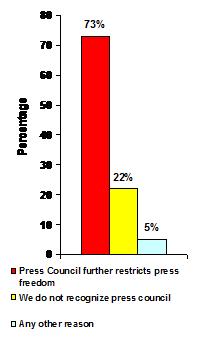 |
Figure 1 demonstrates a highly significant majority's (73%) opinion that they do not support the press council because it further restricts freedom. |
Figure 2. Reasons for not supporting code of ethics. (n=199)
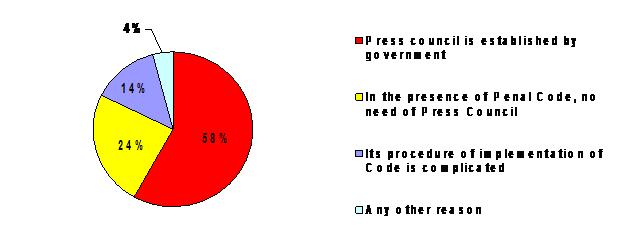
Figure 2 indicates a majority's (58%) view that they do not support the press council because it is established by the government.
Figure 3. Reasons as why APNS not nominating its members in the Press Council. (n=355)
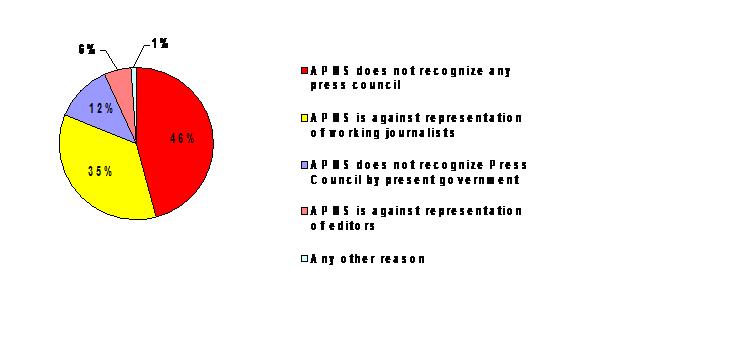
Figure 3 reflects less than half of the respondents' (46%) opinion that since APNS does not recognize any press council, therefore it is not nominating its members for the press council.
Figure 4. Reasons as why PFUJ is not nominating its members for the Press Council. (n=355)
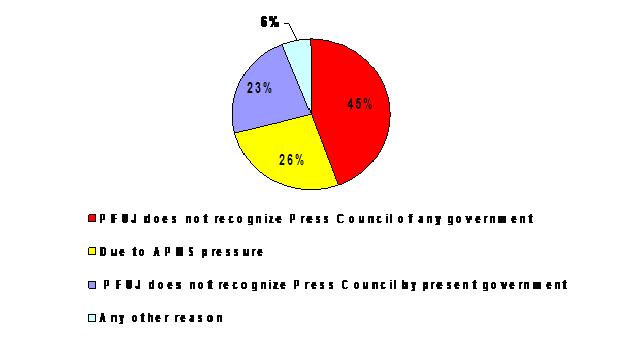
Figure 4 displays less than half of the respondents' (45%) opinion that since PFUJ does not recognize any press council, therefore it is not nominating its members for the press council.
Figure 5. Reasons for non representation of PFUJ in the Press Council. (n=355)
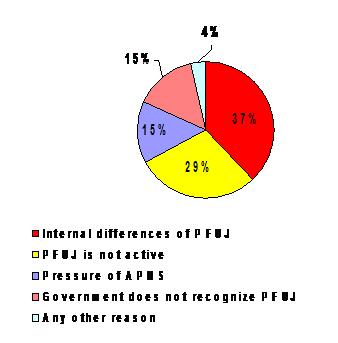
Figure 5 reveals a split opinion of the respondents. Thirty seven percent opine that due to internal differences of PFUJ, representation of the working journalists has been mentioned in the press council but there is no mention of PFUJ; twenty nine percent feel that PFUJ is not active; fifteen percent say that due to pressure of APNS, there is no mention of PFUJ in the press council, whereas another fifteen percent of the same think that government does not recognize PFUJ.
6. Discussion
In depth interviews were also conducted from different stake holders and it was found that there was an agreement among all stakeholders that press council should have dominant representation of the civil society and not the government. One of the ex-Secretary Information opined that government should not delay the completion of the press council and should fix a deadline for APNS, CPNE and working journalists to nominate their members for the press council. However, he suggested that such council should not have the power to recommend suspension or cancellation of a newspaper rather he suggested that the press council should only be responsible to redress complaints and publish its annual report .
The findings further revealed the respondents' perception that APNS was not nominating its members because it did not recognize the press council, the highly placed officer in the Ministry of Information and Broadcasting apprised that APNS was consulted and was taken into confidence before promulgation of the Press Council Ordinance -2002 . The reason for the delay in nominating its member for the Press Council was stated by a representative of APNS that some amendments were suggested by their body and response from government side was still awaited. The same government officer said that APNS was using delaying tactics because the APNS, perhaps, did not want the completion of the press council. The only viable way in this situation was suggested by the ex-Secretary Information that government should give a dead line to all professional organizations of media to nominate their members. Though such council, according to the media managers and practitioners, should be independent of government influence, but as a first drop of the rain the establishment of Press Council should be accepted whole heartedly . And it is hoped to gain more autonomy with the passage of time up to the extent that members will elect the chairman of the press council rather than nominated by the government as recommended in the proposal for reforms prepared by Griffin and Price (2004). (Paracha-2007).
7. Suggestions
At the end we may suggest that Press Council of Pakistan Ordinance 2002 be given nation wide publicity so that people should get benefit of it. The newspaper organizations should appoint ombudsmen to check the complaints of general public against newspaper and journalists. A separate study should be undertaken to assess the performance of the Press Council of Pakistan.
About the authors
__________________________________________________________________
* Assistant Professor, Department of Media Studies, The Islamia University of Bahawalpur, (Pakistan). E-mail:drparacha_mediastudies@iub.edu.pk
** Assistant Professor, Department of Mass Communication, GC University Faisalabad, (Pakistan). E-mail: iremmasscom@gmail.com
References
Griffin, Douglas. A. and Price Monroe E. (2004). Review and Analysis
of the Legal Framework Governing the Media in Pakistan .
Islamabad; Internews Pakistan .
Hassan, Jawad and Hadi, Syed Ali. (2004) Media and the Mass
Communication Laws of Pakistan . Lahore: Bookbiz.
Isaacs,Alan.(1991) The Macmillan Encyclopedia .New York:
Macmillan.
Laski,Harold J.(1936) The rise of European liberalism .London:
G.Allen & Unwin Ltd.
Paracha, Sajjad.(1999) Pakistan's print media policy: a historical
perspective . An unpublished thesis of M.Phil submitted to
the Department of the Mass
Communication, University of the Punjab, Lahore, Pakistan.
____.(2007) Pakistan's media policy: a normative approach . An
unpublished thesis of PhD submitted to the Institute of
Communication Studies, University of the Punjab, Lahore,
Pakistan.
Rampal, Kuldip R. (1982) Press Councils of the World. In George
Thomas kurian (ed) World Press Encyclopedia. New York:
Facts on Files, Inc.
Siebert, Fred S. Peterson, Theodore and Schramm, Wilbur. (1956)
Four Theories of the Press . Chicago: University of Illinois press.
Face to face interview with Salim Gul Shaikh, Ex-secretary Information and Broadcasting, Govt. of Pakistan, Islamabad February 8, 2007.
Face to face interview with Syed Fayyaz Hussain, Director General, Internal Publicity wing, Ministry of Information and Broadcasting on February 6 & 8, 2007.
Face to face interview with Agha Nasir, Executive Director, Geo TV , Blue Area, Islamabad and Ex MD, PTV, DG, PBC and with Najib Ahmed, Director Programme, FM Radio Power 99 , 25 Jannat Arcade, Suite 12 , G-11 Markaz, Islamabad , Pakistan on February 9, 2007.
Copyright © 2011 Global Media Journal. All rights reserved.